
Characterization antagonism of Nigrospora spp. against Fusarium solani causing Fusarium wilt in Capsicum frutescens L. plants
Abstract
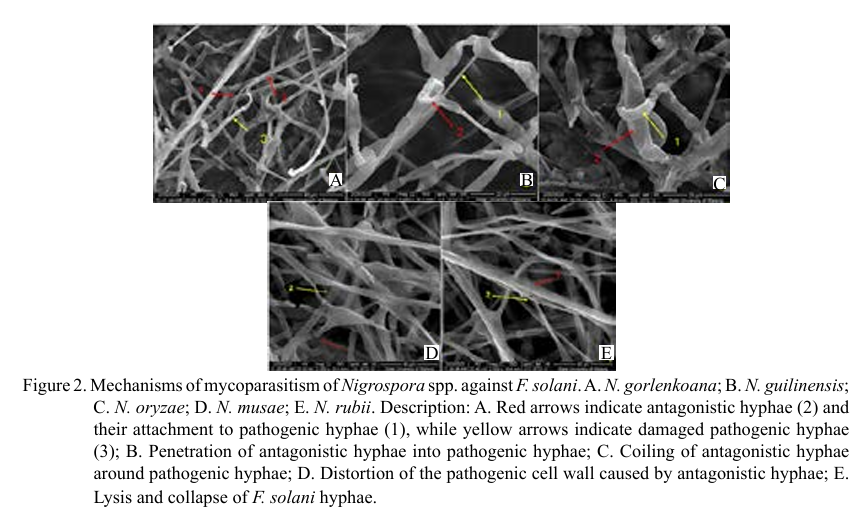
Fusarium wilt is a major disease affecting horticultural crops in Indonesia, including chili, where it causes root rot, disrupts nutrient uptake, and reduces plant growth. This study aimed to evaluate the antagonistic activity of five Nigrospora spp. isolates against Fusarium solani, the causal agent of Fusarium wilt in chili plants (Capsicum frutescens L.). The tested isolates included Nigrospora gorlenkoana, N. guilinensis, N. musae, N. oryzae, and N. rubii. Antagonistic activity was assessed using the dual culture method on potato dextrose agar (PDA) at 25 ºC for 72 hours. The results showed that all isolates inhibited the growth of F. solani, with N. rubii exhibiting the highest inhibition (56.2%), followed by N. oryzae (50.0%), N. gorlenkoana (30.4%), and N. musae (28.2%), while N. guilinensis showed the lowest inhibition (9.3%). The antagonistic mechanisms involved competition for nutrients and space, as well as mycoparasitism. These findings indicate that N. rubii and N. oryzae are promising candidates for biological control of Fusarium wilt in chili, offering environmentally friendly alternatives to chemical fungicides. This study provides comparative evidence of species-specific antagonistic activity and highlights the potential of Nigrospora spp. for sustainable disease management.
How to Cite
References
Al-Mutar DMK, Alzawar NSA, Noman M, Azizullah, Li D, & Song F. 2023. Suppression of Fusarium wilt in watermelon by Bacillus amyloliquefaciens DHA55 through extracellular production of antifungal lipopeptides. J. Fungi. 9(3): 336. https://doi.org/10.3390/jof9030336
Aprile AM, Coppola M, Turrà D, Vitale S, Cascone P, Diretto G, Fiore A, Castaldi V, Romanelli A, Avitabile C, Guerrieri E, Woo SL, & Rao R. 2022. Combination of the systemin peptide with the beneficial fungus Trichoderma afroharzianum T22 improves plant defense responses against pests and diseases. J. Plant Interact. 17(1): 569–579. https://doi.org/10.1080/17429145.2022.2072528
Attia MS, El-Wakil DA, Hashem AH, & Abdelaziz AM. 2022. Antagonistic effect of plant growth-promoting fungi against Fusarium wilt disease in tomato: In vitro and in vivo study. Appl. Biochem. Biotechnol. 194(11): 5100–5118. https://doi.org/10.1007/s12010-022-03975-9
Awad-Allah EFA, Shams AHM, Helaly AA, & Ragheb EIM. 2022. Effective applications of Trichoderma spp. as biofertilizers and biocontrol agents mitigate tomato Fusarium wilt disease. Agriculture. 12(11). 1950. https://doi.org/10.3390/agriculture12111950
Bekkar AA, Belabid L, & Zaim S. 2016. Biocontrol of phytopathogenic Fusarium spp. by antagonistic Trichoderma. Biopestic. Int. 12(1): 37–45.
Boulahouat S, Cherif-Silini H, Silini A, Bouket AC, Luptakova L, Alenezi FN, & Belbahri L. 2023. Biocontrol efficiency of rhizospheric Bacillus against the plant pathogen Fusarium oxysporum: A promising approach for sustainable agriculture. Microbiol. Res. 14(3): 892–908. https://doi.org/10.3390/microbiolres14030062
Dullah S, Hazarika DJ, Parveen A, Kakoti M, Borgohain T, Gautom T, Bhattacharyya A, Barooah M, & Boro RC. 2021. Fungal interactions induce changes in hyphal morphology and enzyme production. Mycology. 12(4): 279–295. https://doi.org/10.1080/21501203.2021.1932627
Dutta S, Houdinet G, NandaKafle G, Kafle A, Hawkes CV, & Garcia K. 2023. Agrobacterium tumefaciens-mediated transformation of Nigrospora sp. isolated from switchgrass leaves and antagonistic toward plant pathogens. J. Microbiol. Methods. 215: 106849. https://doi.org/10.1016/j.mimet.2023.106849
Ebrahimi L, Rad SH, & Etebarian HR. 2022. Apple endophytic fungi and their antagonism against apple scab disease. Front. Microbiol. 13: 1024001. https://doi.org/10.3389/fmicb.2022.1024001
Ekaputri A, Amin N, & Patandjengi B. 2023. Exploration of vesicular arbuscular mycorrhizae (VAM) in chili plants and their relationship with Fusarium oxysporum wilt disease. IOP Conf. Ser.: Earth Environ. Sci. 1230: 012106. https://doi.org/10.1088/1755-1315/1230/1/012106
Erazo JG, Palacios SA, Pastor N, Giordano FD, Rovera M, Reynoso MM, Venisse JS, & Torres AM. 2021. Biocontrol mechanisms of Trichoderma harzianum ITEM 3636 against peanut brown root rot caused by Fusarium solani RC 386. Biol. Control. 164: 104774. https://doi.org/10.1016/j.biocontrol.2021.104774
Filho JG, Dos Santos EB, & Amorim EPR. 2020. Control of root rot (Fusarium solani f. sp. piperis) in black pepper cv. Bragantina with crude aqueous extracts and fungicide. Summa Phytopathol. 46(1): 49–52. https://doi.org/10.1590/0100-5405/188781
He D, Feng Z, Gao S, Wei Y, Han S, & Wang L. 2021. Contribution of NADPH–cytochrome P450 reductase to azole resistance in Fusarium oxysporum. Front. Microbiol. 12: 709942. https://doi.org/10.3389/fmicb.2021.709942
Hiscox J, O’Leary J, & Boddy L. 2018. Fungus wars: Basidiomycete battles in wood decay. Stud. Mycol. 89(1): 117–124. https://doi.org/10.1016/j.simyco.2018.02.003
Islam S, Banerjee A, Shah MH, Ahammad F, Rahman SKS, & Hossain A. 2023. Beneficial fungi as a biocontrol agent against fungi. In: Abd-Elsalam KA & Alghuthaymi MA (Eds.). Biofungicides: Eco-Safety and Future Trends. pp. 65–93. CRC Press. Boca Raton, Florida, USA. https://doi.org/10.1201/9781003287575
Islam T, Danishuddin, Tamanna NT, Matin MN, Barai HR, & Haque MA. 2024. Resistance Mechanisms of Plant Pathogenic Fungi to Fungicide, Environmental Impacts, and Sustainable Solutions. Plants. 13(19): 2737. https://doi.org/10.3390/plants13192737
Ivayani I, Ginting C, Yusnita Y, & Dirmawati SR. 2018. Effectiveness of the application of organic matter and Trichoderma viride from suppressive soil to control fusarium wilt on banana plant. J. Trop. Plant Pests Dis. 18(2): 119–126. https://doi.org/10.23960/j.hptt.218119-126
Karyani T, Susanto A, Djuwendah E, & Hapsari H. 2020. Red chili agribusiness and the risks faced by farmers. IOP Conf. Ser.: Earth Environ. Sci. 466: 012002. https://doi.org/10.1088/1755-1315/466/1/012002
Khattak B, Saifullah, Hussain S, Ahmad M, Ali A, Junaid M, Khan IA, Khan TA, & Hussain M. 2018. Genetic relatedness among indigenous isolates of Trichoderma harzianum, using RAPD and their nematocidal capabilities against Meloidogyne javanica. Sarhad J. Agric. 34(2): 486–493. https://doi.org/10.17582/journal.sja/2018/34.2.486.493
Kumar V, Huang J, Dong Y, & Hao GF. 2024. Targeting Fks1 proteins for novel antifungal drug discovery. Trends Pharmacol. Sci. 45(4): 366–384. https://doi.org/10.1016/j.tips.2024.02.007
Kurchenko I, Patyka V, Kalinichenko A, & Kopylov Y. 2023. The genus Trichoderma as biocontrol agent of plant pathogens. In: Sharma V, Salwan R, Moliszewska E, Ruano-Rosa D, & Jędryczka M (Eds.). The Chemical Dialogue between Plants and Beneficial Microorganisms. pp. 153–165. Elsevier. Amsterdam. https://doi.org/10.1016/B978-0-323-91734-6.00012-0
Kurniawan E, Panphon S, & Leelakriangsak M. 2019. Potential of marine chitinolytic Bacillus isolates as biocontrol agents of phytopathogenic fungi. IOP Conf. Ser.: Earth Environ. Sci. 217: 012044. https://doi.org/10.1088/1755-1315/217/1/012044
Lee W, Kim DG, Perera RH, Kim JS, Cho Y, Lee JW, Seo CW, & Lim YW. 2023. Diversity of Nigrospora (Xylariales, Apiosporaceae) species identified in Korean macroalgae including five unrecorded species. Mycobiology. 51(6): 401–409. https://doi.org/10.1080/12298093.2023.2283272
Liu S, Liu R, Chu B, Li Z, Meng Q, Gou Y, Xue C, Tian T, Chen P, Wei F, Wen S, Liu Y, Sun S, & Gao S. 2023. Identification and screening of fungicides against Piper nigrum basal Fusarium wilt disease in Hainan, China. J. Basic Microbiol. 63(11): 1254–1264. https://doi.org/10.1002/jobm.202300183
Maitlo SA, Rajput NA, Naz Syed R,Khanzada MA, Rajput AQ, Lodhi AM. 2019. Microbial control of Fusarium wilt of chickpea caused by Fusarium oxysporum f. sp. ciceris. Pak. J. Bot. 51(6): 2261–2268.
Malik MA, Ahmad N, & Bhat MY. 2024. The green shield: Trichoderma’s role in sustainable agriculture against soil-borne fungal threats. Curr. Res. Microb. Sci. 7: 100313. https://doi.org/10.1016/j.crmicr.2024.100313
Mukherjee PK, Mendoza-Mendoza A, Zeilinger S, & Horwitz BA. 2022. Mycoparasitism as a mechanism of Trichoderma-mediated suppression of plant diseases. Fungal Biol. Rev. 39: 15–33. https://doi.org/10.1016/j.fbr.2021.11.004
Müller T & Behrendt U. 2021. Exploiting the biocontrol potential of plant-associated pseudomonads – A step towards pesticide-free agriculture?. Biol. Control. 155: 104538. https://doi.org/10.1016/j.biocontrol.2021.104538
Mustofa A & Hastuti US. 2024. Antagonism and mycoparasitism mechanism of T. harzianum against pathogenic fungus species of F. oxysporum and Capnodium sp. Inornatus. Biol. Educ. J. 4(1): 1–10. https://doi.org/10.30862/inornatus.v4i1.581
Mustofa A, Hastuti US, & Susanto H. 2024. Endophytic fungi isolated from Heliotropium indicum and their antagonism activity toward Fusarium solani and F. oxysporum. Biodiversitas. 25(12):5063–5073. https://doi.org/10.13057/biodiv/d251244
Niu J, Yan X, Bai Y, Li W, Lu G, Wang Y, Liu H, Shi Z, & Liang J . 2024. Integration of transcriptomics and WGCNA to characterize Trichoderma harzianum-induced systemic resistance in Astragalus mongholicus for defense against Fusarium solani. Genes. 15(9): 1180. https://doi.org/10.3390/genes15091180
Pal KK & Gardener BM. 2006. Biological control of plant pathogens. The Plant Health Instructor. 2: 1117–1142. https://doi.org/10.1094/PHI-A-2006-1117-02
Piombo E, Vetikuri RR, Sundararajan P, Kushwaha S, Jensen DF, Karlsson M, & Dubey M. 2022. Comparative small RNA and degradome sequencing provides insights into antagonistic interactions in the biocontrol fungus Clonostachys rosea. Appl. Environ. Microbiol. 88(13): e00643-22. https://doi.org/10.1128/aem.00643-22
Podgórska-Kryszczuk I, Solarska E, & Kordowska-Wiater M. 2022. Biological control of Fusarium culmorum, Fusarium graminearum and Fusarium poae by antagonistic yeasts. Pathogens. 11(1): 86. https://doi.org/10.3390/pathogens11010086
Pozo MJ, Verhage A, García-Andrade J, García JM, & Azcón-Aguilar C. 2009. Priming plant defence against pathogens by arbuscular mycorrhizal fungi. In: Azcón-Aguilar C, Barea J, Gianinazzi S, & Gianinazzi-Pearson V (Eds.). Mycorrhizas - Functional Processes and Ecological Impact. pp. 123–135. Springer Berlin, Heidelberg. https://doi.org/10.1007/978-3-540-87978-7_9
Prasetyo J, Juniar NB, Evizal R, Maryono T, & Ginting C. 2024. Molecular identification of Trichoderma sp. Margodadi isolate and its potential against Phytophthora capsici causing foot rot of black pepper. J. Trop. Plant Pests Dis.24(1):128–138. https://doi.org/10.23960/jhptt.124128-138
Pukalski J, Olchawa-Pajor M, Jedynak P, Nawrot-Chorabik K, & Latowski D. 2024. Vitality and inhibition parameters in the analysis of dual fungal cultures as an effective tool in the bioprotection of forest ecosystems. Forests. 15(9): 1510. https://doi.org/10.3390/f15091510
Reddy S, Kumar A, Sharma S, Akhilesh C, Kumari R, & Kumar V. 2023. Discussion on the consequences of chickpea wilt and management through induced resistance. Plant Sci. Today. 10(4): 78–87. https://doi.org/10.14719/pst.2324
Rocha FS, Ferreira GHS, Silva TCSR, Amaral FL, Muniz MFS, & Pereira EA. 2016. Characterization of Fusarium solani f. sp. piperis, phytotoxin production, and disease incidence in Northern Minas Gerais, Brazil. Summa Phytopathol. 42(1): 67–72. https://doi.org/10.1590/0100-5405/2100
Serrano-Jamaica LM, Villordo-Pineda E, González-Chavira MM, Guevara-González RG, & Medina-Ramos G. 2021. Effect of fragmented DNA from plant pathogens on the protection against wilt and root rot of Capsicum annuum L. plants. Front. Plant Sci. 11: 581891. https://doi.org/10.3389/fpls.2020.581891
Singh S, Singh AK, Pradhan B, Tripathi S, Kumar KS, Chand S, Rout PR, & Shahid MK. 2024. Harnessing Trichoderma mycoparasitism as a tool in the management of soil dwelling plant pathogens. Microb. Ecol. 87(1): 158. https://doi.org/10.1007/s00248-024-02472-2
Soesanto L, Prastyani N, Utami DS, & Manan A. 2020. Application of raw secondary metabolites from four entomopathogenic fungi against chilli disease caused by viruses. J. Trop. Plant Pests Dis. 20(2): 100–107. https://doi.org/10.23960/j.hptt.220100-107
Tariq M, Khan A, Asif M, Khan F, Ansari T, Shariq M, & Siddiqui MA. 2020. Biological control: a sustainable and practical approach for plant disease management. Acta Agric. Scand. B Soil Plant Sci. 70(6): 507–524. https://doi.org/10.1080/09064710.2020.1784262
Thanabalasingam D, Kumar NS, Jayasinghe L, & Fujimoto Y. 2015. Endophytic fungus Nigrospora oryzae from a medicinal plant Coccinia grandis, a high yielding new source of phenazine-l-carboxamide§. Natural Product Communications. 10(10): 1659–1660. https://doi.org/10.1177/1934578X15010010
Tian L, Zhu X, Guo Y, Zhou Q, Wang L, & Li W. 2024. Antagonism of rhizosphere Trichoderma brevicompactum DTN19 against the pathogenic fungi causing corm rot in saffron (Crocus sativus L.) in vitro. Front. Microbiol. 15: 1454670. https://doi.org/10.3389/fmicb.2024.1454670
Toghueo RMK, Eke P, Zabalgogeazcoa Í, de Aldana BRV, Nana LW, & Boyom FF. 2016. Biocontrol and growth enhancement potential of two endophytic Trichoderma spp. from Terminalia catappa against the causative agent of common bean root rot (Fusarium solani). Biol. Control. 96: 8–20. https://doi.org/10.1016/j.biocontrol.2016.01.008
Tong J, Zhang X, Li J, & Zhang FL. 2022. Advances in chemical constituents and bioactivities of Nigrospora sp. fungi. Nat. Prod. Res. Dev. 34(9): 1618–1631. https://doi.org/10.16333/j.1001-6880.2022.9.019
Venturini TP, Rossato L, Chassot F, Keller JT, Piasentin FB, Santurio JM, & Alves SH. 2016. In vitro synergistic combinations of pentamidine, polymyxin B, tigecycline and tobramycin with antifungal agents against Fusarium spp. J. Med. Microbiol. 65(8): 770–774. https://doi.org/10.1099/jmm.0.000301
Wang M, Liu F, Crous PW, & Cai L. 2017. Phylogenetic reassessment of Nigrospora: Ubiquitous endophytes, plant and human pathogens. Persoonia. 39: 118–142. https://doi.org/10.3767/persoonia.2017.39.06
Wang Q, Meng X, Sun M, Wang Z, He J, Huang S, & Huang L. 2023. Evaluation of the antifungal activity of polysubstituted cyclic 1,2-diketones against Colletotrichum gloeosporioides. Forests. 14(6): 1172. https://doi.org/10.3390/f14061172
Winarto B, Susila A, Triastono J, Pramono J, Supriyo A, Cempaka IG, Sihombing D, & Handayati W. 2024. Chili growth-yield improvement under different experience-creativity farmer levels, agronomical components, and their partial economic analysis. Int. J. Adv. Sci. Eng. Inf. Technol. 14(2): 691–698. https://doi.org/10.18517/ijaseit.14.2.18830
Xu T, Song Z, Hou Y, Liu S, Li X, Yang Q, & Wu S. 2022. Secondary metabolites of the genus Nigrospora from terrestrial and marine habitats: Chemical diversity and biological activity. Fitoterapia. 161: 105254. https://doi.org/10.1016/j.fitote.2022.105254
Yadav K, Damodaran T, Dutt K, Kumari S, Debnath P, Shukla A, & Gopal R. 2023. Biological management of cumin Fusarium wilt caused by Fusarium oxysporum f.sp. cumini using antagonistic rhizospheric bacteria Bacillus licheniformis. J. Appl. Hort. 25(3): 224–229. https://doi.org/10.37855/jah.2023.v25i03.40
Yuan J, Yang L, Yu P, Tang N, Liu L, Wang W, Wang P, Yang Q, Guo S, & Li J. 2024. Comparison and development of scanning electron microscope techniques for delicate plant tissues. Plant Sci. 340: 111963. https://doi.org/10.1016/j.plantsci.2023.111963
Yusnawan E. 2013. The effectiveness of polar and non-polar fractions of Ageratum conyzoides L. to control peanut rust disease and phytochemical screenings of secondary metabolites. J. Trop. Plant Pests Dis. 13(2): 159–166. https://doi.org/10.23960/j.hptt.213159-166
Yusnawan E, Inayati A, & Baliadi Y. 2019. Solation of antagonistic fungi from rhizosphere and its biocontrol activity against different isolates of soil borne fungal pathogens infected legumes. Biodiversitas. 20(7): 2048–2054. https://doi.org/10.13057/biodiv/d200735
License
Copyright (c) 2026 Jurnal Hama dan Penyakit Tumbuhan Tropika

This work is licensed under a Creative Commons Attribution-NonCommercial 4.0 International License.
The copyright of each published article are with the Jurnal Hama dan Penyakit Tumbuhan Tropika : Journal of Tropical Plant Pests and Diseases. By submitting and publishing manuscript in Jurnal Hama dan Penyakit Tumbuhan Tropika: Journal of Tropical Plant Pests and Diseases, the author(s) grant the journal the right of first publication and the right to publish, reproduce, and disseminate the article in various formats, including print, online, and electronic media, with full acknowledgment of the author(s) as the copyright holder(s).
All articles published in Jurnal Hama dan Penyakit Tumbuhan Tropika: Journal of Tropical Plant Pests and Diseases are licensed under the Creative Commons Attribution–NonCommercial (CC BY-NC) license. Under this license, others are permitted to copy, distribute, display, and adapt the work for non-commercial purposes, provided that appropriate credit is given to the original author(s) and source. Any commercial use of the published material is prohibited without prior written consent from the author(s).
The journal reserves the right to archive, preserve, distribute, and provide access to published articles for academic, educational, and other non-commercial purposes in accordance with the terms and conditions of the CC BY-NC license.