
Development of a cost-effective IoT-based smart fruit fly trap with LoRa communication for area-wide pest monitoring
Abstract
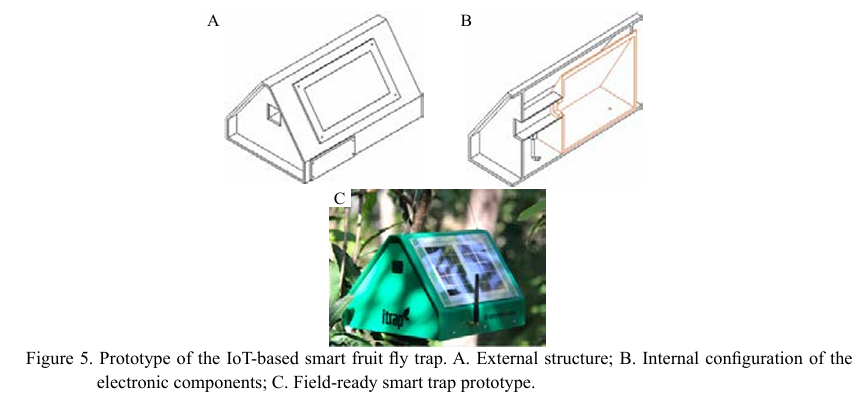
Fruit flies (Diptera: Tephritidae) are among the most destructive pests of horticultural crops, requiring continuous and coordinated surveillance to support effective Area-Wide Pest Management (AWPM). This study developed and evaluated a low-cost IoT-based smart fruit fly trap designed for automated pest monitoring under field conditions. The system was adapted from a conventional fruit fly trap and integrated with automatic infrared counting sensors, environmental sensors, a microcontroller, and LoRa/GSM communication for wireless data transmission Sensor performance was evaluated under laboratory conditions using three fruit fly population densities (10, 30, and 50 individuals). Single- and two-sensor configurations produced relatively low counting accuracy (<35% and 34–58%, respectively), whereas the three-sensor configuration consistently achieved counting accuracies exceeding >84%, demonstrating reliable automated insect detection. Power consumption remained stable during sensing operations, with only brief increases during data transmission, allowing the system to operate for approximately 3.5 days using rechargeable batteries before recharging. Field evaluation showed that LoRa communication maintained stable wireless data transmission over distances of up to 3 km, enabling coordinated monitoring across multiple trapping locations. Monitoring data were transmitted to a web-based platform for real-time visualization, storage, and management, facilitating rapid access to pest population information. The developed smart trapping system provides a practical, affordable, and energy-efficient approach for large-scale fruit fly surveillance and has strong potential to support timely decision-making in AWPM programs and sustainable pest management.
How to Cite
References
Cardim Ferreira Lima M, Damascena de Almeida LME, Valero C, Pereira CLC, & Gonçalves Bazzo CO. 2020. Automatic detection and monitoring of insect pests—A review. Agriculture. 10(5): 161. https://doi.org/10.3390/agriculture10050161
Cox JSH. 2007. The role of geographic information systems and spatial analysis in area-wide vector control programm. In: Vreysen MJB, Robinson AS, & Hendrichs J (Eds.). Area-Wide Control of Insect Pests. pp. 199–209. Springer, Dordrecht. https://doi.org/10.1007/978-1-4020-6059-5_18
Dara SK. 2019. The new integrated pest management paradigm for the modern age. J. Integr. Pest Manag. 10(1): 12. https://doi.org/10.1093/jipm/pmz010
Eliopoulos P, Tatlas NA, Rigakis I, & Potamitis I. 2018. A “smart” trap device for detection of crawling insects and other arthropods in urban environments. Electronics. 7(9): 161. https://doi.org/10.3390/electronics7090161
Green KK, Potgieter F, & Vreysen M. 2007. A strategy for an area-wide control campaign with an SIT component to establish a tsetse-(Glossina austeni and Glossina brevipalpis) free South Africa. In: Vreysen MJB, Robinson AS, & Hendrichs J (Eds.). Area-Wide Control of Insect Pests. pp. 309–323. Springer, Dordrecht. https://doi.org/10.1007/978-1-4020-6059-5_29
Jiménez-López FR, Jiménez-López AF, & García-Ramírez DY. 2024. Intelligent system for integrated pest management in agriculture: An electronic approach to sustainable farming. Visión Electrón. 18(2): 1–20.
Junaidi, Gassa A, Ramli R, & Patandjengi B. 2026. Distribution areas of quarantine plant pest organisms of the fruit fly Bactrocera musae (Diptera: Tephritidae) in South Sulawesi, Indonesia. J. Trop. Plant Pests Dis. 26(1): 68–77. https://doi.org/10.23960/jhptt.12668-77
Jung CR, Park YJ, & Boo KS. 2003. Optimal sex pheromone composition for monitoring Spodoptera exigua (Lepidoptera: Noctuidae) in Korea. J. Asia-Pac. Entomol. 6(2): 175–182. https://doi.org/10.1016/S1226-8615(08)60183-1
Kardinan A & Maris P. 2022. The effect of methyl eugenol from ocimum minimum on the sticky trap to the direction and daily activity of fruit flies (Bactrocera spp.). J. Trop. Plant Pests Dis. 22(1): 16–22. https://doi.org/10.23960/jhptt.12216-22
Klassen W. 2005. Area-wide integrated pest management and the sterile insect technique. In: Dyck VA, Hendrichs J, & Robinson A (Eds.) Sterile Insect Technique. pp. 39–68. Springer, Dordrecht. https://doi.org/10.1007/1-4020-4051-2_2
López Jr JD. 1998. Evaluation of some commercially available trap designs and sex pheromone lures for Spodoptera exigua (Lepidoptera: Noctuidae). J. Econ. Entomol. 91(2): 517–521. https://doi.org/10.1093/jee/91.2.517
López O, Rach MM, Migallon H, Malumbres MP, Bonastre A, & Serrano JJ. 2012. Monitoring pest insect traps by means of low-power image sensor technologies. Sensors. 12(11): 15801–15819. https://doi.org/10.3390/s121115801
Manurung B, Prastowo P, & Tarigan EE. 2012. Pola aktivitas harian dan dinamika populasi lalat buah Bactrocera dorsalis complex pada pertanaman jeruk di dataran tinggi Kabupaten Karo Provinsi Sumatera Utara [Daily activity pattern and population dynamic of fruit fly Bactrocera dorsalis complex on citrus plantation at highland Karo district North Sumatera Province]. J. Trop. Plant Pests Dis. 12(2): 103–110. https://doi.org/10.23960/j.hptt.212103-110
Mikhaylov K, Petaejaejaervi J, & Haenninen T. 2016. Analysis of capacity and scalability of the LoRa low power wide area network technology. European Wireless 2016, 22th European Wireless Conference. pp. 1–6. Oulu, Finland.
Miles B, Bourennane EB, Boucherkha S, & Chikhi S. 2020. A study of LoRaWAN protocol performance for IoT applications in smart agriculture. Comput. Commun. 164: 148–157. https://doi.org/10.1016/j.comcom.2020.10.009
Oliveira D & Mafra S. 2024. Implementation of an intelligent trap for effective monitoring and control of the Aedes aegypti mosquito. Sensors. 24(21): 6932. https://doi.org/10.3390/s24216932
Petäjäjärvi J, Mikhaylov K, Pettissalo M, Janhunen J, & Iinatti J. 2017. Performance of a low-power wide-area network based on LoRa technology: Doppler robustness, scalability, and coverage. Int. J. Distrib. Sens. Netw. 13(3): 1550147717699412. https://doi.org/10.1177/1550147717699412
Pobozniak M, Tokarz K, & Musynov K. 2020. Evaluation of sticky trap colour for thrips (Thysanoptera) monitoring in pea crops (Pisum sativum L.). J. Plant Dis. Prot. 127(3): 307–321. https://doi.org/10.1007/s41348-020-00301-5
Potamitis I, Rigakis I, & Fysarakis K. 2015. Insect biometrics: Optoacoustic signal processing and its applications to remote monitoring of McPhail type traps. PloS One. 10(11): e0140474. https://doi.org/10.1371/journal.pone.0140474
Qin Y, Paini DR, Wang C, Fang Y, & Li Z. 2015. Global establishment risk of economically important fruit fly species (Tephritidae). PLoS One. 10(1): e0116424. https://doi.org/10.1371/journal.pone.0116424
Rachmani AF & Zulkifli FY. 2018. Design of IoT monitoring system based on LoRa technology for starfruit plantation. TENCON 2018-2018 IEEE Region 10 Conference. pp. 1241–1245. Jeju, Korea (South). https://doi.org/10.1109/TENCON.2018.8650052
Radonjić S, Hrnčić S, & Perović T. 2019. Overview of fruit flies important for fruit production on the Montenegro seacoast. Biotechnol. Agron. Soc. Environ. 23(1): 46–56. https://doi.org/10.25518/1780-4507.17776
Saputra HM & Afriyansyah B. 2021. Distribution and identification of fruit flies (Diptera: Tephritidae) attracted on methyl euganol and cue lure in Central Bangka Regency, Bangka Belitung. J. Trop. Plant Pests Dis. 21(1): 72–81. https://doi.org/10.23960/jhptt.12172-81
Savary S, Willocquet L, Pethybridge SJ, Esker P, McRoberts N, & Nelson A. 2019. The global burden of pathogens and pests on major food crops. Nat. Ecol. Evol. 3(3): 430–439. https://doi.org/10.1038/s41559-018-0793-y
Sciarretta A & Calabrese P. 2019. Development of automated devices for the monitoring of insect pests. Curr. Agric. Res. J. 7(1): 19. https://doi.org/10.12944/CARJ.7.1.03
Shaked B, Amore A, Ioannou C, Valdés F, Alorda B, Papanastasiou S, Goldshtein E, Shenderey C, Leza M, Pontikakos C, Perdikis D, Tsiligiridis T, Tabilio MR, Sciarretta A, Barceló C, Athanassiou C, Miranda MA, Alchanatis V, Papadopoulos N, & Nestel D. 2018. Electronic traps for detection and population monitoring of adult fruit flies (Diptera: Tephritidae). J. Appl. Entomol. 142(1–2): 43–51. https://doi.org/10.1111/jen.12422
Shi Y, Wang Z, Wang X, & Zhang S. 2015. Internet of things application to monitoring plant disease and insect pests. Proceedings of the 2015 International conference on Applied Science and Engineering Innovation. pp. 31–34. Atlantis Press. https://doi.org/10.2991/asei-15.2015.7
Shieh JC, Wang JY, Lin TS, Lin CH, Yang EC, Tsai YJ, Tsai HT, Chiou MT, Lu FM, & Jiang JA. 2011. A GSM-based field monitoring system for Spodoptera litura (Fabricius). Eng. Agric. Environ. Food. 4(3): 77–82. https://doi.org/10.11165/eaef.4.77
Talebpour B, Türker U, & Yegül U. 2015. The role of precision agriculture in the promotion of food security. Int. J. Agric. Food Res. 4(1): 1–23.
Thulasi Priya C, Praveen K, & Srividya A. 2013. Monitoring of pest insect traps using image sensors & dspic. Int. J. Eng. Trends Tech. 4(9): 4088–4093.
Van Huis A. 2007. Strategies to control the desert locust Schistocerca gregaria. In: Vreysen MJB, Robinson AS, & Hendrichs J (Eds.). Area-Wide Control of Insect Pests. pp. 285–296. Springer, Dordrecht. https://doi.org/10.1007/978-1-4020-6059-5_27
Vargas RI, Mau RFL, Stark JD, Piñero JC, Leblanc L, & Souder SK. 2010. Evaluation of methyl eugenol and cue-lure traps with solid lure and insecticide dispensers for fruit fly monitoring and male annihilation in the Hawaii areawide pest management program. J. Econ. Entomol. 103(2): 409–415. https://doi.org/10.1603/ec09299
Vargas RI, Piñero JC, Leblanc L, Manoukis NC, & Mau RF. 2016. Area-wide management of fruit flies (Diptera: Tephritidae) in Hawaii. In: Ekesi S, Mohamed S, & De Meyer M (Eds.). Fruit Fly Research and Development in Africa - Towards a Sustainable Management Strategy to Improve Horticulture. pp. 673–693. Springer, Cham. https://doi.org/10.1007/978-3-319-43226-7_29
Vargas RI, Stark JD, Kido MH, Ketter HM, & Whitehand LC. 2000. Methyl eugenol and cue-lure traps for suppression of male oriental fruit flies and melon flies (Diptera: Tephritidae) in Hawaii: Effects of lure mixtures and weathering. J. Econ. Entomol. 93(1): 81–87. https://doi.org/10.1603/0022-0493-93.1.81
Vreysen MJB, Robinson AS, Hendrichs J, & Kenmore P. 2007. Area-wide integrated pest management (AW-IPM): Principles, practice and prospects. In: Vreysen MJB, Robinson AS, & Hendrichs J (Eds,). Area-Wide Control of Insect Pests. pp. 3–33. Springer, Dordrecht. https://doi.org/10.1007/978-1-4020-6059-5_1
White IM & Elson-Harris MM. 1992. Fruit Flies of Economic Significance: Their Identification and Bionomics. CAB International. Wallingford, Oxon, UK.
License
Copyright (c) 2026 Alan Soffan, Firdaus, Hesty B.T. Asminingsih, Mursyid F. Sabilillah, Suputa, Imaduddin Abdul Majid, Dualim Atma Dewangga, Fathi Alfinur Rizqi

This work is licensed under a Creative Commons Attribution-NonCommercial 4.0 International License.
The copyright of each published article are with the Jurnal Hama dan Penyakit Tumbuhan Tropika : Journal of Tropical Plant Pests and Diseases. By submitting and publishing manuscript in Jurnal Hama dan Penyakit Tumbuhan Tropika: Journal of Tropical Plant Pests and Diseases, the author(s) grant the journal the right of first publication and the right to publish, reproduce, and disseminate the article in various formats, including print, online, and electronic media, with full acknowledgment of the author(s) as the copyright holder(s).
All articles published in Jurnal Hama dan Penyakit Tumbuhan Tropika: Journal of Tropical Plant Pests and Diseases are licensed under the Creative Commons Attribution–NonCommercial (CC BY-NC) license. Under this license, others are permitted to copy, distribute, display, and adapt the work for non-commercial purposes, provided that appropriate credit is given to the original author(s) and source. Any commercial use of the published material is prohibited without prior written consent from the author(s).
The journal reserves the right to archive, preserve, distribute, and provide access to published articles for academic, educational, and other non-commercial purposes in accordance with the terms and conditions of the CC BY-NC license.