
Biphasic expression pattern of heat shock protein 90 (PnHsp90) in Pentalonia nigronervosa during acquisition of banana bunchy top virus (BBTV)
Abstract
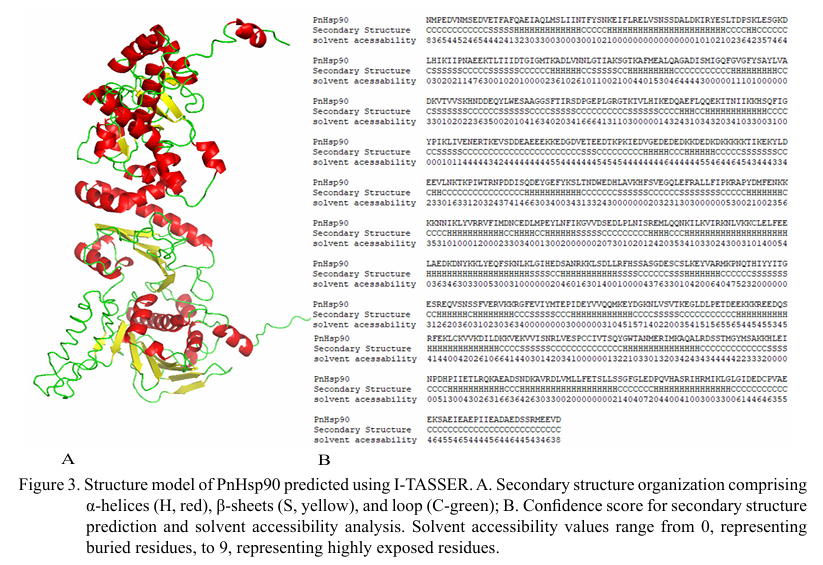
Heat shock protein 90 (Hsp90) is highly conserved molecular chaperone chaperone involved in cellular stress responses and has been implicated in insect–virus interactions. This study aimed to characterize the Hsp90 gene (PnHsp90) of Pentalonia nigronervosa, the principal vector of banana bunchy top virus (BBTV), and to investigate its transcriptional dynamics during virus acquisition. RNA-seq datasets (SRX6918251 and SRX6918252) were retrieved from GenBank for PnHsp90 identification and subsequent physicochemical, structural, and phylogenetic analyses using ProtParam, CYS-REC, I-TASSER, SWISS-MODEL, and MEGA X. PnHsp90 encodes a protein of 726 amino acids with an acidic theoretical isoelectric point (pI = 4.94), a high aliphatic index (82.84), and a conserved EEVD motif characteristic of cytosolic Hsp90s proteins. Structural modelling based on the Saccharomyces cerevisiae Hsp90–Sba1 complex (PDB: 2C9B) generated a reliable tertiary structure (TM-score = 0.72), supporting the conservation of Hsp90 domain architecture. Phylogenetic analysis placed PnHsp90 in a clade closely related to Myzus persicae, consistent with aphid evolutionary relationships. Quantitative real-time PCR revealed a biphasic transcriptional response during acquisition access periods (AAPs), characterized by rapid induction at 1 hour (2.5-fold), marked downregulation at 5 and 10 h, and renewed upregulation at 20 hours (1.7-fold). The dynamic expression profile suggests that PnHsp90 is involved in the physiological responses of P. nigronervosa during both the early and later stages of BBTV acquisition. This study provides the first integrative characterization of PnHsp90 and identifies it as a promising candidate for future functional studies aimed at elucidating the molecular mechanisms underlying BBTV acquisition and vector competence.
How to Cite
References
Alvira S, Cuéllar J, Röhl A, Yamamoto S, Itoh H, Alfonso C, Rivas G, Büchner J, & Valpuesta JM. 2014. Structural characterization of the substrate transfer mechanism in Hsp70/Hsp90 folding machinery mediated by Hop. Nat. Commun. 5(1): 5484. https://doi.org/10.1038/ncomms6484
Bagariang W, Hidayat P, & Hidayat SH. 2019. Morphometric analysis and host range of the genus Pentalonia Coquerel (Hemiptera: Aphididae) infesting banana in Java. Indones. J. Plant Prot. 23(2): 171–178. https://doi.org/10.22146/jpti.38220
Blacklock K & Verkhivker GM. 2013. Experimentally guided structural modeling and dynamics analysis of Hsp90–p53 interactions: Allosteric regulation of the Hsp90 chaperone by a client protein. J. Chem. Inf. Model. 53(11): 2962–2978. https://doi.org/10.1021/ci400434g
Blundell KLIM, Pal M, Roe SM, Pearl LH, & Prodromou C. 2017. The structure of FKBP38 in complex with the MEEVD tetratricopeptide binding motif of Hsp90. PLoS One. 12(3): e0173543. https://doi.org/10.1371/journal.pone.0173543
Castorena KM, Weeks SA, Stapleford KA, Cadwallader AM, & Miller DJ. 2007. A functional heat shock protein 90 chaperone is essential for efficient flock house virus RNA polymerase synthesis in Drosophila cells. J. Virol. 81(16): 8412–8420. https://doi.org/10.1128/jvi.00189-07
Chakraborty A, Boel NME, & Edkins AL. 2020. Hsp90 interacts with the fibronectin N-terminal domains and increases matrix formation. Cells. 9(2): 272. https://doi.org/10.3390/cells9020272
Cheng W, Li D, Wang Y, Liu Y, & Zhu-Salzman K. 2016. Cloning of heat shock protein genes (hsp70, hsc70 and hsp90) and their expression in response to larval diapause and thermal stress in the wheat blossom midge, Sitodiplosis mosellana. J. Insect Physiol. 95: 66–77. https://doi.org/10.1016/j.jinsphys.2016.09.005
Faya N, Penkler DL, & Bishop ÖT. 2015. Human, vector and parasite Hsp90 proteins: A comparative bioinformatics analysis. FEBS Open Bio. 5(1): 916–927. https://doi.org.10.1016/j.fob.2015.11.003
Folmer O, Black M, Hoeh W, Lutz R. & Vrijenhoek, R. 1994. DNA primers for amplification of mitochondrial cytochrome c oxidase subunit I from diverse metazoan invertebrates. Mol. Mar. Biol. Biotechnol.3(5): 294–299.
García-Gómez BI, Cano SN, Zagal EE, Dantán-González E, Bravo A, & Soberón M. 2019. Insect Hsp90 chaperone assists Bacillus thuringiensis Cry toxicity by enhancing protoxin binding to the receptor and by protecting protoxin from gut protease degradation. MBio. 10(6): 10–128. https://doi.org/10.1128/mBio.02775-19
Geller R, Taguwa S, & Frydman J. 2012. Broad action of Hsp90 as a host chaperone required for viral replication. Biochim. Biophys. Acta - Mol. Cell Res. 1823(3): 698–706. https://doi.org/10.1016/j.bbamcr.2011.11.007
Genest O, Reidy M, Street TO, Hoskins JR, Camberg JL, Agard DA, Masison DC, & Wickner S. 2013. Uncovering a region of heat shock protein 90 important for client binding in E. coli and chaperone function in yeast. Mol. Cell. 49(3): 464–473. https://doi.org/10.1016/j.molcel.2012.11.017
Graf C, Lee CT, Meier-Andrejszki LE, Nguyen MTN, & Mayer MP. 2014. Differences in conformational dynamics within the Hsp90 chaperone family reveal mechanistic insights. Front. Mol. Biosci. 1: 4. https://doi.org/10.3389/fmolb.2014.00004
Guz N, Dageri A, Altincicek B, & Aksoy S. 2021. Molecular characterization and expression patterns of heat shock proteins in Spodoptera littoralis, heat shock or immune response? Cell Stress Chaperones. 26(1): 29–40. https://doi.org/10.1007/s12192-020-01149-2
Jekayinoluwa T, Tripathi JN, Dugdale B, Obiero G, Muge E, Dale JL, & Tripathi L. 2021. Transgenic expression of dsRNA targeting the Pentalonia nigronervosa acetylcholinesterase gene in banana and plantain reduces aphid populations. Plants. 10(4): 613. https://doi.org/10.3390/plants10040613
Kampmueller KM & Miller DJ. 2005. The cellular chaperone heat shock protein 90 facilitates Flock House virus RNA replication in Drosophila cells. J. Virol. 79(11): 6827–6837. https://doi.org/10.1128/jvi.79.11.6827-6837.2005
Kravats AN, Doyle SM, Hoskins JR, Genest O, Doody E, & Wickner S. 2017. Interaction of E. coli Hsp90 with DnaK involves the DnaJ binding region of DnaK. J. Mol. Biol. 429(6): 858–872. https://doi.org/10.1016/j.jmb.2016.12.014
Kravats AN, Hoskins JR, Reidy M, Johnson JL, Doyle SM, Genest O, Masison DC, & Wickner S. 2018. Functional and physical interaction between yeast Hsp90 and Hsp70. PNAS. 115(10): E2210–E2219. https://doi.org/10.1073/pnas.1719969115
Li K, Sun P, Wang Y, Gao T, Zheng D, Liu A, & Ni Y. 2020. Hsp90 interacts with Cdc37, is phosphorylated by PKA/PKC, and regulates SRC phosphorylation in human sperm capacitation. Andrology. 9(1): 185–195. https://doi.org/10.1111/andr.12862
Liu T, Hou X, Zhang J, Song Y, Zhang S, & Liu Y. 2011. A cDNA clone of BcHSP81-4 from the sterility line (Pol CMS) of non-heading Chinese cabbage (Brassica campestris ssp. chinensis). Plant Mol. Biol. Rep. 29(3): 723–732. https://doi.org/10.1007/s11105-010-0285-y
Livak KJ & Schmittgen TD. 2001. Analysis of relative gene expression data using real-time quantitative PCR and the 2^−ΔΔCt method. Methods. 25(4): 402–408. https://doi.org/10.1006/meth.2001.1262
Lubkowska A, Pluta W, Strońska A, & Lalko A. 2021. Role of heat shock proteins (HSP70 and HSP90) in viral infection. Int. J. Mol. Sci. 22(17): 9366. https://doi.org/10.3390/ijms22179366
Mollapour M, Tsutsumi S, Kim YS, Trepel JB, & Neckers L. 2011. Casein kinase 2 phosphorylation of Hsp90 threonine 22 modulates chaperone function and drug sensitivity. Oncotarget. 2(5): 407–417. https://doi.org/10.18632/oncotarget.272
Murhububa IS, Tougeron K, Bragard C, Fauconnier ML, Bugeme DM, Basengere EB, Masamba JW, & Hance T. 2023. The aphid Pentalonia nigronervosa (Hemiptera: Aphididae) takes advantage from the quality change in banana plant associated with banana bunchy top virus infection. J. Econ. Entomol. 116(5): 1481–1489. https://doi.org/10.1093/jee/toad130
O’Meara TR, O’Meara MJ, Polvi EJ, Pourhaghighi MR, Liston SD, Lin ZY, Veri AO, Emili A, Gingras AC, & Cowen LE. 2019. Global proteomic analyses define an environmentally contingent Hsp90 interactome and reveal chaperone-dependent regulation of stress granule proteins and the R2TP complex in a fungal pathogen. PLoS Biol. 17(7): e3000358. https://doi.org/10.1371/journal.pbio.3000358
Pascual S, Rodríguez-Álvarez CI, Kaloshian I, & Nombela G. 2023. Hsp90 gene is required for Mi-1-mediated resistance of tomato to the whitefly Bemisia tabaci. Plants. 12(3): 641. https://doi.org/10.3390/plants12030641
Pratt WB, Morishima Y, Peng HM, & Osawa Y. 2010. Proposal for a role of the Hsp90/Hsp70-based chaperone machinery in making triage decisions when proteins undergo oxidative and toxic damage. Exp. Biol. Med. 235(3): 278–289. https://doi.org/10.1258/ebm.2009.009250
Qiao L, Wu J, Qin DZ, Liu XC, Lu ZC, Lv L, Pan ZL, Chen H, & Li GW. 2015. Gene expression profiles of heat shock proteins 70 and 90 from Empoasca onukii (Hemiptera: Cicadellidae) in response to temperature stress. J. Insect Sci. 15(1): 49. https://doi.org/10.1093/jisesa/iev030
Shu Y, Du Y, & Wang J. 2011. Molecular characterization and expression patterns of Spodoptera litura heat shock protein 70/90, and their response to zinc stress. Comp. Biochem. Physiol. A Mol. Integr. Physiol. 158(1): 102–110. https://doi.org/10.1016/j.cbpa.2010.09.006
Singh A, Puri D, Kumar B, & Singh SK. 2016. Heat shock proteins: Knowledge so far and its future prospects. Asian J. Pharm. Clin. Res. 9(5): 1–8.
Singh MK, Shin Y, Ju S, Han S, Choe W, Yoon K-S, Kim SS, & Kang I. 2024. Heat shock response and heat shock proteins: Current understanding and future opportunities in human diseases. Int. J. Mol. Sci. 25(8): 4209. https://doi.org/10.3390/ijms25084209
Sørensen JG, Kristensen TN, & Loeschcke V. 2003. The evolutionary and ecological role of heat shock proteins. Ecol. Lett. 6(11): 1025–1037. https://doi.org/10.1046/j.1461-0248.2003.00528.x
Stainton D, Kraberger S, Walters M, Wiltshire EJ, Rosario K, Halafihi M, Lolohea S, Katoa I, Faitua TH, Aholelei W, Taufa L, Thomas JE, Collings DA, Martin DP, & Varsani1 A. 2012. Evidence of inter-component recombination, intra-component recombination and reassortment in banana bunchy top virus. J. Gen. Virol. 93(5): 1103–1119. https://doi.org/10.1099/vir.0.040337-0
Street TO, Lavery LA, & Agard DA. 2011. Substrate binding drives large-scale conformational changes in the Hsp90 molecular chaperone. Mol. Cell. 42(1): 96–105. https://doi.org/10.1016/j.molcel.2011.01.029
Subandiyah S, Rahayuniati RF, Hartono S, Somowiyarjo S, Afiahayati & Soffan A. 2020. RNA-seq data of banana bunchy top virus (BBTV) viruliferous and non-viruliferous banana aphid (Pentalonia nigronervosa). Data Br. 28: 104860. https://doi.org/10.1016/j.dib.2019.104860
Suparman, Oktarida R, Hamidson H, & Arsi. 2023. Morphometrics and biological characteristics of Pentalonia nigronervosa, the vector of banana bunchy top virus, living on various Araceous plant species. J. Trop. Plant Pests Dis. 23(1): 77–87. https://doi.org/10.23960/jhptt.12377-87
Taipale M, Krykbaeva I, Koeva M, Kayatekin C, Westover KD, Karras GI, & Lindquist S. 2012. Quantitative analysis of Hsp90-client interactions reveals principles of substrate recognition. Cell. 150(5): 987–1001. https://doi.org/10.1016/j.cell.2012.06.047
Tsutsumi S, Mollapour M, Prodromou C, Lee CT, Panaretou B, Yoshida S, Mayer MP, & Neckers LM. 2012. Charged linker sequence modulates eukaryotic heat shock protein 90 (Hsp90) chaperone activity. PNAS. 109(8): 2937–2942. https://doi.org/10.1073/pnas.1114414109
Verkhivker GM. 2022. Conformational dynamics and mechanisms of client protein integration into the Hsp90 chaperone controlled by allosteric interactions of regulatory switches: Perturbation-based network approach for mutational profiling of the Hsp90 binding and allostery. J. Phys. Chem. B. 126(29): 5421–5442. https://doi.org/10.1021/acs.jpcb.2c03464
Watanabe S, Borthakur D, & Bressan A. 2015. Localization of banana bunchy top virus and cellular compartments in gut and salivary gland tissues of the aphid vector Pentalonia nigronervosa. Insect Sci. 23(4): 591–602. https://doi.org/10.1111/1744-7917.12211
Wayne N & Bolon DN. 2010. Charge-rich regions modulate the anti-aggregation activity of Hsp90. JMB. 401(5): 931–939. https://doi.org/10.1016/j.jmb.2010.06.066
Wojda I & Kowalski P. 2013. Galleria mellonella infected with Bacillus thuringiensis involves Hsp90. Cent. Eur. J. Biol. 8(6): 561–569. https://doi.org/10.2478/s11535-013-0162-9
Wu P, Jiang X, Guo X, Li L, & Chen T. 2016. Genome-wide analysis of differentially expressed microRNA in Bombyx mori infected with nucleopolyhedrosis virus. PLoS One. 11(11): e0165865. https://doi.org/10.1371/journal.pone.0165865
Wu P, Shang Q, Huang H, Zhang S, Zhong J, Hou Q, & Guo X. 2019. Quantitative proteomics analysis provides insight into the biological role of Hsp90 in BmNPV infection in Bombyx mori. J. Proteom. 203: 103379. https://doi.org/10.1016/j.jprot.2019.103379
Xu W, Beebe K, Chavez JD, Boysen M, Lu Y, Zuehlke AD, Keramisanou D, Trepel JB, Prodromou C, Mayer M, Bruce JE, Gelis I, & Neckers L. 2019. Hsp90 middle domain phosphorylation initiates a complex conformational program to recruit the ATPase-stimulating cochaperone Aha1. Nat. Commun. 10(1): 2574. https://doi.org/10.1038/s41467-019-10463-y
Yang Y, Wang W, Li M, Gao Y, Zhang W, Huang Y, Zhuo W, Yan X, Liu W, Wang F, Chen D, & Zhou T. 2018. NudCL2 is an Hsp90 cochaperone to regulate sister chromatid cohesion by stabilizing cohesin subunits. Cell. Mol. Life Sci. 76(2): 381–395. https://doi.org/10.1007/s00018-018-2957-y
Yoodee S, Peerapen P, Plumworasawat S, & Thongboonkerd V. 2022. Roles of heat-shock protein 90 and its four domains (N, LR, M and C) in calcium oxalate stone-forming processes. Cell. Mol. Life Sci. 79(8): 454. https://doi.org/10.1007/s00018-022-04483-z
Yoshimura C, Nagatoishi S, Kuroda D, Kodama Y, Uno T, Kitade M, Chong-Takata K, Oshiumi H, Muraoka H, Yamashita S, Kawai Y, Ohkubo S, & Tsumoto K. 2021. Thermodynamic dissection of potency and selectivity of cytosolic Hsp90 inhibitors. J. Med. Chem. 64(5): 2669–2677. https://doi.org/10.1021/acs.jmedchem.0c01715
Zhang H, Zhou C, Chen W, Xu Y, Shi Y, Wen Y, & Zhang N. 2015. A dynamic view of ATP-coupled functioning cycle of Hsp90 N-terminal domain. Sci. Rep. 5(1): 9542. https://doi.org/10.1038/srep09542
Zhang X, Ma S, Gu C, Hu M, Miao M, Quan Y, & Yu W. 2024. K64 acetylation of heat shock protein 90 suppresses nucleopolyhedrovirus replication in Bombyx mori. Arch. Insect Biochem. Physiol. 115(1): e22079. https://doi.org/10.1002/arch.22079
Zhao L & Jones WA. 2012. Expression of heat shock protein genes in insect stress responses. Invert. Surviv. J. 9(1): 93–101.
License
Copyright (c) 2026 Alan Soffan, Indah Nuraini, Siti Subandiyah

This work is licensed under a Creative Commons Attribution-NonCommercial 4.0 International License.
The copyright of each published article are with the Jurnal Hama dan Penyakit Tumbuhan Tropika : Journal of Tropical Plant Pests and Diseases. By submitting and publishing manuscript in Jurnal Hama dan Penyakit Tumbuhan Tropika: Journal of Tropical Plant Pests and Diseases, the author(s) grant the journal the right of first publication and the right to publish, reproduce, and disseminate the article in various formats, including print, online, and electronic media, with full acknowledgment of the author(s) as the copyright holder(s).
All articles published in Jurnal Hama dan Penyakit Tumbuhan Tropika: Journal of Tropical Plant Pests and Diseases are licensed under the Creative Commons Attribution–NonCommercial (CC BY-NC) license. Under this license, others are permitted to copy, distribute, display, and adapt the work for non-commercial purposes, provided that appropriate credit is given to the original author(s) and source. Any commercial use of the published material is prohibited without prior written consent from the author(s).
The journal reserves the right to archive, preserve, distribute, and provide access to published articles for academic, educational, and other non-commercial purposes in accordance with the terms and conditions of the CC BY-NC license.