
A new report of moss-camouflaging mantis Nanomantinae in Bali, Indonesia
Abstract
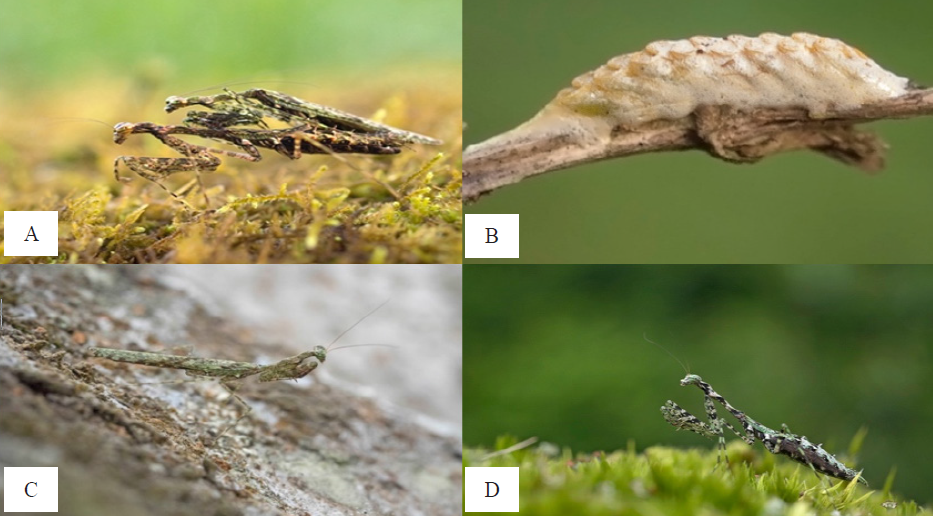
In 2019 we found moss praying mantis around the forest in the Bedugul Area of Bali, Indonesia. This species belongs to the family Mantidae, subfamily Nanomantinae, and predicted as member of Calofulcinia genus based on diagnostics of morphological characteristics, behavior, and habitat. Information about the morphological characteristics and data from the molecular sequencing database of the genus Calofulcinia has been very limited. In this research, the barcoding DNA of mitochondrial Cytochrome Oxidase I (mtCOI) of the species is noted using paired primers LCO1490 and HCO2198. Based on the sequence analysis (identity matrix and phylogeny analysis), the moss mantis from Bali has low similarity and genetic relationship with other Mantodea species from GenBank database. The data indicate the moss mantis from Bali has not been reported previously. In addition, the distribution of moss mantis species in Bedugul, Bali, Indonesia has just been described and recorded.
How to Cite
References
Alzohairy AM. 2011. BioEdit: An important software for molecular biology (SoftwareReview) . GERF Bulletin of Biosciences. 2(1): 60–61.
Beier M. 1933. Beiträge zur fauna sinica. herausgegeben von R. mell, Berlin. XIII. Die mantodeen chinas. Mitteilungen aus dem Museum für Naturkunde in Berlin. Zoologisches Museum und Institut für Spezielle Zoologie (Berlin). 18(3): 322–337. https://doi.org/10.1002/mmnz.19320180304
Brannoch SK & Svenson GJ. 2016. A new genus and species (Cornucollis gen. n. masoalensis sp. n.) of praying mantis from northern Madagascar (Mantodea, Iridopterygidae, Tropidomantinae). Zookeys. 556: 65–81. https://doi.org/10.3897/zookeys.556.6906
Carle T, Horiwaki R, Hurlbert A, & Yamawaki Y. 2018. Aversive learning in the praying mantis (Tenodera aridifolia), a sit and wait predator. J. Insect Behav. 31: 158–175. https://doi.org/10.1007/s10905-018-9665-1
Doyle JJ & Doyle JL. 1987. A rapid DNA isolation of procedure for small quantities of fresh leaf tissue. Phytochem Bull. 19: 11–15.
Ehrmann R. 2002. Mantodea: Gottesanbeterinnen der Welt. Natur und Tier Verlag GmbH, Mu?nster.
Folmer O, Black M, Hoeh W, Lutz R, & Vrijenhoek R. 1994. DNA primers for amplification of mitochondrial cytochrome c oxidase subunit I from diverse metazoan invertebrates. Mol. Mar. Biol. Biotechnol. 3(5): 294–299.
Giglio-Tos E. 1915. Mantidi Esotici. Generi e Specie Nuove. Bullettino della Società Entomo-logica Italiana (Firenze). 46: 31–108.
Hebard M. 1920. Studies in Malayan, Papuan and Australian Mantidae. Proceedings of the Academy of Natural Sciences of Philadelphia. 72(1): 14–82.
Jiang F, Jin Q, Liang L, Zhang AB, & Li ZH. 2014. Existences of species complex largely reduced barcoding success for invasive species of Tephritidae: a case study in Bactrocera spp. Mol. Ecol. Resour. 14(6): 1114–1128. https://doi.org/10.1111/1755-0998.12259
La Greca M. 1966. Su du specie di Mantodei dell’Australia. Annuario dell’Istituto e Museo di Zoologia dell’Università di Napoli. 17: 1–8.
Loftus RT, MacHugh DE, Bradley DG, Sharp PM, & Cunningham P. 1994. Evidence for two independent domestications of cattle. Proc. Natl. Acad. Sci. USA. 91(7): 2757–2761. https://doi.org/10.1073/pnas.91.7.2757
Saussure H. 1899. Wissenschaftliche Ergebnisse der Reisen in Madagaskar und Ostafrika in den Jahren 1889-1895. In: Voeltzkow A (Ed). Orthoptera-Mantidae. S., Taf. 27–28. Frankfurt. Abhandlungen der Senckenbergischen Naturforschenden Gesellschaft. 1(24): 1–76.
Stål C. 1877. Systema Mantodeorum. Essai d’une systematization systématisation nouvelle des Mantodées. Bihang till Kongl. Svenska vetenskaps-akademiens handlingar. 4(10): 1–91.
Statistic Centre Agency (SCA) Bali Province. 2017. https://bali.bps.go.id/. Accessed on 17 August 2021.
Svenson GJ & Vollmer W. 2014. A case of the higher-level classification of praying mantises (Mantodea) obscuring the synonymy of Majangella Giglio-Tos, 1915 (Liturgusidae, Liturgusinae) and Ephippiomantis Werner, 1922 (Hymenopodidae, Acromantinae). Zootaxa. 3797: 103–119. https://doi.org/10.11646/zootaxa.3797.1.10
Tamura K, Stecher G, Peterson D, Filipski A, & Kumar S. 2013. MEGA6: Molecular evolutionary genetics analysis version 6.0. Mol. Biol. Evol. 30(12): 2725–2729. https://doi.org/10.1093/molbev/mst197
Thompson JD, Gibson TJ, Plewniak F, Jeanmougin F, & Higgins DG. 1997. The CLUSTAL_X windows interface: flexible strategies for multiple sequence alignment aided by quality analysis tools. Nucleic Acids Res. 25(24): 4876–4882. https://doi.org/10.1093/nar/25.24.4876
Unnahachote T, Shcherbakov E, & Pinkaew N. 2021. First record of the genus Arria (Mantodea, Haaniidae, Arriini) from Thailand, with the description of a new species of moss-dwelling praying mantis. Zookeys. 1028: 49–60. https://doi.org/10.3897/zookeys.1028.62347
Westwood JO. 1889. Revisio Insectorum Familiae Mantidarum, speciebus novis aut minus cognitis descriptis et delineatis. Gurney and Jackson, London.
Williams G. 2002. A Taxonomic and Biogeographic Review of the Invertebrates of the Central Eastern Rainforest Reserves of Australia (CERRA) World Heritage Area, and Adjacent Regions. Technical Reports of the Australian Museum. 16: 1–208.http://www.ephemeroptera-galactica.com/pubs/pub_w/pubwilliamsg2002p1.pdf
License
Copyright (c) 2023 Jurnal Hama dan Penyakit Tumbuhan Tropika

This work is licensed under a Creative Commons Attribution-NonCommercial 4.0 International License.
The copyright of each published article are with the Jurnal Hama dan Penyakit Tumbuhan Tropika : Journal of Tropical Plant Pests and Diseases. By submitting and publishing manuscript in Jurnal Hama dan Penyakit Tumbuhan Tropika: Journal of Tropical Plant Pests and Diseases, the author(s) grant the journal the right of first publication and the right to publish, reproduce, and disseminate the article in various formats, including print, online, and electronic media, with full acknowledgment of the author(s) as the copyright holder(s).
All articles published in Jurnal Hama dan Penyakit Tumbuhan Tropika: Journal of Tropical Plant Pests and Diseases are licensed under the Creative Commons Attribution–NonCommercial (CC BY-NC) license. Under this license, others are permitted to copy, distribute, display, and adapt the work for non-commercial purposes, provided that appropriate credit is given to the original author(s) and source. Any commercial use of the published material is prohibited without prior written consent from the author(s).
The journal reserves the right to archive, preserve, distribute, and provide access to published articles for academic, educational, and other non-commercial purposes in accordance with the terms and conditions of the CC BY-NC license.