
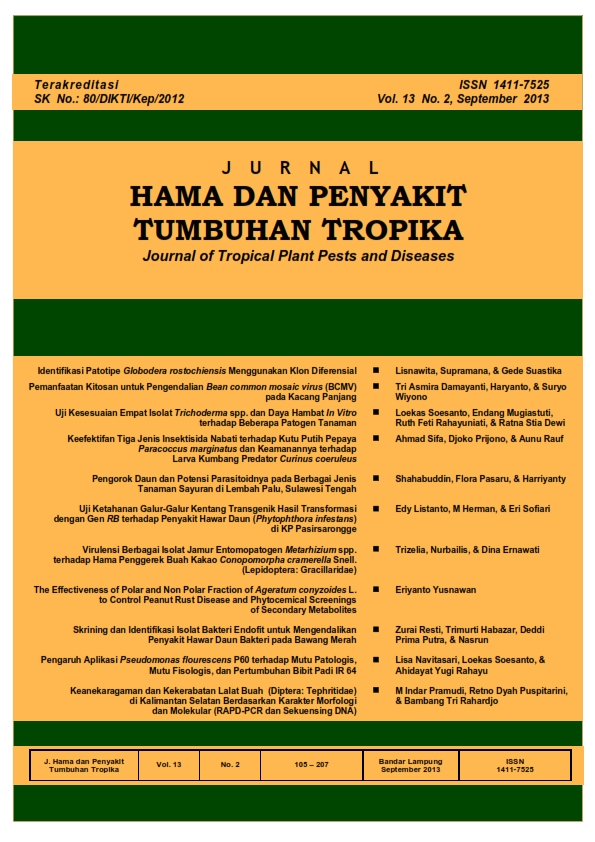
PENGOROK DAUN DAN POTENSI PARASITOIDNYA PADA BERBAGAI JENIS TANAMAN SAYURAN DI LEMBAH PALU, SULAWESI TENGAH
Abstract
identify the leafminer species and their associated parasitoids. Several leaves of all crops infested by leafminers were collected for rearing the leafminers and their parasitoids in laboratory. The study recorded three species of leafminers:Liriomyza chinensis, L. sativae, and L. huidobrensis and five species of parasitoids: Hemiptarsenus varicornis, Chrysocharis pentheus, Sympiesis sp., Gronotoma micromorpha, and Opius sp. While Liriomyza chinensis was only recorded from onion crops (monophagus), other species were poliphagus. An average infestation level among leafminer species varied, i.e. 21% -51% while parasitism ranged were 13%-40 %. The most abundant parasitoid recorded from all observed crops was H. varicornis.The results suggest that parasitoids, mainly H. varicornis have a high potential to control leafminers in the vegetable crops in Palu Valley.
How to Cite
License
Copyright (c) 2014 Jurnal Hama dan Penyakit Tumbuhan Tropika

This work is licensed under a Creative Commons Attribution-NonCommercial 4.0 International License.
The copyright of each published article are with the Jurnal Hama dan Penyakit Tumbuhan Tropika : Journal of Tropical Plant Pests and Diseases. By submitting and publishing manuscript in Jurnal Hama dan Penyakit Tumbuhan Tropika: Journal of Tropical Plant Pests and Diseases, the author(s) grant the journal the right of first publication and the right to publish, reproduce, and disseminate the article in various formats, including print, online, and electronic media, with full acknowledgment of the author(s) as the copyright holder(s).
All articles published in Jurnal Hama dan Penyakit Tumbuhan Tropika: Journal of Tropical Plant Pests and Diseases are licensed under the Creative Commons Attribution–NonCommercial (CC BY-NC) license. Under this license, others are permitted to copy, distribute, display, and adapt the work for non-commercial purposes, provided that appropriate credit is given to the original author(s) and source. Any commercial use of the published material is prohibited without prior written consent from the author(s).
The journal reserves the right to archive, preserve, distribute, and provide access to published articles for academic, educational, and other non-commercial purposes in accordance with the terms and conditions of the CC BY-NC license.