Abstract
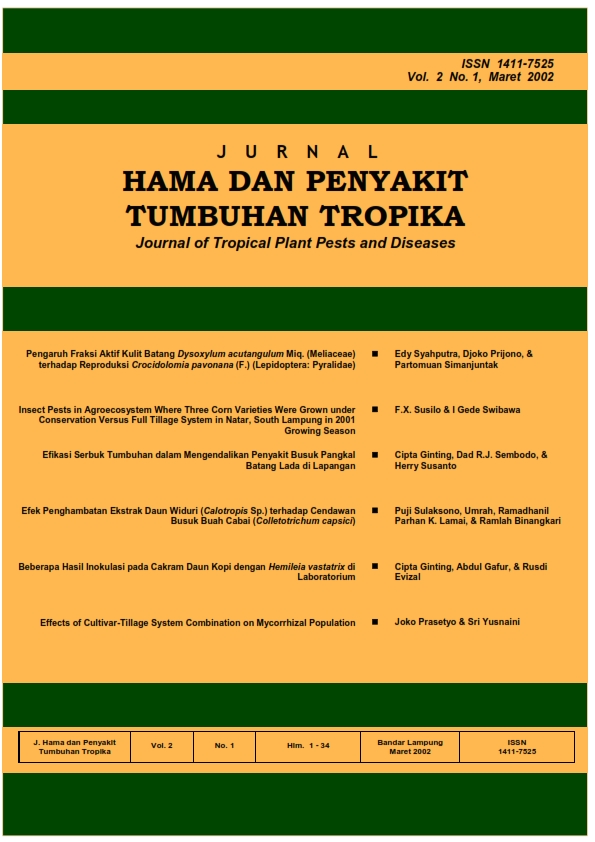
The efficacy of plant powder to control foot rot on black pepper in field condition. One of the problems in cultivating black pepper (Piper nigrum L.) is foot rot caused by Phytophthora capsici Leonian (P. palmivora MF4), that could kill the plants in only few days especially during rainy season. The objective of this experiment was to evaluate the efficacy of several plant powder to control the disease in semi-field condition. The experiment was conducted at the experiment station located at the campus of the University of Lampung from May to October of 2000. The semi-field condition was made by pushing a barrel into the soil to isolate the field soil as testing medium from the rest of the field soil. The treatments were arranged in a randomized complete block design with five replications and consisted of the rhizomes of Zingiber officinale, Alpinia galanga, and Kaempferia galanga, whole plant of Cymbopogon citratus and Elephantopus scaber, metalaxyl, and untreated control. To prepare the plant powder, each material was cut into small pieces then dried in oven at 50o C for 4 days and then ground in a blender. The powder was applied 3 days after inoculum infestation. The powder and inoculum was mixed with soil to the depth of 12 cm so that the soil contained 2% each. After one week, four plants were planted. As additional bioindicator to detect infective inoculum, eight leaf portions were pressed into the soil so that half of the leaf was bellowed the soil line. The plants were watered and observed daily. To determine viable fungal propagules, soil sample was taken weekly for five weeks. Soil assay was done with dilution technique using PDA supplemented with rosebengal. The results of the observation show that the treatments did not influence significantly the disease intensity on leaf portions or the whole plants. There were no significant differences on viable fungal propagules in soils received different treatments.
License
Copyright (c) 2011 Jurnal Hama dan Penyakit Tumbuhan Tropika

This work is licensed under a Creative Commons Attribution-NonCommercial 4.0 International License.
The copyright of each published article are with the Jurnal Hama dan Penyakit Tumbuhan Tropika : Journal of Tropical Plant Pests and Diseases. By submitting and publishing manuscript in Jurnal Hama dan Penyakit Tumbuhan Tropika: Journal of Tropical Plant Pests and Diseases, the author(s) grant the journal the right of first publication and the right to publish, reproduce, and disseminate the article in various formats, including print, online, and electronic media, with full acknowledgment of the author(s) as the copyright holder(s).
All articles published in Jurnal Hama dan Penyakit Tumbuhan Tropika: Journal of Tropical Plant Pests and Diseases are licensed under the Creative Commons Attribution–NonCommercial (CC BY-NC) license. Under this license, others are permitted to copy, distribute, display, and adapt the work for non-commercial purposes, provided that appropriate credit is given to the original author(s) and source. Any commercial use of the published material is prohibited without prior written consent from the author(s).
The journal reserves the right to archive, preserve, distribute, and provide access to published articles for academic, educational, and other non-commercial purposes in accordance with the terms and conditions of the CC BY-NC license.