
Molecular detection and characterization of potato virus Y-NTN and cucumber mosaic virus-S in microtubers and G0 tubers of red and Granola potato
Abstract
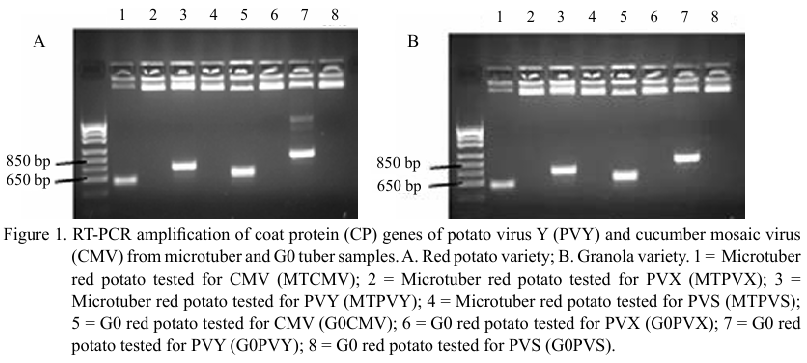
This study aimed to detect and molecularly characterize viruses infecting microtubers and G0 tubers of red and Granola potato varieties produced by PT. G10 Agrotechnology, Medan, Indonesia. A total of 50 microtubers and 50 G0 tubers from each variety were collected and tested using serological methods, including enzyme-linked immunosorbent assay (ELISA) and dot immunobinding assay (DIBA), followed by reverse transcription polymerase chain reaction (RT-PCR) and nucleotide sequence analysis. Serological and molecular assays showed that all microtuber samples were free from potato virus Y (PVY), potato virus X (PVX), potato virus S (PVS), and cucumber mosaic virus (CMV). In contrast, G0 tubers were infected by PVY and CMV, whereas PVX and PVS were not detected. The incidence of PVY and CMV reached 80.0% and 82.0%, respectively, in red potato G0 tubers and 28.0% for both viruses in Granola G0 tubers. RT-PCR successfully amplified the coat protein (CP) genes of PVY and CMV, producing fragments of approximately 801 bp and 657 bp, respectively. Sequence and phylogenetic analyses identified the PVY isolates as belonging to the PVY-NTN strain and the CMV isolates as closely related to the CMV soybean stunt strain (CMV-S). These findings indicate that microtubers produced through tissue culture were virus-free, whereas viral infection occurred during the screen-house multiplication stage. The results provide important baseline information for virus monitoring and management strategies to support the production of high-quality potato seed in Indonesia.
How to Cite
References
Abohatem MA, Al-Qubati Y, Abohatem H, & Bakil Y. 2024. In vitro sprouts culture, shoots multiplication, and plants acclimatization for commercial production of potato minitubers. J. Crop Sci. Biotechnol. 27(2): 187–194. https://doi.org/10.1007/s12892-023-00221-4
Aksoy E, Demirel U, Bakhsh A, Zia MAB, Naeem M, Saeed F, Çalışkan S, & Çalışkan MEE. 2021. Recent advances in potato (Solanum tuberosum L.) breeding. In: Al-Khayri JM, Jain SM, & Johnson DV (Eds.). Advances in Plant Breeding Strategies: Vegetable Crops. pp. 409–487. Springer, Cham. https://doi.org/10.1007/978-3-030-66965-2_10
Baranwal VK, Nabi SU, & Yadav MK. 2021. Plant virus diagnostics: Traditional to recent and emerging advances. In: Singh KP, Jahagirdar S, & Sarma BK (Eds.). Emerging Trends in Plant Pathology. pp. 97–111. Springer, Singapore. https://doi.org/10.1007/978-981-15-6275-4_5
Chaudhary S, Lal M, Sagar S, Sharma S, & Kumar M. 2024. Black scurf of potato: Insights into biology, diagnosis, detection, host-pathogen interaction, and management strategies. Trop. Plant Pathol. 49(2): 169–192. https://doi.org/10.1007/s40858-023-00622-4
Chikh-Ali M, Bosque-Pérez NA, Vander Pol D, Sembel D, & Karasev AV. 2016. Occurrence and molecular characterization of recombinant potato virus YNTN isolates from Sulawesi, Indonesia. Plant Dis. 100(2): 269–275. https://doi.org/10.1094/PDIS-07-15-0817-RE
Damayanti TA, Alabi OJ, Hidayat SH, Crosslin JM, & Naidu RA. 2014. First report of potato virus Y in potato in West Java, Indonesia. Plant Dis. 98(2): 287–287. https://doi.org/10.1094/PDIS-07-13-0745-PDN
Devaux A, Goffart JP, Kromann P, Andrade-Piedra J, Polar V, & Hareau G. 2021. The potato of the future: Opportunities and challenges in sustainable agri-food systems. Potato Res. 64(4): 681–720. https://doi.org/10.1007/s11540-021-09501-4
de Oliveira GD, de Souza MR, de Oliveira JRG, de Oliveira KKP, da Silveira MA, de Melo Ferreira W, Barreto HG, & Ságio SA. 2025. Evaluation of cleaning methods and viral indexing in sweet potato genotypes. In Vitro Cell. Dev. Biol.-Plant. 61(1): 219–228. https://doi.org/10.1007/s11627-024-10501-5
Diningrat DS, Febriyossa A, Suryanto ED, Maulana B, Sari AN, Asmin, Nainggolan TB, Hasibuan AAU, & Rambe KU. 2024. Design of artificial intelligence for evaluation of in vitro potato (Solanum tuberosum) microtuber growth from tissue culture based on digital imagery. J. Phys.: Conf. Ser. 2908: 012001. https://doi.org/10.1088/1742-6596/2908/1/012001
Funke CN, Tran LT, & Karasev AV. 2024. Screening three potato cultivars for resistance to potato virus Y strains: Broad and strain-specific sources of resistance. Am. J. Potato Res. 101(2): 132–141. https://doi.org/10.1007/s12230-024-09946-6
Hadiarto T & Ambarwati AD. 2024. Breeding of genetically engineered Indonesian potato, Bio Granola, resistant to late blight pathogen Phytophthora infestans. Potato Res. 67(2): 695–709. https://doi.org/10.1007/s11540-023-09662-4
Kuan CP, Hsiao CJ, Cheng YH, & Chen S. 2024. Using multiplex RT-PCR assay for detection and differentiation of three pepper-infecting viruses. J. Taiwan Agric. Res. 73(3): 89–99. https://doi.org/10.6156/JTAR.202406_73(2).0002
Kumar R, Kaundal P, Tiwari RK, Lal MK, Kumari H, Kumar R, Sagar V, & Singh B. 2023. Optimization of a simple, low-cost one-step reverse transcription recombinase polymerase amplification method for real-time detection of potato virus A in potato leaves and tubers. 3 Biotech. 13(11): 373. https://doi.org/10.1007/s13205-023-03791-w
Kumari M, Sinha A, Solankey SS, & Swapnil. 2025. Advances in research on potato seed production. In: Solankey SS (Ed.). Advances in Research on Potato Production. pp. 139–152. Advances in Olericulture. Springer, Cham. https://doi.org/10.1007/978-3-031-82710-5_6
Kunjan M. 2024. Potato Meristem Culture to Generate Virus-Free Plantlets and Optimization of Callus Induction, Transformation, and Microtuberization Parameters. Master Thesis. Tribhuvan University. Kathmandu, Nepal.
Lalpekhlua K, Tirkey A, Saranya S, & Babu PJ. 2024. Post-harvest management strategies for quality preservation in crops. Int. J. Veg. Sci. 30(5): 587–635. https://doi.org/10.1080/19315260.2024.2392551
Lindqvist-Kreuze H, Bonierbale M, Grüneberg WJ, Mendes T, De Boeck B, & Campos H. 2024. Potato and sweetpotato breeding at the International Potato Center: Approaches, outcomes and the way forward. Theor. Appl. Genet. 137(1): 12. https://doi.org/10.1007/s00122-023-04515-7
Listihani, Selangga DGW, Yuliadhi KA, Yuniti IGAD, & Ariati PEP. 2024. Molecular characterization of ice ragged stunt virus and rice grassy stunt virus on rice in Gianyar, Bali, Indonesia. J. Trop .Plant Pests Dis. 24(1): 48–57. https://doi.org/10.23960/jhptt.12448-57
Mahfut, Sari M, Akin HM, Wahyuningsih S, & Irawan B. 2025. Molecular characterization and effectiveness cross-protection of weak strains against super-infection malignant strains cucumber mosaic virus (CMV) on cayenne pepper (Capsicum annuum L.) in Lampung, Indonesia. J. Trop. Plant Pests Dis. 25(1): 63–75. https://doi.org/10.23960/jhptt.12563-75
Maulana H, Widaningsih NA, Jaenudin U, Utami DW, Akhdiya A, Handayani T, Karjadi AA, Maharijaya A, Sobir, & Roostika I. 2024. Selection of superior potato (Solanum tuberosum L.) by combined stability analysis for future breeding strategies. Agriculture. 70(2): 72–86. https://doi.org/10.2478/agri-2024-0006
Maulidiyah R, Salam M, Jamil MH, Tenriawaru AN, Rahmadanih, & Saadah. 2024. Examining the effects of input allocation on potato production, production efficiency, and technical inefficiency in potato farming: Evidence from the Stochastic Frontier Model in search of sustainable farming practices. Sustain. Futures. 7: 100218. https://doi.org/10.1016/j.sftr.2024.100218
Mishra P, Pandey R, Chauhan R, Vishwakarama A, Mishra M, Shukla AK, Singh PK, & Saurabh S. 2025. Plant virus management: Account of conventional and next-generation approaches. In: Golnaraghi A, Gaur RK, & Verma RK (Eds.). Detection and Management of New and Emerging Mystery Plant Virus Sources. pp. 153–189. Apple Academic Press, New York. https://doi.org/10.1201/9781003493136-8
Motti R. 2021. The Solanaceae family: Botanical features and diversity. In: Carputo D, Aversano R, & Ercolano MR (Eds.). The Wild Solanums Genomes. Compendium of Plant Genomes. pp. 1–9. Springer International Publishing, Cham. https://doi.org/10.1007/978-3-030-30343-3_1
Pronk AA, Gunadi N, Hermelink MI, Hengsdijk H, Jindo K, & Silva JV. 2024. Opportunities to narrow potato yield gaps and increase resource use efficiency in West Java, Indonesia. Potato Res. 68(2): 1137–1158. https://doi.org/10.1007/s11540-024-09778-1
Putri DD, Fadlillah N, Suyono S, & Wijayanti IK. 2024. Efficiency of supply chain management performance in potato farming with data envelopment analysis. Jurnal Penelitian Pendidikan IPA. 10(8): 5976–5983. https://doi.org/10.29303/jppipa.v10i8.8031
Raza M, Hussain Z, Abbas F, Ashraf MA, Imene HH, & Riaz T. 2025. Advanced strategies for detection and diagnosis of potato viruses: Harnessing molecular innovations and digital tools for precision agriculture. Hosts Viruses. 12: 39–46. https://dx.doi.org/10.17582/journal.hv/2025/12.39.46
Ru Y. 2024. Research progress on fog cultivation technology for potato seed production. Pac. Int. J. 7(2): 161–169. https://doi.org/10.55014/pij.v7i2.590
Santosa AI, Wulandari R, Vadilah MN, Sabila E, Kusuma AF, Mulyadi D, Berlian I, Wangi MGP, Sutejo AM, & Çelik A. 2025. Survey of Potyviruses, Carlaviruses, and Begomoviruses in Potato Cultivation Centers of West, Central, and East Java Provinces, Indonesia. Int. J. Plant Biol. 16(2): 65. https://doi.org/10.3390/ijpb16020065
Saptana, Sayekti AL, Perwita AD, Sayaka B, Gunawan E, Sukmaya SG, Hayati NQ, Yusuf, Sumaryanto, Yufdy MP, Mardianto S, & Pitaloka AD. 2022. Analysis of competitive and comparative advantages of potato production in Indonesia. PLoS One. 17(2): e0263633. https://doi.org/10.1371/journal.pone.0263633
Shabrina NH, Indarti S, Maharani R, Kristiyanti DA, Irmawati, Prastomo N, & Adilah MT. 2024. A novel dataset of potato leaf disease in uncontrolled environment. Data Br. 52: 109955. https://doi.org/10.1016/j.dib.2023.109955
Singh C, Randhawa GS, Farooque AA, Gill YS, Kumar KML, Singh M, & Al-Mughrabi K. 2025. Evaluation of deep learning models for RGB image-based detection of potato virus Y strain symptoms (O, NO, and NTN) in potato plants. Smart Agric. Technol. 10: 100755. https://doi.org/10.1016/j.atech.2024.100755
Sivakumar P, Sasikala K, Prabha T, Selvaraj KSV, Karunakaran V, Selvamurugan M, Shree GGK, & Kiruba M. 2024. Microtuber induction and plant regeneration of potato (Solanum tuberosum L.): A Review. Int. J. Plant Soil Sci. 36(3): 166–176. https://doi.org/10.9734/IJPSS/2024/v36i34412
Stemerding D, Beumer K, Edelenbosch R, Swart JAA, de Vries ME, ter Steeg E, Almekinders CJM, Lindhout P, van Dijk LCM, & Struik PC. 2023. Responsible innovation in plant breeding: The case of hybrid potato breeding. Plants. 12(9): 1751. https://doi.org/10.3390/plants12091751
Syamsiyah N, Qanti SR, & Rochdiani D. 2024. Risk mitigation in environmental conservation for potato production in Cisangkuy Sub-Watershed, Bandung Regency, West Java, Indonesia. Agriculture. 14(10): 1726. https://doi.org/10.3390/agriculture14101726
Taylor AS & Dawson P. 2021. Major constraints to potato production in Indonesia: A review. Am. J. Potato Res. 98(3): 171–186. https://doi.org/10.1007/s12230-021-09831-6
Tkaczyńska A, Rytel E, Kucharska AZ, Kolniak‐Ostek J, & Sokół‐Łętwska A. 2024. Stability of color and biologically active compounds of pasteurized juices from potatoes with colored flesh. Food Sci. Nutr. 12(7): 4637–4655. https://doi.org/10.1002/fsn3.4102
Vishal, Mali S, Dutta M, Choudhary A, & Zinta G. 2025. Potato microtuberization: Its regulation and applications. Crit. Rev. Biotechnol. 45(7): 1454–1477. https://doi.org/10.1080/07388551.2025.2490957
Wardani TP, Hartono S, Sulandari S, & Somowiyarjo S. 2021. Double infections of rehmannia mosaic virus and potato virus Y on tobacco plants in Central Java and Special Region of Yogyakarta. Indones. J. Plant Prot. 25(2): 133–140. https://doi.org/10.22146/jpti.67468
Wu W, Ma F, Zhang X, Tan Y, Han T, Ding J, Wu J, Xing W, Wu B, Huang D, Zhang S, Xu Y, & Song S. 2024. Research progress on viruses of Passiflora edulis. Biology. 13(10): 839. https://doi.org/10.3390/biology13100839
License
Copyright (c) 2026 Diky Setya Diningrat, Laela Sari, Ashar Hasairin, Adelia Febriyossa, Heppy Setya Prima, Selvia Dewi Pohan, Larasati Arum Utami

This work is licensed under a Creative Commons Attribution-NonCommercial 4.0 International License.
The copyright of each published article are with the Jurnal Hama dan Penyakit Tumbuhan Tropika : Journal of Tropical Plant Pests and Diseases. By submitting and publishing manuscript in Jurnal Hama dan Penyakit Tumbuhan Tropika: Journal of Tropical Plant Pests and Diseases, the author(s) grant the journal the right of first publication and the right to publish, reproduce, and disseminate the article in various formats, including print, online, and electronic media, with full acknowledgment of the author(s) as the copyright holder(s).
All articles published in Jurnal Hama dan Penyakit Tumbuhan Tropika: Journal of Tropical Plant Pests and Diseases are licensed under the Creative Commons Attribution–NonCommercial (CC BY-NC) license. Under this license, others are permitted to copy, distribute, display, and adapt the work for non-commercial purposes, provided that appropriate credit is given to the original author(s) and source. Any commercial use of the published material is prohibited without prior written consent from the author(s).
The journal reserves the right to archive, preserve, distribute, and provide access to published articles for academic, educational, and other non-commercial purposes in accordance with the terms and conditions of the CC BY-NC license.