
Metatranscriptomic analysis reveals two new viruses and highly expressed endogenous elements in pepper in Iraq
Abstract
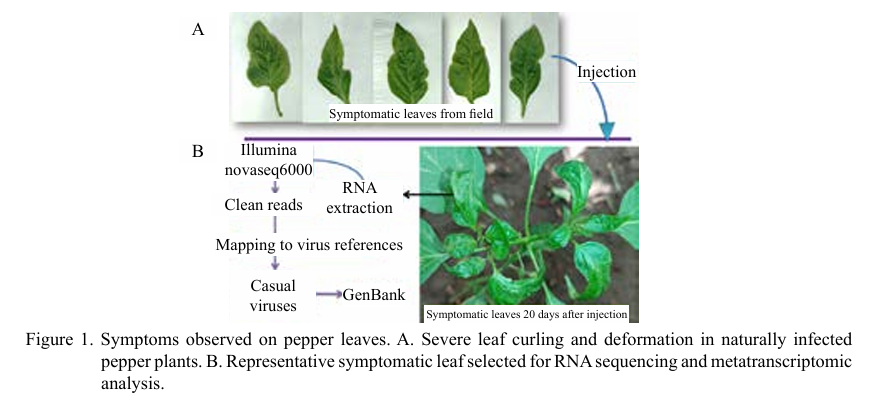
Pepper plants exhibiting severe leaf curling and deformation in open fields in Iraq were investigated to characterize their associated virome using metatranscriptomic sequencing. High-throughput sequencing (HTS) revealed the presence of bell pepper alphaendornavirus (BPEV) and pepper cryptic virus 2 (PCV-2), together with fragmented sequences related to tobacco vein clearing virus (TVCV). A nearly complete genome of the Iraqi BPEV isolate (14,700 bp) and both genomic segments of PCV-2 (1,623 bp and 1,513 bp) were assembled and deposited in GenBank. Phylogenetic analysis showed that the BPEV isolate clustered closely with isolates from South Korea, Jamaica, and the Dominican Republic, whereas both PCV-2 genomic segments were most closely related to Turkish isolates, indicating high genetic conservation among geographically distant populations. In addition, transcriptome mapping revealed abundant expression of ten endogenous pararetroviral elements integrated within the pepper genome, with most transcripts corresponding to reverse transcriptase (RT-LTR) and RNase H domains. This study represents the first comprehensive metatranscriptomic characterization of the pepper virome in Iraq, documenting the first detection of BPEV and PCV-2 in the country while revealing extensive expression of endogenous viral elements. These findings expand current knowledge of pepper-associated viruses in the Middle East and demonstrate the value of metatranscriptomic sequencing for detecting both exogenous viruses and endogenous viral components.
How to Cite
References
Adhab M, Al-Kuwaiti N, & Al-Ani R. 2021. Biodiversity and occurrence of plant viruses over four decades: Case study for Iraq. 2021 Third International Sustainability and Resilience Conference: Climate Change. pp. 159–163. Sakheer, Bahrain. https://doi.org/10.1109/IEEECONF53624.2021.9668128
Ali RM, Alisawi O, & Al-Fahad M. 2024. Three endogenous pararetrovirus genomes in Medicago sativa. Microbiol. Resour. Announc. 13(11): e00742-24. https://doi.org/10.1128/mra.00742-24
Alisawi ON. 2019. Virus Integration and Tandem Repeats in the Genomes of Petunia. Dissertation. University of Leicester, Leicester.
Al-Kaeath N, Zagier S, Alisawi O, Al Fadhal F, & Mahfoudhi N. 2024. High-throughput sequencing identified multiple fig viruses and viroids associated with fig mosaic disease in Iraq. Plant Pathol. J. 40(5): 486–497. https://doi.org/10.5423/PPJ.OA.04.2024.0068
Arogundade O, Ajose T, Osijo I, Onyeanusi H, Matthew J, & Aliyu TH. 2020. Management of viruses and viral diseases of pepper (Capsicum spp.) in Africa. In: Dekebo A (Ed.). Capsicum. pp. 73–86. IntechOpen. London, England. https://doi.org/10.5772/intechopen.92266
Escalante C & Valverde RA. 2024. Interactions between bell pepper endornavirus and the host. In: Ali A & Gaur RK (Eds.). Pepper Virome. Molecular Biology, Diagnostics and Management. pp. 315–333. Academic Press, Elsevier, London. https://doi.org/10.1016/B978-0-443-15576-5.00013-7
Hadidi A, Flores R, Candresse T, & Barba M. 2016. Next-generation sequencing and genome editing in plant virology. Front. Microbiol. 7: 1325. https://doi.org/10.3389/fmicb.2016.01325
Huelsenbeck JP & Ronquist F. 2001. MRBAYES: Bayesian inference of phylogenetic trees. Bioinformatics. 17(8): 754–755. https://doi.org/10.1093/bioinformatics/17.8.754
Jo Y, Choi H, Lee JH, Moh SH, & Cho WK. 2022. Viromes of 15 pepper (Capsicum annuum L.) cultivars. Int. J. Mol. Sci. 23(18): 10507. https://doi.org/10.3390/ijms231810507
Jurka J, Kapitonov VV, Pavlicek A, Klonowski P, Kohany O, & Walichiewicz J. 2005. Repbase update, a database of eukaryotic repetitive elements. Cytogenet. Genome Res. 110(1–4): 462–467. https://doi.org/10.1159/000084979
Kearse M, Moir R, Wilson A, Stones-Havas S, Cheung M, Sturrock S, Buxton S, Cooper A, Markowitz S, Duran C, Thierer T, Ashton A, Meintjes P, & Drummond A. 2012. Geneious Basic: An integrated and extendable desktop software platform for the organization and analysis of sequence data. Bioinformatics. 28(12): 1647–1649. https://doi.org/10.1093/bioinformatics/bts199
Khaffajah B, Alisawi O, & Al Fadhl F. 2022. Genome sequencing of eggplant reveals Eggplant mild leaf mottle virus existence with associated two endogenous viruses in diseased eggplant in Iraq. Arch. Phytopathol. Plant Prot. 55(16): 1930–1943. https://doi.org/10.1080/03235408.2022.2123601
Matzke M. Gregor W, Mette MF, Aufsatz W, Kanno T, Jakowitsch J, & Matzke AJ. 2004. Endogenous pararetroviruses of allotetraploid Nicotiana tabacum and its diploid progenitors, N. sylvestris and N. tomentosiformis. Biol. J. Linn. Soc. 82(4): 627–638. https://doi.org/10.1111/j.1095-8312.2004.00347.x
Minicka J, Taberska A, Borodynko-Filas N, Kaźmińska K, Bartoszewski G, & Hasiów-Jaroszewska B. 2024. Viruses infecting Capsicum crops in Poland and molecular characterization of newly detected bell pepper alphaendornavirus (BPEV). Crop Prot. 176: 106478. https://doi.org/10.1016/j.cropro.2023.106478
Mustafa SI, Schwarzacher T, & Heslop-Harrison JS. 2018. Complete mitogenomes from Kurdistani sheep: Abundant centromeric nuclear copies representing diverse ancestors. Mitochondrial DNA Part A. 29(8): 1180–1193. https://doi.org/10.1080/24701394.2018.1431226
Nibert ML, Ghabrial SA, Maiss E, Lesker T, Vainio JE, Jiang D, & Suzuki N. 2014. Taxonomic reorganization of family Partitiviridae and other recent progress in partitivirus research. Virus Res. 188: 128–141. https://doi.org/10.1016/j.virusres.2014.04.007
Okada R, Kiyota E, Moriyama H, Fukuhara T, & Valverde RA. 2017. Molecular and biological properties of an endornavirus infecting winged bean (Psophocarpus tetragonolobus). Virus Genes. 53(1): 141–145. https://doi.org/10.1007/s11262-016-1398-7
Paudel S, Valverde RA, & Davis JA. 2024. Bell pepper endornavirus alters green peach aphid (Hemiptera: Aphididae) host choice and population dynamics. J. Econ. Entomol. 118(1): 57–62. https://doi.org/10.1093/jee/toae256
Roossinck MJ, Sabanadzovic S, Okada R, & Valverde RA. 2011. The remarkable evolutionary history of endornaviruses. J. Gen. Virol. 92(11): 2674–2678. https://doi.org/10.1099/vir.0.034702-0
Sabanadzovic S & Valverde RA. 2011. Properties and detection of two cryptoviruses from pepper (Capsicum annuum). Virus Genes. 43(2): 307–312. https://doi.org/10.1007/s11262-011-0634-4
Paslay C & Ali A. 2025. Characterization of the pepper virome in Oklahoma reveals emerging RNA and DNA viruses. Pathogens. 14(10): 1035. https://doi.org/10.3390/pathogens14101035
Sun M, Jing CC, Wu GT, Sun XC, Liu Y, & Qing L. 2017. First report of pepper cryptic virus 2 infecting pepper in China. J. Plant Pathol. 99(1): 298.
Tamura K, Stecher G, & Kumar S. 2021. MEGA11: Molecular evolutionary genetics analysis version 11. Mol. Biol. Evol. 38(7): 3022–3027. https://doi.org/10.1093/molbev/msab120
Tomašechová J, Hančinský R, Predajňa L, Kraic J, Mihálik D, Šoltys K, Vávrová S, Böhmer M, Sabanadzovic S, & Glasa M. 2019. High-throughput sequencing reveals bell pepper endornavirus infection in pepper (Capsicum annuum) in Slovakia and enables its further molecular characterization. Plants. 9(1): 41. https://doi.org/10.3390/plants9010041
Tomašechová J, Predajňa L, Sihelská N, Kraic J, Mihálik D, Šoltys K, & Glasa M., 2020. First report of pepper cryptic virus 2 infecting pepper (Capsicum annum) in Slovakia. Plant Dis. 104(5): 1565–1565. https://doi.org/10.1094/PDIS-12-19-2577-PDN
Valverde RA, Nameth S, Abdalla O, Al-Musa O, Desjardins P, & Dodds A. 1990. Indigenous double-stranded RNA from pepper (Capsicum annuum). Plant Sci. 67(2): 195–201. https://doi.org/10.1016/0168-9452(90)90243-H
Valverde RA & Gutierrez DL. 2007. Transmission of a dsRNA in bell pepper and evidence that it consists of the genome of an endornavirus. Virus Genes. 35(2): 399–403. https://doi.org/10.1007/s11262-007-0092-1
Villamor DEV, Ho T, Al Rwahnih M, Martin RR, & Tzanetakis IE. 2019. High throughput sequencing for plant virus detection and discovery. Phytopathology. 109(5): 716–725. https://doi.org/10.1094/PHYTO-07-18-0257-RVW
Zhang Y, Li S, Tan R, Zhang D, Zhang S, & Liu Y. 2020. First report of hot pepper endornavirus infecting pepper in China. J. Plant Pathol. 102(1): 229–229. https://doi.org/10.1007/s42161-019-00366-8
Zhang F, Su X, Zhang S, Wang M, Wang T, Zheng X, Wu K, Zheng K, & Zhang Z. 2023. Genomic characterization and seed transmission of a novel unclassified partitivirus infecting Polygonatum kingianum Coll. et Hemsl. Heliyon. 9(6): e16719. https://doi.org/10.1016/j.heliyon.2023.e16719
License
Copyright (c) 2026 Shurooq Zagier , Osamah Alisawi, Wisam Aljuaifari , Fadhal Al Fadhal

This work is licensed under a Creative Commons Attribution-NonCommercial 4.0 International License.
The copyright of each published article are with the Jurnal Hama dan Penyakit Tumbuhan Tropika : Journal of Tropical Plant Pests and Diseases. By submitting and publishing manuscript in Jurnal Hama dan Penyakit Tumbuhan Tropika: Journal of Tropical Plant Pests and Diseases, the author(s) grant the journal the right of first publication and the right to publish, reproduce, and disseminate the article in various formats, including print, online, and electronic media, with full acknowledgment of the author(s) as the copyright holder(s).
All articles published in Jurnal Hama dan Penyakit Tumbuhan Tropika: Journal of Tropical Plant Pests and Diseases are licensed under the Creative Commons Attribution–NonCommercial (CC BY-NC) license. Under this license, others are permitted to copy, distribute, display, and adapt the work for non-commercial purposes, provided that appropriate credit is given to the original author(s) and source. Any commercial use of the published material is prohibited without prior written consent from the author(s).
The journal reserves the right to archive, preserve, distribute, and provide access to published articles for academic, educational, and other non-commercial purposes in accordance with the terms and conditions of the CC BY-NC license.