
Identification of Meloidogyne spp. (Tylenchida: Meloidogynidae) as potato tuber-borne nematodes (PTBN) in the potato production center of Java Island, Indonesia
Abstract
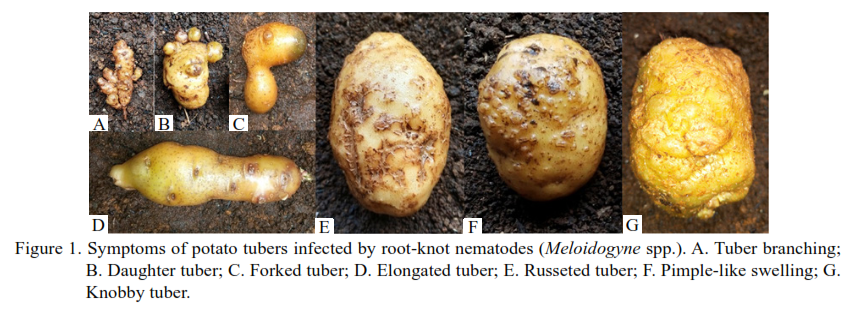
Root-knot nematodes (Meloidogyne spp.) are among the most destructive plant-parasitic nematodes affecting potato production worldwide. However, information on Meloidogyne spp. associated with potato tubers and their potential as potato tuber-borne nematodes (PTBN) in Indonesia remains limited. This study aimed to identify Meloidogyne species associated with potato tubers and determine their distribution in major potato-producing regions of Java, Indonesia. Surveys were conducted from January 2023 to December 2024 in West, Central, and East Java. Symptomatic potato tubers were collected and examined using morphological, morphometric, and molecular approaches. Tubers were stored under refrigerated conditions for 3–24 months to evaluate nematode persistence. Molecular identification was performed using species-specific SCAR markers, followed by phylogenetic and sequence homology analyses. Root-knot nematodes were detected in all surveyed production areas and were associated with characteristic symptoms, including knobby, branched, elongated, and russeted tubers. Two species were identified: Meloidogyne incognita, which was widely distributed throughout Java, and Meloidogyne javanica, which was detected only in Cikandang Village, Garut, West Java. The nucleotide sequences were deposited in GenBank under accession numbers LC894939–LC894951 (M. incognita) and LC894966 (M. javanica). Both species remained viable in potato tubers for up to 24 months, confirming their potential as PTBN. These findings provide a scientific basis for strengthening nematode-free seed certification and phytosanitary measures to reduce the spread of Meloidogyne spp. through seed tubers.
How to Cite
References
Abad P, Favery B, Rosso MN, & Castagnone-Sereno P. 2003. Root-knot nematode parasitism and host response: Molecular basis of a sophisticated interaction. Mol. Plant Pathol. 4(4): 217–224. https://doi.org/10.1046/j.1364-3703.2003.00170.x
Adam MAM, Phillips MS, & Blok VC. 2007. Molecular diagnostic key for identification of single juveniles of seven common and economically important species of root-knot nematode (Meloidogyne spp.). Plant Pathol. 56(1): 190–197. https://doi.org/10.1111/j.1365-3059.2006.01455.x
Aprilyani, Supramana, & Suastika G. 2015. Meloidogyne incognita penyebab umbi berbintil pada kentang di beberapa sentra produksi kentang di Jawa [Meloidogyne incognita causing pimple-like knot on potatoes in several Provinces in Java]. J. Fitopatol. Indones. 11(5): 143–149. https://doi.org/10.14692/jfi.11.5.143
Blok VC & Powers TO. 2009. Biochemical and molecular identification. In: Perry RN, Moens M, Starr JL (Eds.). Root-Knot Nematodes. pp. 98–118. CABI. Wallingford, UK. https://doi.org/10.1079/9781845934927.0098
Bridge J & Starr J. 2007. Collection, extraction, and preservation of nematodes for diagnosis. In: Bridge J & Starr J (Eds.). Plant Nematodes of Agricultural Importance. pp. 135–144. CRC Press. London. https://doi.org/10.1201/B15142-10
Carneiro RMDG, Souza CFB, Mattos VS, & Correia VR. 2024. Molecular techniques for root-knot nematode identification. In: Molinari S (Ed.). Plant-Nematode Interactions. Methods in Molecular Biology. Vol. 2756. pp. 227–245. Humana, New York. https://doi.org/10.1007/978-1-0716-3638-1_5
Castagnone-Sereno P, Danchin EGJ, Perfus-Barbeoch L, & Abad P. 2013. Diversity and evolution of root-knot nematodes, genus Meloidogyne: New insights from the genomic era. Annu. Rev. Phytopathol. 51(1): 203–220. https://doi.org/10.1146/annurev-phyto-082712-102300
Demi̇Rbaş Pehli̇ VH, Kaşkavalci G, Kasapoğlu Uludamar EB, Toktay H, & Elekcioğlu H. 2020. Identification and prevalence of potato cyst nematodes and root-knot nematodes in the potato production areas of İzmir Province, Turkey. Turk. Entomol. Derg. 44(2): 259–272. https://doi.org/10.16970/entoted.683173
Edgar RC. 2004. MUSCLE: Multiple sequence alignment with high accuracy and high throughput. Nucleic Acids Res. 32(5): 1792–1797. https://doi.org/10.1093/nar/gkh340
Eisenback JD, Hirschmann H, & Triantaphyllou AC. 1980. Morphological comparison of Meloidogyne female head structures, perineal patterns, and stylets. J. Nematol. 12(4): 300–313.
Eisenback JD & Triantaphyllou HH. 1991. Root-knot nematodes: Meloidogyne species and races. In: Nickle WR (Ed.). Manual of Agricultural Nematology. pp. 191–274. CRC Press. Boca Raton. https://doi.org/10.1201/9781003066576-6
Hamidi I, Supramana, Mutaqin, KH, & Kurniawati F. 2022. Spesies Meloidogyne penyebab umbi berbintil kentang pada tiga sentra produksi di Sumatra [Species Meloidogyne cause pimple-like swelling on potato tuber in three production centers in Sumatra]. Jurnal Fitopatologi Indonesia. 18(2): 66–74. https://doi.org/10.14692/jfi.18.2.66-74
Holterman M, van der Wurff A, van den Elsen S, van Megen H, Bongers T, Holovachov O, Bakker J, & Helder J. 2006. Phylum-wide analysis of SSU rDNA reveals deep phylogenetic relationships among nematodes and accelerated evolution toward crown clades. Mol. Biol. Evol. 23(9): 1792–1800. https://doi.org/10.1093/molbev/msl044
Hunt DJ & Handoo ZA. 2009. Taxonomy, identification and principal species. In: Perry RN, Moens M, & Starr JL (Eds.). Root-Knot Nematodes. pp. 55–97. CABI. Wallingford, UK. https://doi.org/10.1079/9781845934927.0055
Jones JT, Haegeman A, Danchin EGJ, Gaur HS, Helder J, Jones MGK, Kikuchi T, Manzanilla-López R, Palomares-Rius JE, Wesemael WML, & Perry RN. 2013. Top 10 plant-parasitic nematodes in molecular plant pathology. Mol. Plant Pathol. 14(9): 946–961. https://doi.org/10.1111/mpp.12057
Ju Y, Lin Y, Yang G, Wu H, & Pan Y. 2019. Development of recombinase polymerase amplification assay for rapid detection of Meloidogyne incognita, M. javanica, M. arenaria, and M. enterolobii. Eur. J. Plant Pathol. 155(4): 1155–1163. https://doi.org/10.1007/s10658-019-01844-6
Karssen G, Wesemael W, & Moens M. 2013. Root-knot nematodes. In: Perry RN & Moens M (Eds.). Plant Nematology. 2nd Edition. pp. 73–108. CABI. Wallingford, UK. https://doi.org/10.1079/9781780641515.0073
Kurniawan W. 2010. Identifikasi Penyakit Umbi Bercabang pada Wortel, Daucus carota (L.) di Indonesia [Identification of Forked Root Disease in Carrot, Daucus carota (L.), in Indonesia]. Thesis. Institut Pertanian Bogor. Bogor.
Marquez J & Hajihassani A. 2023. Identification and virulence of five isolates of root-knot nematode Meloidogyne floridensis on vegetables. Plant Dis. 107(5): 1522–1528. https://doi.org/10.1094/PDIS-06-22-1331-RE
Meng QP, Long H, & Xu JH. 2004. PCR assays for rapid and sensitive identification of three major root-knot nematodes, Meloidogyne incognita, M. javanica, and M. arenaria. Acta Phytopathol. Sin. 34: 204–210. https://eurekamag.com/research/004/260/004260581.php?srsltid=AfmBOooKm8vLk3jHc2_TCJMkyDbJom3uKJtA0nK_IXkTfaCoIiUnblz&__cf_chl_f_tk=KMocBPxQSdc.tyvjv_veOIIRWAbmUkPGI9fE6fPlDtw-1783438742-1.0.1.1-bz1brNTcugS6ZKZ7tdNosK3J08n4dmDYLOdQw4Sy3xw
Moens M, Perry RN, & Starr JL. 2009. Meloidogyne species - a diverse group of novel and important plant parasites. In: In: Perry RN, Moens M, & Starr JL (Eds.). Root-knot Nematodes. pp. 1–17. CABI. Wallingford, UK. https://doi.org/10.1079/9781845934927.0001
Muhire BM, Varsani A, & Martin DP. 2014. SDT: A virus classification tool based on pairwise sequence alignment and identity calculation. PLoS ONE. 9(9): e108277. https://doi.org/10.1371/journal.pone.0108277
Mutala’liah, Indarti S, & Wibowo A. 2019. Short Communication: The prevalence and species of root-knot nematode which infect on potato seed in Central Java, Indonesia. Biodiversitas. 20(1): 11–16. https://doi.org/10.13057/biodiv/d200102
Patel B, Patel D, Tapre PV, Singh NK, & Patel R. 2019. Integrated management of root-knot nematode (Meloidogyne incognita) in potato (Solanum tuberosum L.) cv. Lady Rosetta. Int. J. Bio-resource. Stress Manag. 10(5): 561.
Patel B, Patel DB, Tapre PV, Singh NK, & Patel R. 2020. Pathogenicity of root-knot nematode (Meloidogyne incognita) and determination threshold level in potato (Solanum tuberosum L.) crop cv. Lady Rosseta. Int. J. Bio-Resour. Stress Manag. 11(1): 103–107. https://indianjournals.com/article/ijbsm-11-1-016
Przybylska A & Obrępalska-Stęplowska A. 2020. Plant defense responses in monocotyledonous and dicotyledonous host plants during root-knot nematode infection. Plant Soil. 451: 239–260. https://doi.org/10.1007/s11104-020-04533-0
Scurrah MI, Niere B, & Bridge J 2005. Nematode parasites of solanum and sweet potatoes. In: Luc M, Sikora RA, & Bridge J (Eds.). Plant Parasitic Nematodes in Subtropical and Tropical Agriculture: Second Edition. pp. 193–219. CABI. Wallingford, UK. https://doi.org/10.1079/9780851997278.0193
Semblat JP, Bongiovanni M, Wajnberg E, Dalmasso A, Abad P, & Castagnone-sereno P. 2000. Virulence and molecular diversity of parthenogenetic root-knot nematodes, Meloidogyne spp. Heredity. 84(1): 81–89. https://doi.org/10.1046/j.1365-2540.2000.00633.x
Sikora RA, Coyne D, Hallmann J, & Timper P. 2018. Reflections and challenges: Nematology in subtropical and tropical agriculture. In: Sikora RA, Coyne D, Hallmann J, & Timper P (Eds.). Plant Parasitic Nematodes in Subtropical and Tropical Agriculture. 3rd Edition. pp. 1–19. CABI. Wallingford, UK. https://doi.org/10.1079/9781786391247.0001
Swibawa IG, Fitriana Y, Solikhin, Fiandani A, Suharjo R, Purnomo, Susilo FX. 2024. Effectiveness of bionematicide from Purpureocillium lilacinum in controlling root-knot nematodes (Meloidogyne spp.). J. Trop. Plant Pests Dis. 24(2): 181–189. https://doi.org/10.23960/jhptt.224181-189
Tamura K, Stecher G, & Kumar S. 2021. MEGA11: Molecular evolutionary genetics analysis version 11. Mol. Biol. Evol. 38(7): 3022–3027. https://doi.org/10.1093/molbev/msab120
Utami BS, Supramana S, & Giyanto G. 2017. Deteksi dan identifikasi spesies Meloidogyne penyebab umbi berbintil pada kentang asal Sulawesi Utara [Detection and identification of Meloidogyne species, pimple-like knot pathogen of potato tuber from North Sulawesi]. Jurnal Fitopatologi Indonesia. 13(3): 98–104. https://doi.org/10.14692/jfi.13.3.98
Wainer J & Dinh Q. 2021. Taxonomy, morphological and molecular identification of the potato cyst nematodes, Globodera pallida and G. rostochiensis. Plants. 10(1): 184. https://doi.org/10.3390/plants10010184
Yadav H, Roberts P A, & Lopez-Arredondo D. 2025. Combating root-knot nematodes (Meloidogyne spp.): From molecular mechanisms to resistant crops. Plants. 14(9): 1321. https://doi.org/10.3390/plants14091321
Zijlstra C, Donkers-Venne DTHM, & Fargette M. 2000. Identification of Meloidogyne incognita, M. javanica and M. arenaria using sequence characterised amplified region (SCAR) based PCR assays. Nematology. 2(8): 847–853. https://doi.org/10.1163/156854100750112798
License
Copyright (c) 2026 Wawan Kurniawan, Supramana, Giyanto, Abdul Munif

This work is licensed under a Creative Commons Attribution-NonCommercial 4.0 International License.
The copyright of each published article are with the Jurnal Hama dan Penyakit Tumbuhan Tropika : Journal of Tropical Plant Pests and Diseases. By submitting and publishing manuscript in Jurnal Hama dan Penyakit Tumbuhan Tropika: Journal of Tropical Plant Pests and Diseases, the author(s) grant the journal the right of first publication and the right to publish, reproduce, and disseminate the article in various formats, including print, online, and electronic media, with full acknowledgment of the author(s) as the copyright holder(s).
All articles published in Jurnal Hama dan Penyakit Tumbuhan Tropika: Journal of Tropical Plant Pests and Diseases are licensed under the Creative Commons Attribution–NonCommercial (CC BY-NC) license. Under this license, others are permitted to copy, distribute, display, and adapt the work for non-commercial purposes, provided that appropriate credit is given to the original author(s) and source. Any commercial use of the published material is prohibited without prior written consent from the author(s).
The journal reserves the right to archive, preserve, distribute, and provide access to published articles for academic, educational, and other non-commercial purposes in accordance with the terms and conditions of the CC BY-NC license.