
Fumigant activity of three aromatic essential oils against fruit fly Bactrocera carambolae
Abstract
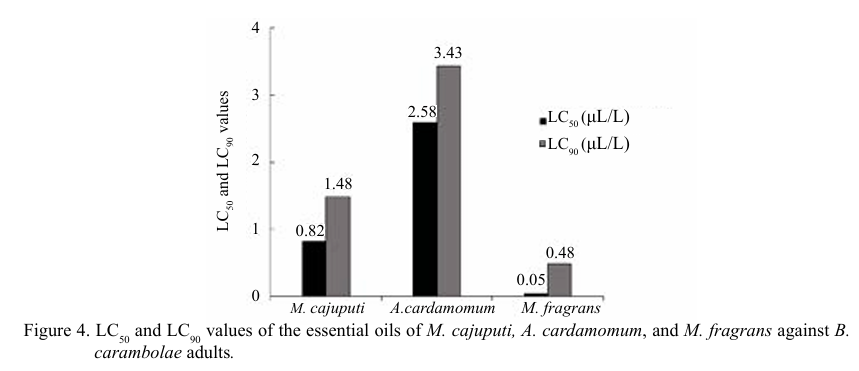
Essential oils have attracted considerable attention as environmentally friendly alternatives to synthetic insecticides because of their selective neurotoxicity, high volatility, and rapid biodegradability. This study investigated the chemical composition and fumigant toxicity of the essential oils of Melaleuca cajuputi, Amomum cardamomum, and Myristica fragrans against the fruit fly Bactrocera carambolae. The chemical constituents of each oil were characterized by gas chromatography–mass spectrometry (GC–MS), and their fumigant toxicity was evaluated by determining the median lethal concentration (LC50) and 90% lethal concentration (LC90). GC–MS analysis identified 27 compounds in M. cajuputi oil, with 1,8-cineole (34.88%), α-terpineol (10.52%), β-caryophyllene (10.44%), α-humulene (5.74%), and limonene (5.15%) as the major constituents. A. cardamomum oil contained 32 compounds and was dominated by 1,8-cineole (60.48%), followed by β-pinene (8.24%) and α-terpineol (5.35%). In contrast, M. fragrans oil contained 12 compounds, with sabinene (21.51%), α-pinene (17.34%), terpinen-4-ol (15.92%), β-pinene (15.10%), β-phellandrene (8.72%), and α-terpinene (5.95%) as the principal constituents. Among the three oils, M. fragrans exhibited the highest fumigant toxicity against B. carambolae, with LC50 and LC90 values of 0.05 and 0.48 μL/L, respectively, followed by M. cajuputi (LC50 = 0.82 μL/L; LC90 = 1.48 μL/L) and A. cardamomum (LC50 = 2.58 μL/L; LC90 = 3.43 μL/L). The superior fumigant toxicity of M. fragrans was associated with its characteristic mixture of monoterpene hydrocarbons and oxygenated monoterpenes, whereas the high proportion of 1,8-cineole in A. cardamomum alone did not result in greater toxicity. These findings demonstrate that M. fragrans essential oil is a promising botanical fumigant for the management of B. carambolae and highlight the importance of overall chemical composition rather than the abundance of a single constituent in determining fumigant efficacy.
How to Cite
References
Abdelgaleil SAM, Badawy MEI, Shawir MS, & Mohamed MIE. 2015. Chemical composition, fumigant and contact toxicities of essential oils isolated from Egyptian plants against the stored grain insects: Sitophilus oryzae L. and Tribolium castaneum (Herbst). Egypt. J. Biol. Pest Control. 25(3): 639–647.
Abdelgaleil SAM, Mohamed MIE, Badawy MEI, & El-arami SAA. 2009. Fumigant and contact toxicities of monoterpenes to Sitophilus oryzae (L.) and Tribolium castaneum (Herbst) and their inhibitory effects on acetylcholinesterase activity. J. Chem. Ecol. 35(5): 518–525. https://doi.org/10.1007/s10886-009-9635-3
Abdelgaleil SAM, Gad HA, Ramadan GRM, El-Bakry AM, & El-Sabrout AM. 2024. Monoterpenes: chemistry, insecticidal activity against stored product insects and modes of action—a review. Int. J. Pest Manag. 70(3): 267–289. https://doi.org/10.1080/09670874.2021.1982067
Alif T & Wahidah FF. 2021. Repellency of celery essential oils (Apium graveolens L.) against Spodoptera frugiperda (Lepidoptera: Noctuidae) in the laboratory. J. Trop. Plant Pests Dis. 21(2): 91–96. https://doi.org/10.23960/jhptt.22191-96
Al-Sarar AS, Hussein HI, Abobakr Y, Bayoumi AE, & Al-Otaibi MT. 2014. Fumigant toxicity and antiacetylcholinesterase activity of Saudi Mentha longifolia and Lavandula dentata species against Callosobruchus maculatus (F.) (Coleoptera: Bruchidae). Turk. Entomol. Derg. 38(1): 11–18. https://doi.org/10.16970/ted.10646
Chaudhari AK, Singh VK, Kedia A, Das S, & Dubey NK. 2021. Essential oils and their bioactive compounds as eco-friendly novel green pesticides for management of storage insect pests: prospects and retrospects. Environ. Sci. Pollut. Res. 28(15): 18918–18940. https://doi.org/10.1007/s11356-021-12841-w
Dey D & Gupta MK. 2016. Use of essential oils for insect pest management–A review. Innovative Farming. 1(2): 21–29.
Eliopoulos PA, Hassiotis CN, Andreadis SS, & Porichi AE. 2015. Fumigant toxicity of essential oils from basil and spearmint against two major pyralid pests of stored products. J. Econ. Entomol. 108(2): 805–810. https://doi.org/10.1093/jee/tov029
Farag SM, Moustafa MAM, Fónagy A, Kamel OMHM, & Abdel‑Haleem DR. 2024. Chemical composition of four essential oils and their adulticidal, repellence, and field oviposition deterrence activities against Culex pipiens L. (Diptera: Culicidae). Parasitol. Res. 123(1): 110. https://doi.org/10.1007/s00436-024-08118-z
Fateha RN, Grasela M, Ichwan MN, Purwanti EW, & Kurniasari I. 2020. Larvacidal and antifeedant activities of clove leaf oil against Spodoptera litura (F.) on soybean. J. Trop. Plant Pests Dis. 21(1): 20–25. https://doi.org/10.23960/jhptt.12120-25
Gaire S, Scharf ME, & Gondhalekar AD. 2020. Synergistic toxicity interactions between plant essential oil components against the common bed bug (Cimex lectularius L.). Insects. 11(2): 133. https://doi.org/10.3390/insects11020133
Hayouni A, Bouix M, Abedrabba M, Leveau JY, & Hamdi M. 2008. Mechanism of action of Melaleuca armillaris (Sol. Ex Gaertu) Sm. essential oil on six LAB strains as assessed by multiparametric flow cytometry and automated microtiter-based assay. Food Chem. 111(3): 707–718. https://doi.org/10.1016/j.foodchem.2008.04.044
Hossain MdS, Akter S, Hossain MdF, Rizvi SZ, Mendez V, Taylor P, & Park SJ. 2025. Essential oils as potential insecticides and behavior-modifying agents against Bactrocera tryoni (Diptera: Tephritidae). J. Insect Sci. 25(5): ieaf073. http://doi.org/10.1093/jisesa/ieaf073
Husain SS & Ali M. 2014. Analysis of volatile oil of the fruits of Elettaria cardamomum (L.) Maton and its antimicrobial activity. World J. Pharm. Pharm. Sci. 3(2): 1798–1808.
Jaffar S & Lu Y. 2022. Toxicity of some essential oils constituents against oriental fruit fly, Bactrocera dorsalis (Hendel) (Diptera: Tephritidae). Insects. 13(10): 954. https://doi.org/10.3390/insects13100954
Jankowska M, Rogalska J, Wyszkowska J, & Stankiewicz M. 2017. Molecular targets for components of essential oils in the insect nervous system—A review. Molecules. 23(1): 34. https://doi.org/10.3390/molecules23010034
Kasman, Ishak NI, Hastutiek P, Suprihati E, & Mallongi A. 2020. Identification of active compounds of ethanol extract of Citrus amblycarpa leaves by analysis of thin-layer chromatography and gas chromatography-mass spectrometry as bioinsecticide candidates for mosquitoes. J. Med. Sci. 8(T2): 1–6. https://doi.org/10.3889/oamjms.2020.5207
Khoa VV, Dai DN, Huong LT, & Thinh BB. 2024. Sesquiterpene hydrocarbon-rich essential oil from Teucrium viscidum blume and its antimicrobial and mosquito larvicidal activities. Nat. Prod. Commun. 19(11): 1–9. https://doi.org/10.1177/1934578X241299995
Koswanudin D, Basukriadi A, Samudra IM, & Ubaidillah R. 2018. Host preference fruit flies Bactrocera carambolae (Drew & Hancock) and Bactrocera dorsalis (Drew and Hancock) (Diptera: Tephritidae). Jurnal Entomologi Indonesia. 15(1): 40–49. https://doi.org/10.5994/jei.15.1.40
Kumar S, Mahapatro GK, Yadav DK, Tripathi K, Koli P, Kaushik P, Sharma K, & Nebapure S. 2022. Essential oils as green pesticides: An overview. Indian J. Agric. Sci. 92(11): 1298–1305. https://doi.org/10.56093/ijas.v92i11.122746
Langsi JD, Nukenine EN, Oumarou KM, Moktar H, Fokunang CN, & Mbata GN. 2020. Evaluation of the insecticidal activities of α-pinene and 3-carene on Sitophilus zeamais Motschulsky (Coleoptera: Curculionidae). Insects. 11(8): 540. https://doi.org/10.3390/insects11080540
Lee S, Peterson CJ, & Coats JR. 2003. Fumigation toxicity of monoterpenoids to several stored product insects and Blattella germanica. J. Stored Prod. Res. 39(1): 77–85. https://doi.org/10.1016/S0022-474X(02)00020-6
Liu J, Hua J, Qu B, Guo X, Wang Y, Shao M, & Luo S. 2021. Insecticidal terpenes from the essential oils of Artemisia nakaii and their inhibitory effects on acetylcholinesterase. Front. Plant Sci. 12: 720816. https://doi.org/10.3389/fpls.2021.720816
Marchioro CA. 2016. Global potential distribution of Bactrocera carambolae and the risks for fruit production in Brazil. PLoS One. 11(11): e0166142. https://doi.org/10.1371/journal.pone.0166142
Miyazawa M & Yamafuji C. 2005. Inhibition of acetylcholinesterase activity by bicyclic monoterpenoids. J. Agric. Food Chem. 53(5): 1765–1768. https://doi.org/10.1021/jf040019b
Nowak J, Woźniakiewicz M, Gładysz M, Sowa A, & Kościelniak P. 2016. Development of advanced extraction methods for the extraction of myristicin from Myristica fragrans. Food Anal. Methods. 9(5): 1246–1253. https://doi.org/10.1007/s12161-015-0300-x
Nyamador SW, Mondédji AD, Kasseney BD, Ketoh GK, Koumaglo HK, & Glitho IA. 2017. Insecticidal activity of four essential oils on the survival and oviposition of two sympatric bruchid species: Callosobruchus maculatus F. and Callosobruchus subinnotatus Pic. (Coleoptera: Chrysomelidae: Bruchinae). J. Stored Prod. Postharvest Res. 8(9): 103–112. https://doi.org/10.5897/JSPPR2017.0240
Oyarce GA, Loyola P, Iubini-Aravena M, Romero A, Rodriguez-Maciel JC, Becerra J, & Silva-Aguayo G. 2025. Adulticidal and repellent activity of essential oils from three cultivated aromatic plants against Musca domestica L. Insects. 16(5): 542. https://doi.org/10.3390/insects16050542
Padalia RC, Verma RS, Chauhan A, Goswami P, Verma SK, & Darokar MP. 2015. Chemical composition of Melaleuca linarrifolia Sm. from India: A potential source of 1,8-cineole. Ind. Crops Prod. 63: 264–268. https://doi.org/10.1016/j.indcrop.2014.09.039
Pal M, Srivastava M, Soni DK, Kumar A, & Tewari SK. 2011. Composition and anti-microbial activity of essential oil of Myristica fragrans from Andaman Nicobar Island. Int. J. Pharm. & Life Sci. 2(10): 1115–1117.
Paul A, Visakh NU, Pathrose B, Mori N, Baeshen RS, & Shawer R. 2024. Exploring the chemical characterization and insecticidal activities of Curcuma angustifolia roxb. leaf essential oils against three major stored product insects. Saudi J. Biol. Sci. 31(6): 103986. https://doi.org/10.1016/j.sjbs.2024.103986
Pavela R. 2015. Essential oils for the development of eco-friendly mosquito larvicides: A review. Ind. Crops Prod. 76: 174–187. https://doi.org/10.1016/j.indcrop.2015.06.050
Pujiarti R, Ohtani Y, & Ichiura H. 2011. Physicochemical properties and chemical compositions of Melaleuca leucadendron leaf oils taken from the plantations in Java, Indonesia. J. Wood Sci. 57(5): 446–451. https://doi.org/10.1007/s10086-011-1183-0
Pujiarti R, Ohtani Y, Ichiura H, & Nishimura Y. 2013. Insecticidal activity of Melaleuca leucadendron oil against greenhouse whitefly Trialeurodes vaporium. In: Suwinarti W, Sari NM, Kiswanto, Kusuma IW, Erwin, & Ismail (Eds.). Utilization of Renewable Natural Resources Towards Welfare and Environmental Sustainability. Proc. 5th Int. Symp. Indones. Wood Res. Soc. Indonesian Wood Research Society (IWoRS). pp. 65–70. Balikpapan.
Purnawan P, Hidayat Y, & Dono D. 2025. Controlling Bactrocera spp. fruit flies using several essential oils from clove, lemongrass, citronella grass and eucalyptus plants on chili plants (Capsicum annuum L.). Cropsaver J. Plant Prot. 8(1): 7–18. https://doi.org/10.24198/cropsaver.v8i1.62092
Rani PU. 2012. Fumigant and contact toxic potential of essential oils from plant extracts against stored product pests. J. Biopestic. 5(2): 120–128. https://doi.org/10.57182/jbiopestic.5.2.120-128
Rants’o TA, Koekemoer LL, Panayides JL, & van Zyl RL. 2022. Potential of essential oil-based anticholinesterase insecticides against Anopheles vectors: A review. Molecules. 27(20): 7026. https://doi.org/10.3390/molecules27207026
Said-Al AHAH, Hikal WM, & Tkachenko KG. 2017. Essential oils with potential as insecticidal agents: A review. Int. J. Environ. Plan. Manag. 3(4): 23–33.
Salem N, Bachrouch O, Sriti J, Msaada K, Khammassi S, Hammami M, Selmis S, Boushih E, Koorani S, Abderraba M, Marzouk B, Limam F, & Jemaa JMB. 2017. Fumigant and repellent potentials of Ricinus communis and Mentha pulegium essential oils against Tribolium castaneum and Lasioderma serricorne. Int. J. Food Prop. 20(sup3): S2899–S2913. https://doi.org/10.1080/10942912.2017.1382508
Seaforth CE. 1991. Natural Products in Caribbean Folk Medicine. University of the West Indies, Jamaica.
Setiawan Y, Hamdoen FM, Muhammad FN, Hata K, Tarno H, & Wang J. 2024. Species composition of Bactrocera fruit flies (Diptera: Tephritidae) and their parasitoids on horticultural commodities in Batu City and Malang District, East Java, Indonesia. Biodiversitas. 25(1): 305–311. https://doi.org/10.13057/biodiv/d250135
Siani AC, Nakamura MJ, Neves GPd, Monteiro SdS, & Ramos MFS. 2016. Leaf essential oil from three exotic mytaceae species growing in the botanical garden of Rio de Janeiro, Brazil. Am. J. Plant Sci. 7(6): 834–840. https://doi.org/10.4236/ajps.2016.76079
Sudiarta IP, Wijayanti FE, Temaja IGRM, Wirya GNAS, Sumiartha K, & Selangga DGW. 2020. Present status of fruit fly Bactrocera carambolae Drew & Hancock in Bali Island, Indonesia. Proceedings of the International Conference on Climate Change and Environmental Sustainability (ICCESI 2019). pp. 101–106. https://doi.org/10.2991/absr.k.200513.017
Tanoh EA, Boué GB, Nea F, Genva M, Wognin EL, Ledoux A, Martin H, Tonzibo ZF, Frederich M, & Fauconnier ML. 2020. Seasonal effect on the chemical composition, insecticidal properties and other biological activities of Zanthoxylum leprieurii Guill. & Perr. essential oils. Foods. 9(5): 550. https://doi.org/10.3390/foods9050550
Vargas RI, Piñero JC, & Leblanc L. 2015. An overview of pest species of Bactrocera fruit flies (Diptera: Tephritidae) and the integration of biopesticides with other biological approaches for their management with a focus on the pacific region. Insects. 6(2): 297–318. https://doi.org/10.3390/insects6020297
Wandjou JGN, Baldassarri C, Ferrati M, Maggi F, Pavela R, Tsabang N, Petrelli R, Ricciardi R, Desneux N, & Benelli G. 2022. Essential oils from Cameroonian aromatic plants as effective insecticides against mosquitoes, houseflies, and moths. Plants. 11(18): 2353. https://doi.org/10.3390/plants11182353
Wang DC, Sun SH, Shi LN, Qiu DR, Li X, Wei DS, Zhang YM, & Qin JC. 2015. Chemical composition, antibacterial, and antioxidant activity of the essential oils of Metaplexis japonica and their antibacterial components. Int. J. Food Sci. Tech. 50(2): 449–457. https://doi.org/10.1111/ijfs.12645
Warsito MF. 2021. A review on chemical composition, bioactivity, and toxicity of Myristica fragrans Houtt. essential oil. Indonesian. J. Pharm. 32(3): 304–313. https://doi.org/10.22146/ijp.1271
Widihastuty, Utami S, Munar A, Ardilla D, & Rangkuti K. 2023. Fruit fly Bactrocera spp. responses to odour of curry leaves, Murraya koenigii L. Spreng. Serangga. 28(2): 99–108.
Yakhlef G, Hambaba L, Pinto DCGA, & Silva AMS. 2020. Chemical composition and insecticidal, repellent and antifungal activities of essential oil of Mentha rotundifolia (L.) from Algeria. Ind. Crops Prod. 158(22): 112988. https://doi.org/10.1016/j.indcrop.2020.112988
License
Copyright (c) 2026 Rini Pujiarti, Ananto Triyogo, Suputa Suputa, Brandon Aristo Verick Purba

This work is licensed under a Creative Commons Attribution-NonCommercial 4.0 International License.
The copyright of each published article are with the Jurnal Hama dan Penyakit Tumbuhan Tropika : Journal of Tropical Plant Pests and Diseases. By submitting and publishing manuscript in Jurnal Hama dan Penyakit Tumbuhan Tropika: Journal of Tropical Plant Pests and Diseases, the author(s) grant the journal the right of first publication and the right to publish, reproduce, and disseminate the article in various formats, including print, online, and electronic media, with full acknowledgment of the author(s) as the copyright holder(s).
All articles published in Jurnal Hama dan Penyakit Tumbuhan Tropika: Journal of Tropical Plant Pests and Diseases are licensed under the Creative Commons Attribution–NonCommercial (CC BY-NC) license. Under this license, others are permitted to copy, distribute, display, and adapt the work for non-commercial purposes, provided that appropriate credit is given to the original author(s) and source. Any commercial use of the published material is prohibited without prior written consent from the author(s).
The journal reserves the right to archive, preserve, distribute, and provide access to published articles for academic, educational, and other non-commercial purposes in accordance with the terms and conditions of the CC BY-NC license.