
Induced expression and functional role of heat shock protein 70 in Pentalonia nigronervosa (PnHsp 70) during banana bunchy top virus (BBTV) transmission
Abstract
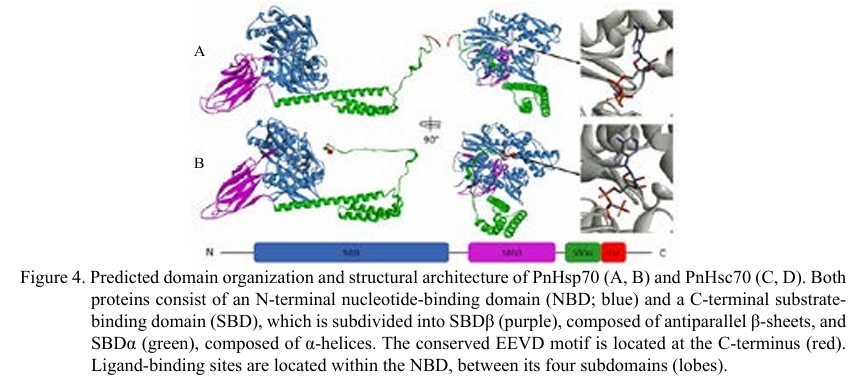
Heat shock protein 70 (Hsp70) plays a critical role in cellular stress responses and virus–vector interactions; however, its diversity and function in Pentalonia nigronervosa, the sole vector of banana bunchy top virus (BBTV), remain poorly understood. This study aimed to identify, characterize, and evaluate the expression of Hsp70/Hsc70 genes in P. nigronervosa during BBTV acquisition. RNA-seq datasets from viruliferous and non-viruliferous P. nigronervosa (SRX6918251–SRX6918252) were assembled and annotated, resulting in the identification of seven PnHsp70 and three PnHsc70 genes, which were deposited in GenBank (MW456681–MW456690). Molecular characterization included subcellular localization prediction, physicochemical analysis, structural modeling, and phylogenetic analysis. Differentially expressed gene (DEG) analysis was validated by quantitative real-time PCR (qRT-PCR) using plant access period (PAP) assays (0, 1, 5, 10, and 20 hours) on BBTV-infected banana plants. PnHsp70 showed high sequence similarity to Hsp70 proteins from aphids, particularly Myzus persicae and Acyrthosiphon pisum. Structural analyses revealed conserved Hsp70 domains and molecular features, whereas phylogenetic analysis grouped PnHsp70 with other hemipteran Hsp70 homologs. DEG analysis identified PnHsp1, PnHsp2, and PnHsc1 as BBTV-responsive genes. qRT-PCR demonstrated that PnHsp70 expression increased following BBTV acquisition, with peak induction at 1 hour and renewed upregulation at 20 hours PAP. These results suggest that BBTV acquisition induces PnHsp70 expression and support its potential involvement in BBTV–vector interactions. This study provides the first comprehensive characterization of Hsp70/Hsc70 genes in P. nigronervosa and offers new molecular insights into BBTV transmission.
How to Cite
References
Alam SB & Rochon DA. 2015. Cucumber necrosis virus recruits cellular heat shock protein 70 homologs at several stages of infection. J. Virol. 90(7): 3302–3317. https://doi.org/10.1128/JVI.02833-15
Anhalt MD & Almeida RPP. 2008. Effect of temperature, vector life stage, and plant access period on transmission of banana bunchy top virus to banana. Phytopathol. 98(6): 743–748. https://doi.org/10.1094/PHYTO-98-6-0743
Arimbawa IM, Wirya GNAS, & Sudiarta IP. 2022. First report of Banana bunchy top virus on heliconia (Heliconia spp.) in Bali, Indonesia. J. Trop. Plant Pests Dis. 22(1): 77–82. https://doi.org/10.23960/jhptt.12277-82
Arsi, Suparman, Pujiastuti Y, & Irsan C. 2025. Epidemiology of banana bunchy top disease in South Sumatra, Indonesia. J. Trop. Plant Pests Dis. 25(2): 298–308. https://doi.org/10.23960/jhptt.225298-308
Bukau B & Horwich AL. 1998. The Hsp70 and Hsp60 chaperone machines. Cell. 92(3): P351–366. https://doi.org/10.1016/S0092-8674(00)80928-9
Chang KY & Yang JR. 2013. Analysis and prediction of highly effective antiviral peptides based on random forests. PLoS One. 8(8): e70166. https://doi.org/10.1371/journal.pone.0070166
Folmer O, Black M, Hoeh W, Lutz R, & Vrijenhoek R. 1994. DNA primers for amplification of mitochondrial cytochrome c oxidase subunit I from diverse metazoan invertebrates. Mol. Mar. Biol. Biotechnol. 3(5): 294–299. https://pubmed.ncbi.nlm.nih.gov/7881515/
Gorovits R, Moshe A, Ghanim M, & Czosnek H. 2013. Recruitment of the host plant heat shock protein 70 by tomato yellow leaf curl virus coat protein is required for virus infection. PLoS One. 8(7): e70280. https://doi.org/10.1371/journal.pone.0070280
Götz M, Popovski S, Kollenberg M, Gorovits R, Brown JK, Cicero JM, Czosnek H, Winter S, & Ghanim M. 2012. Implication of Bemisia tabaci heat shock protein 70 in begomovirus-whitefly interactions. J. Virol. 86(24): 13241–13252. https://doi.org/10.1128/JVI.00880-12
Gumiero A, Conz C, Gesé GV, Zhang Y, Weyer FA, Lapouge K, Kappes J, von Plehwe U, Schermann G, Fitzke E, Wölfle T, Fischer T, Rospert S, & Sinning I. 2016. Interaction of the cotranslational Hsp70 Ssb with ribosomal proteins and rRNA depends on its lid domain. Nat. Commun. 7(1): 13563. https://doi.org/10.1038/ncomms13563
Gupta RS & Singh B. 1994. Phylogenetic analysis of 70 kD heat shock protein sequences suggests a chimeric origin for the eukaryotic cell nucleus. Curr. Biol. 4(12): 1104–1114. https://doi.org/10.1016/S0960-9822(00)00249-9
Guruprasad K, Reddy BVB, & Pandit MW. 1990. Correlation between stability of a protein and its dipeptide composition: a novel approach for predicting in vivo stability of a protein from its primary sequence. Protein Eng. Des. Sel. 4(2): 155–161. https://doi.org/10.1093/protein/4.2.155
Hall TA. 1999. BioEdit: A user-friendly biological sequence alignment editor and analysis program for Windows 95/98/NT. Nucl. Acids Symp. Ser. 41: 95–98. https://doi.org/10.14601/Phytopathol_Mediterr-14998u1.29
Hartl FU, Bracher A, & Hayer-Hartl M. 2011. Molecular chaperones in protein folding and proteostasis. Nature. 475(7356): 324–332. https://doi.org/10.1038/nature10317
Hu C, Yang J, Qi Z, Wu H, Wang B, Zou F, Mei H, Liu J, Wang W, & Liu Q. 2022. Heat shock proteins: Biological functions, pathological roles, and therapeutic opportunities. MedComm. 3(3): e161. https://doi.org/10.1002/mco2.161
Ikai A. 1980. Thermostability and aliphatic index of globular proteins. J. Biochem. 88(6): 1895–1898. https://doi.org/10.1093/oxfordjournals.jbchem.a133168
Jiang S, Lu Y, Li K, Lin L, Zheng H, Yan F, & Chen J. 2014. Heat shock protein 70 is necessary for rice stripe virus infection in plants. Mol. Plant Pathol. 15(9): 907–917. https://doi.org/10.1111/mpp.12153
Kampinga HH, Hageman J, Vos MJ, Kubota H, Tanguay RM, Bruford EA, Cheetham ME, Chen B, & Hightower LE. 2009. Guidelines for the nomenclature of the human heat shock proteins. Cell Stress Chap. 14(1): 105–111. https://doi.org/10.1007/s12192-008-0068-7
Kregel KC. 2002. Invited Review: Heat shock proteins: modifying factors in physiological stress responses and acquired thermotolerance. J. Appl. Physiol. 92(5): 2177–2186. https://doi.org/10.1152/japplphysiol.01267.2001
Kyte J & Doolittle RF. 1982. A simple method for displaying the hydropathic character of a protein. J. Mol. Biol. 157(1): 105–132. https://doi.org/10.1016/0022-2836(82)90515-0
Lang BJ, Guerrero ME, Prince TL, Okusha Y, Bonorino C, & Calderwood SK. 2021. The functions and regulation of heat shock proteins: Key orchestrators of proteostasis and the heat shock response. Arch. Toxicol. 95(6): 1943–1970. https://doi.org/10.1007/s00204-021-03070-8
Livak KJ & Schmittgen TD. 2001. Analysis of relative gene expression data using real-time quantitative PCR and the 2-ΔΔCT method. Methods. 25(4): 402–408. https://doi.org/10.1006/meth.2001.1262
Nakamoto H, Fujita K, Ohtaki A, Watanabe S, Narumi S, Maruyama T, Suenaga E, Misono TS, Kumar PKR, Goloubinoff P, & Yoshikawa H. 2014. Physical interaction between bacterial heat shock protein 90 and Hsp70 chaperones mediates their cooperative action to refold denatured proteins. J. Biol. Chem. 289(9): P6110–6119. https://doi.org/10.1074/jbc.M113.524801
Pusag JCA, Jahan SH, Lee KS, Lee S, & Lee KY. 2012. Upregulation of temperature susceptibility in Bemisia tabaci upon acquisition of tomato yellow leaf curl virus (TYLCV). J. Insect Physiol. 58(10): 1343–1348. https://doi.org/10.1016/j.jinsphys.2012.07.008
Qazi J. 2016. Banana bunchy top virus and the bunchy top disease. J. Gen. Plant Pathol. 82(1): 2–11. https://doi.org/10.1007/s10327-015-0637-0
Sarge KD, Murphy SP, & Morimoto RI. 1993. Activation of heat shock gene transcription by heat shock factor 1 involves oligomerization, acquisition of DNA-binding activity, and nuclear localization and can occur in the absence of stress. Mol. Cell. Biol. 13(3): 1392–1407. https://doi.org/10.1128/mcb.13.3.1392-1407.1993
Shu Y, Du Y, & Wang J. 2011. Molecular characterization and expression patterns of Spodoptera litura heat shock protein 70/90, and their response to zinc stress. Comp. Biochem. Physiol. Part A. Mol. Integ. Physiol. 158(1): 102–110. https://doi.org/10.1016/j.cbpa.2010.09.006
Stainton D, Kraberger S, Walters M, Wiltshire EJ, Rosario K, Halafihi M, Lolohea S, Katoa I, Faitua TH, Aholelei W, Taufa L, Thomas JE, Collings DA, Martin DP, & Varsani1 A. 2012. Evidence of inter-component recombination, intra-component recombination and reassortment in banana bunchy top virus. J. Gen. Virol. 93(5): 1103–1119. https://doi.org/10.1099/vir.0.040337-0
Subandiyah S, Rahayuniati RF, Hartono S, Somowiyarjo S, & Soffan A. 2020. RNA-seq data of banana bunchy top virus (BBTV) viruliferous and non-viruliferous banana aphid (Pentalonia nigronervosa). Data Br. 28: 104860. https://doi.org/10.1016/j.dib.2019.104860
Taguwa S, Maringer K, Li X, Bernal-Rubio D, Rauch JN, Gestwicki JE, Andino R, Fernandez-Sesma A, & Frydman J. 2015. Defining Hsp70 subnetworks in dengue virus replication reveals key vulnerability in flavivirus infection. Cell. 163(5): P1108–1123. https://doi.org/10.1016/j.cell.2015.10.046
Tamura K, Stecher G, Peterson D, Filipski A, & Kumar S. 2013. MEGA6: Molecular Evolutionary Genetics Analysis Version 6.0. Mol. Biol. Evol. 30(12): 2725–2729. https://doi.org/10.1093/molbev/mst197
Thompson JD, Gibson TJ, Plewniak F, Jeanmougin F, & Higgins DG. 1997. The CLUSTAL_X windows interface: Flexible strategies for multiple sequence alignment aided by quality analysis tools. Nucleic. Acids Res. 25(24): 4876–4882. https://doi.org/10.1093/nar/25.24.4876
Tower J. 2011. Heat shock proteins and Drosophila aging. Exp. Gerontol. 46(5): 355–362. https://doi.org/10.1016/j.exger.2010.09.002
Tran NT, Jakovlić I, & Wang WM. 2015. In silico characterisation, homology modelling and structure-based functional annotation of blunt snout bream (Megalobrama amblycephala) Hsp70 and Hsc70 proteins. J. Anim. Sci. Technol. 57(1): 44. https://doi.org/10.1186/s40781-015-0077-x
Vostakolaei MA, Hatami‐Baroogh L, Babaei G, Molavi O, Kordi S, & Abdolalizadeh J. 2021. Hsp70 in cancer: A double agent in the battle between survival and death. J. Cell. Physiol. 236(5): 3420–3444. https://doi.org/10.1002/jcp.30132
Wang XR, Wang C, Ban FX, Zhu DT, Liu SS, & Wang XW. 2019. Genome‐wide identification and characterization of HSP gene superfamily in whitefly (Bemisia tabaci) and expression profiling analysis under temperature stress. Insect Sci. 26(1): 44–57. https://doi.org/10.1111/1744-7917.12505
Weeks SA, Shield WP, Sahi C, Craig EA, Rospert S, & Miller DJ. 2010. A targeted analysis of cellular chaperones reveals contrasting roles for heat shock protein 70 in flock house virus RNA replication. J. Virol. 84(1): 330–339. https://doi.org/10.1128/jvi.01808-09
Whitley D, Goldberg SP, & Jordan WD. 1999. Heat shock proteins: A review of the molecular chaperones. J. Vasc. Surg. 29(4): 748–751. https://doi.org/10.1016/S0741-5214(99)70329-0
Wiedemann C, Kumar A, Lang A, & Ohlenschläger O. 2020. Cysteines and disulfide bonds as structure-forming units: Insights from different domains of life and the potential for characterization by NMR. Front. Chem. 8: 280. https://doi.org/10.3389/fchem.2020.00280
Yang J & Zhang Y. 2015. I-TASSER server: New development for protein structure and function predictions. Nucleic Acids Res. 43(W1): W174–W181. https://doi.org/10.1093/nar/gkv342
Zhu X, Zhao X, Burkholder WF, Gragerov A, Ogata CM, Gottesman ME, & Hendrickson WA. 1996. Structural analysis of substrate binding by the molecular chaperone DnaK. Science. 272(5268): 1606–1614. https://doi.org/10.1126/science.272.5268.1606
License
Copyright (c) 2026 Indah Nuraini, Siti Subandiyah, Alan Soffan

This work is licensed under a Creative Commons Attribution-NonCommercial 4.0 International License.
The copyright of each published article are with the Jurnal Hama dan Penyakit Tumbuhan Tropika : Journal of Tropical Plant Pests and Diseases. By submitting and publishing manuscript in Jurnal Hama dan Penyakit Tumbuhan Tropika: Journal of Tropical Plant Pests and Diseases, the author(s) grant the journal the right of first publication and the right to publish, reproduce, and disseminate the article in various formats, including print, online, and electronic media, with full acknowledgment of the author(s) as the copyright holder(s).
All articles published in Jurnal Hama dan Penyakit Tumbuhan Tropika: Journal of Tropical Plant Pests and Diseases are licensed under the Creative Commons Attribution–NonCommercial (CC BY-NC) license. Under this license, others are permitted to copy, distribute, display, and adapt the work for non-commercial purposes, provided that appropriate credit is given to the original author(s) and source. Any commercial use of the published material is prohibited without prior written consent from the author(s).
The journal reserves the right to archive, preserve, distribute, and provide access to published articles for academic, educational, and other non-commercial purposes in accordance with the terms and conditions of the CC BY-NC license.