
Antiviral protein genetic markers physiologically induced in cucumber by beneficial microbes against cucumber mosaic virus
Abstract
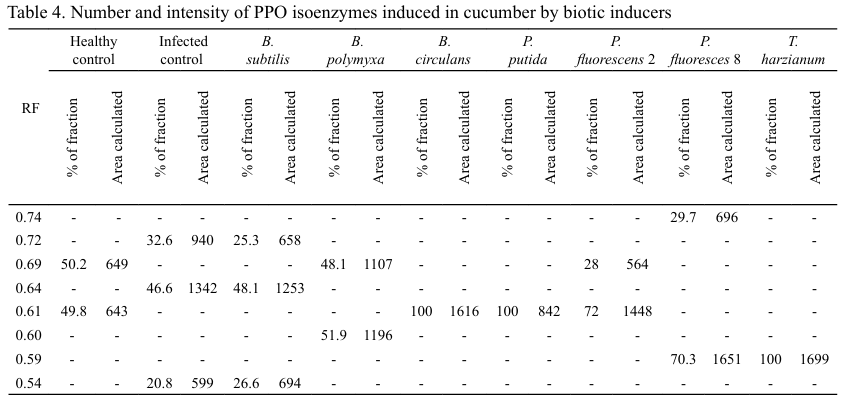
Plant antiviral-induced protein markers provide important indicators of the effectiveness of plant defense responses against viral infection, supporting early detection, disease monitoring, and evaluation of antiviral strategies. In this study, various microbial biotic inducers were applied to cucumber plants to evaluate their ability to trigger systemic resistance against cucumber mosaic virus (CMV-EG). Biochemical and protein-profiling analyses were subsequently performed to quantify the induction of antiviral proteins and the activities of defense-related enzymes. In addition, bioinformatic, spectroscopic, and electrophoretic approaches were employed to characterize antiviral-induced proteins in cucumber plants treated with beneficial microbial isolates under CMV-EG infection. Among the tested treatments, Bacillus circulans produced the highest protein content, whereas B. subtilis resulted in the lowest protein accumulation relative to the healthy untreated control. SDS-PAGE analysis revealed a total of 45 newly induced antiviral protein markers across all microbial treatments, with molecular weights ranging from approximately 13 to 117 kDa and varying in number among the bacterial and fungal inducers. Peroxidase (POD) and polyphenol oxidase (PPO) activities also varied among the tested microbes, with several bacterial and fungal isolates markedly enhancing these defense-related enzymes. Furthermore, all treatments generated distinct POD and PPO isoenzyme patterns, collectively producing a wide range of newly induced antiviral protein markers that confirmed the strong elicitation potential of these biotic agents. Overall, the applied microbial isolates effectively activated antiviral defense responses in cucumber plants, inducing diverse proteins and enzyme markers that highlight their strong potential as biological resistance inducers against CMV-EG.
How to Cite
References
Abdel Razek FS, Ibrahim SD, Megahed AA, Sadik AS, & El-Masry SSA. 2025. In Silico molecular docking analysis of green tea bioactive compounds targeting Banana bunchy top virus proteins. Discov. Appl. Sci. 7(11): 1232. https://doi.org/10.1007/s42452-025-07466-4
Abdel-Kader MM, El-Mougy NS, Masoud HMM, Helmy MS, & Megahed AA. 2024. The impact of certain growth regulators and Trichoderma harzianum on the incidence of root rot and biochemical activity in Phaseolus vulgaris L. Arch. Phytopathol. Pflanzenschutz. 57(8): 569–587. https://doi.org/10.1080/03235408.2024.2377335
Abdelkhalek A, Al-Askar AA, Elbeaino T, Moawad H, & El-Gendi H. 2022. Protective and curative activities of Paenibacillus polymyxa against zucchini yellow mosaic virus infestation in squash plants. Biology. 11(8): 1150. https://doi.org/10.3390/biology11081150
Abo Saif AM, Ahmed AI, Sadik AS, Megahed AA, & Ali SK. 2026. Integrated in silico and in vitro evaluation of the antiviral potential of Hibiscus sabdariffa ethanolic extract against tobacco mosaic virus. Nov. Res. Microbiol. J. 10(3): 286–310. https://dx.doi.org/10.17582/journal.nrmj/2026/10.3.286.310
Abo-Zaid AH, Ali MK, Sadik AS, & Megahed AA. 2025. Conserved epitope mapping of potato virus Y for broad-spectrum antigen design: Implications for plant immune. Nov. Res. Microbiol. J. 9(4): 332–348. https://doi.org/10.17582/journal.NRMJ/2025/9.4.332.348
Ajayi AO, Odeyemi AT, Akinjogunla OJ, Adeyeye AB, & Ayo-ajayi I. 2024. Review of antibiotic-resistant bacteria and antibiotic resistance genes within the one health framework. Infect. Ecol. Epidemiol. 14(1): 2312953. https://doi.org/10.1080/20008686.2024.2312953
Akin HM, Nurdin M, Simamora PB, & Sitorus M. 2012. Efektivitas satelit RNA yang berasosiasi dengan cucumber mosaic virus (CARNA-5) untuk mengendalikan penyakit virus pada tanaman tomat [Effectivity of cucumber mosaic virus associated satellite RNA to control viral disease on tomato plants]. J. Trop. Plant Pests Dis. 12(2): 177–184. https://doi.org/10.23960/j.hptt.212177-184
Al-Zahrani HSM, Elbeshehy EKF, Aldhebiani AY, & Elbeaino T. 2017. Effect of cucumber mosaic virus (CMV) infection on antineoplastic alkaloids from periwinkle (Catharanthus roseus L.) cultured in the Mecca region and resistance induction by plant-growth-promoting rhizobacteria (PGPR). Biotechnol. Biotechnol. Equip. 32(1): 49–57. https://doi.org/10.1080/13102818.2017.1395298
Ali S, Ganai BA, Kamili AN, Bhat AA, Mir ZA, Bhat JA, Tyagi A, Islam ST, Mushtaq M, Yadav P, Rawat S, & Grover A. 2018. Pathogenesis-related proteins and peptides as promising tools for engineering plants with multiple stress tolerance. Microbiol. Res. 212: 29–37. https://doi.org/10.1016/j.micres.2018.04.008
Anikina I, Kamarova A, Issayeva K, Issakhanova S, Mustafayeva N, Insebayeva M, Mukhamedzhanova A, Khan SM, Ahmad Z, Lho LH, Han H, & Raposo A. 2023. Plant protection from virus: A review of different approaches. Front Plant Sci. (14): 1–12. https://doi.org/10.3389/fpls.2023.1163270
Anisimova OK, Shchennikova AV, Kochieva EZ, & Filyushin MA. 2021. Pathogenesis-related genes of PR1, PR2, PR4, and PR5 families are involved in the response to Fusarium infection in Garlic (Allium sativum L.). Int. J. Mol. Sci. 22(13): 6688. https://doi.org/10.3390/ijms22136688
Arafa SM, Ghoneem KhM, Megahed AA, & Shabana YM. 2026. Impact of Trichoderma-Based bioformulations on growth, physiology, and disease mitigation in sorghum. J Plant Protect Pathol. 17(4): 95-103. https://doi.org/10.21608/jppp.2026.485109.1422
Ashwathappa KV, Krishna Reddy M, Venkataravanappa V, Madhavi Reddy K, Hemachandra Reddy P, & Reddy CNL. 2021. Genome characterization and host range studies of cucumber mosaic virus belonging to the Subgroup IB infecting chilli in India and screening of chilli genotypes for identification of resistance. VirusDis. 32(3): 535–547. https://doi.org/10.1007/s13337-021-00713-3
Beal J, Farny NG, Haddock-Angelli T, Selvarajah V, Baldwin GS, Buckley-Taylor R, Gershater M, Kiga D, Marken J, Sanchania V, Sison A, Workman CT, & iGEM Interlab Study Contributors. 2020. Robust estimation of bacterial cell count from optical density. Commun. Biol. 3(1): 512. https://doi.org/10.1038/s42003-020-01127-5
Begović L, Lepeduš H, Lalić A, Štolfa I, Jurković Z, Kovačević J, & Cesar V. 2017. Involvement of peroxidases in structural changes of barley stem. Bragantia. 76(3): 352–359. http://dx.doi.org/10.1590/1678-4499.155
Carfora A, Lucibelli F, Di Lillo P, Mazzucchiello SM, Saccone G, Salvemini M, Varone M, Volpe G, & Aceto S. 2025. Genetic responses of plants to urban environmental challenges. Planta. 261(5): 1–21. https://doi.org/10.1007/s00425-025-04678-1
de Andrade LA, Santos CHB, Frezarin ET, Sales LR, & Rigobelo EC. 2023. Plant growth-promoting rhizobacteria for sustainable agricultural production. Microorganisms. 11(4): 1088. https://doi.org/10.3390/microorganisms11041088
dos Santos C & Franco OL. 2023. Pathogenesis-related proteins (PRs) with enzyme activity activating plant defense responses. Plants. 12(11): 2226. https://doi.org/10.3390/plants12112226
El-Dougdoug KhA, Megahed AA, Othman BA, Lashin SM, Ibrahim MA, & Attitalla IH. 2013. Induction of salicylic acid in cucumber plants against cucumber mosaic cucumovirus using biotic inducers. Am. J. Biochem. Mol. Biol. 3(2): 248–255. http://doi.org/10.3923/ajbmb.2013.248.255
El-Mougy NS, Abdel-Kader MM, Lashin SM, & Megahed AA. 2013. Fungicides alternatives as plant resistance inducers against foliar diseases incidence of some vegetables grown under plastic houses conditions. IJEIT. 3(6): 71–81.
El-Sherif AG, Gad SB, Megahed AA, & Sergany MI. 2019. Induction of tomato plants resistance to Meloidogyne incognita infection by mineral and nano-fertilizer. J. Entomol. Nematol. 11(2): 21–26. https://doi.org/10.5897/JEN2018.0224
Elhalag KM, Al-Anany MS, & Megahed AA. 2025. Efficacy of plant extracts and bio-fertilizers for the control of bacterial wilt and soft rot agents in potato. J. Plant Pathol. 107(2):897–917. https://doi.org/10.1007/s42161-024-01825-7
Elshaer NA, El-Masry SS, Rabiee MS, Sadik AS, & Megahed AA .2025. In silico prediction of the potential of some bioactive compounds from licorice to target banana bunchy top virus. Egypt. J. Phytopathol. 53(1): 194–224. https://doi.org/10.21608/ejp.2025.436169
Elsharkawy MM, Elsawy MM, & Ismail IA. 2022. Mechanism of resistance to cucumber mosaic virus elicited by inoculation with Bacillus subtilis subsp. subtilis. Pest Manag. Sci. 78(1): 86–94. https://doi.org/10.1002/ps.6610
Escalante C, Sanz-Saez A, Jacobson A, Otulak-Kozieł K, Kozieł E, Balkcom KS, Zhao C, & Conner K. 2024. Plant virus transmission during seed development and implications to plant defense system. Front. Plant Sci. 15:1385456. https://doi.org/10.3389/fpls.2024.1385456
Goel N & Paul PK. 2015. Polyphenol oxidase and lysozyme mediate induction of systemic resistance in tomato, when a bioelicitor is used. J. Plant Prot. Res. 55(4): 344–350. https://doi.org/10.1515/jppr-2015-0045
Hamden S, Hanbal SE, El-Kot GA, Elmahalawy SS, & Megahed AA. 2026. Eco-friendly strategies for controlling Fusarium ear rot and mycotoxins in maize: A multi-year field and greenhouse study. J Plant Pathol. 108(2): 1235–1253. https://doi.org/10.1007/s42161-026-02167-2
Han Z & Schneiter R. 2024. Dual functionality of pathogenesis-related proteins: Defensive role in plants versus immunosuppressive role in pathogens. Front. Plant Sci. 15: 1368467. https://doi.org/10.3389/fpls.2024.1368467
Imran M, Abo-Elyousr KAM, Mousa MAA, & Saad MM. 2023. Use of Trichoderma culture filtrates as a sustainable approach to mitigate early blight disease of tomato and their influence on plant biomarkers and antioxidants production. Front Plant Sci. 14: 1192818. https://doi.org/10.3389/fpls.2023.1192818
Jakubowska Z, Gradowski M, & Dobrzyński J. 2025. Role of plant growth-promoting bacteria (PGPB) in enhancing phenolic compounds biosynthesis and its relevance to abiotic stress tolerance in plants: a review. Antonie van Leeuwenhoek. 118(9): 123. https://doi.org/10.1007/s10482-025-02130-8
Joshi A, Virdi AS, Kaur R, Kumar A, & Singh N. 2025. Deciphering food proteins: The applications of SDS-PAGE in food science. Food Biosci. 66: 106126. https://doi.org/10.1016/j.fbio.2025.106126
Jouili H, Bouazizi H, & El-Ferjani E. 2011. Plant peroxidases: Biomarkers of metallic stress. Acta Physiol. Plant. 33(6): 2075–2082. https://doi.org/10.1007/s11738-011-0780-2
Jung J, Ahn S, Kim DH, & Riu M. 2024. Triple interactions for induced systemic resistance in plants. Front. Plant Sci. 15: 1–8. https://doi.org/10.3389/fpls.2024.1464710
Kessler A & Mueller MB. 2024. Induced resistance to herbivory and the intelligent plant. Plant Signal. Behav. 19(1): e2345985.2– e2345985.12. https://doi.org/10.1080/15592324.2024.2345985
Listihani, Pandawani NP, Damayanti TA, Sutrawati M, Selangga DGW, Yuliadhi KA, Phabiola TA, & Wirya GNAS. 2022. Distribution and molecular characterization of Squash mosaic virus on cucumber in Gianyar, Bali. J. Trop. Plant Pests Dis. 22(1): 48–54. https://doi.org/10.23960/jhptt.12248-54
Mahfut, Sari M, Akin HM, Wahyuningsih S, & Irawan B. 2025. Molecular characterization and effectiveness cross-protection of weak strains against super-infection malignant strains cucumber mosaic virus (CMV) on cayenne pepper (Capsicum annuum L.) in Lampung, Indonesia. J. Trop. Plant Pests Dis. 25(1): 63–75. https://doi.org/10.23960/jhptt.12563-75
Masoud HMM, Abdel-Monsef MM, Helmy MS, Esa SS, & Darwish DA. 2025. Isolation and characterization of peroxidase from potato leaves Solanum tuberosum: Application in glucose diagnostic kit. J. Genet. Eng. Biotechnol. 23(4): 100584. https://doi.org/10.1016/j.jgeb.2025.100584
Masoud HMM, Megahed AA, Helmy MSE, Ibrahim MAA, El-Mougy NS, & Abdel-Kader MM. 2023. Phytopathological and biochemical impacts of Trichoderma harzianum and certain plant resistance inducers on faba bean root rot disease. Egypt. J. Biol. Pest Control. 33(1): 63–81. https://doi.org/10.1186/s41938-023-00709-9
Mazuecos-Aguilera I, Anta-Fernández F, Crespo-Barreiro A, Martínez-Quesada A, Lombana-Larrea L, & González-Andrés F. 2025. Plant growth-promoting rhizobacteria enhanced induced systemic resistance of tomato against Botrytis cinerea phytopathogen. Front Plant Sci. 16: 1570986. https://doi.org/10.3389/fpls.2025.1570986
Meena M, Swapnil P, Divyanshu K, Kumar S, Harish, Tripathi YN, Zehra A, Marwal A, & Upadhyay RS 2020. PGPR-mediated induction of systemic resistance and physiochemical alterations in plants against the pathogens: Current perspectives. J. Basic Microbiol. 60(10): 828–861. https://doi.org/10.1002/jobm.202000370
Megahed AA, Barakat A, Embaby AA, Mohamed SH, Sadik AS, & Elshaer NA. 2025. Antiviral activity of turmeric (Curcuma longa) against potato virus Y: In silico molecular docking anlysis. Beni-Suef Univ. J. Bas. Appl. Sci. 14(97): 1–24. https://doi.org/10.1186/s43088-025-00686-y
Megahed AA, El-Dougdoug K, & Othman BA. 2015. Symptomatology and serologicall survey of viruses infecting sugar beet cultivation in Egypt. J. Virol. 12(2): 79–92.
Megahed AA, El-Dougdoug K, Othman BA, Lashin SM, Hassanin MD, Ibrahim MA, & Sofy AR. 2014. Molecular identification and analysis of coat protein gene of cucucmber mosaic cucumovirus sugar beet Egyptian isolate. Inter. J. Plant Pathol. 5(3): 70–83. https://doi.org/10.3923/ijpp.2014.70.83
Megahed AA, El-Dougdoug K, Othman BA, Lashin SM, Ibrahim MA, & Sofy AR. 2012. A new Egyptian satellite strain of cucumber Mosaic Cucumovirus. Inter. J. Virol. 8(3): 240–257. https://doi.org/10.3923/ijv.2012.240.257
Megahed AA, El-Dougdoug K, Othman BA, Lashin SM, Ibrahim MA, & Sofy AR. 2013a. Induction of resistance in tomato plants against tomato mosaic tobamovirus using beneficial microbial isolates. Pak. J. Biol. Sci. 16(8): 385–390. https://doi.org/10.3923/pjbs.2013.385.390
Megahed AA, El-Dougdoug NK, Bondok AM, & Masoud HMM. 2019. Monitoring of co-infection virus and virus-like naturally in sweet pepper plant. Arch. Phytopathol. Pflanzenschutz. 52(3–4): 333–355. https://doi.org/10.1080/03235408.2019.1620512
Megahed AA, Lashin SM, El-Dougdoug K, Othman BA, & Ibrahim MA. 2013b. Potential of biotic inducers on disease severity and variation of cucumber mosaic cucumovirus in cucumber plants. Arch. Phytopathol. Pflanzenschutz. 46(2): 193–200. http://dx.doi.org/10.1080/03235408.2012.736280
Megahed AA, Masoud HMM, Helmy MS, Ibrahim MA, El-Mougy NS, & Abdel-Kader MM. 2023. Efficiency of some abiotic and biotic agents on Vicia faba L. rust and chocolate spot diseases. Plant Protect. 7(3): 449–463. https://doi.org/10.33804/pp.007.03.4798
Nasr-Eldin M, Messiha N, Othman B, Megahed A, & Elhalag K. 2019. Induction of potato systemic resistance against the potato virus Y (PVYNTN), using crude filtrates of Streptomyces spp. under greenhouse conditions. Egypt. J. Biol. Pest Control. 29(1): 62. https://doi.org/10.1186/s41938-019-0165-1
Neupane S & Baysal-Gurel F. 2022. Comparative performance of fungicides biofungicides host-plant defense inducers, and fertilizer in management of Phytophthora root rot on boxwood. Hortsci. 57(8): 864–871. https://doi.org/10.21273/HORTSCI16546-22
Nilmat A, Thepbandit W, Chuaboon W, & Athinuwat D. 2023. Pseudomonas fluorescens SP007S formulations in controlling soft rot disease and promoting growth in Kale. Agronomy. 13(7): 1856. https://doi.org/10.3390/agronomy13071856
Oliveira M, Antunes W, Mota S, Madureira-Carvalho Á, Dinis-Oliveira RJ, & Dias da Silva D. 2024. An overview of the recent advances in antimicrobial resistance. Microorganisms. 12(9): 1920. https://doi.org/10.3390/microorganisms12091920
Pieterse CMJ, Zamioudis C, Berendsen RL, Weller DM, Van Wees SCM, & Bakker PAHM. 2014. Induced systemic resistance by beneficial microbes. Annu. Rev. Phytopathol. 52(1): 347–375. https://doi.org/10.1146/annurev-phyto-082712-102340
Poveda J, Abril-Urias P, & Escobar C. 2020. Biological control of plant-parasitic nematodes by filamentous fungi inducers of resistance: Trichoderma, mycorrhizal and endophytic fungi. Front. Microbiol. 11: 992. https://doi.org/10.3389/fmicb.2020.00992
Rabilloud T. 2013. Silver in protein detection methods in proteomics research. In: Kretsinger RH, Uversky VN, & Permyakov EA. (eds) Encyclopedia of metalloproteins. Springer, New York, NY. https://doi.org/10.1007/978-1-4614-1533-6_571
Sabnam N, Hussain A, & Saha P. 2023. The secret password: Cell death-inducing proteins in filamentous phytopathogen s- As versatile tools to develop disease-resistant crops. Microb. Pathog. 183: 106276. https://doi.org/10.1016/j.micpath.2023.106276
Septariani DN, Hidayat SH, & Nurhayati E. 2014. Identifikasi penyebab penyakit daun keriting kuning pada tanaman mentimun [Identification of the causes of yellow leaf curl disease in cucumber plants]. J. Trop. Plant Pests Dis. 14(1): 80–86. https://doi.org/10.23960/j.hptt.11480-86
Serrão CP, Ortega JCG, Rodrigues PC, & de Souza CRB. 2024. Bacillus species as tools for biocontrol of plant diseases: A meta-analysis of twenty-two years of research, 2000-2021. World J. Microbiol. Biotechnol. 40(4): 110. https://doi.org/10.1007/s11274-024-03935-x
Shoresh M, Harman GE, & Mastouri F. 2010. Induced systemic resistance and plant responses to fungal biocontrol agents. Annu. Rev. Phytopathol. 48(1): 21–43. https://doi.org/10.1146/annurev-phyto-073009-114450
Twala PP, Mitema A, Baburam C, & Feto NA. 2020. Breakthroughs in the discovery and use of different peroxidase isoforms of microbial origin. AIMS Microbiol. 6(3): 330–349. https://doi.org/10.3934/microbiol.2020020
Vaghela P, Das AK, Trived, K, Anand KV, Shinde P, & Ghosh A. 2022. Characterization and metabolomics profiling of Kappaphycus alvarezii seaweed extract. Algal Res. 66: 102774. https://doi.org/10.1016/j.algal.2022.102774
Wilson SK, Pretorius T, & Naidoo S. 2023. Mechanisms of systemic resistance to pathogen infection in plants and their potential application in forestry. BMC Plant Biol. 23(1): 404. https://doi.org/10.1186/s12870-023-04391-9
Yao X, Guo H, Zhang K, Zhao M, Ruan J, & Chen J. 2023. Trichoderma and its role in biological control of plant fungal and nematode disease. Front. Microbiol. 14: 1160551. https://doi.org/10.3389/fmicb.2023.1160551
Zagoskina NV, Zubova MY, Nechaeva TL, Kazantseva VV, Goncharuk EA, Katanskaya VM, Baranova EN, & Aksenova MA. 2023. Polyphenols in plants: Structure, biosynthesis, abiotic stress regulation, and practical applications. Int. J. Mol. Sci. 24(18): 13874. https://doi.org/10.3390/ijms241813874
Zhang S. 2023. Recent advances of polyphenol oxidases in plants. Molecules. 28(5): 2158. https://doi.org/10.3390/molecules28052158
Zhu Y & Gao F. 2025. Involvement of pathogenesis-related proteins and their roles in abiotic stress responses in plants. Biomolecules. 15(8):1103. https://doi.org/10.3390/biom15081103
License
Copyright (c) 2026 Allam A. Megahed, Badawy A. Othman, Hassan M.M. Masoud, Mohamed S. Helmy, Khaled A. El-Dougdoug

This work is licensed under a Creative Commons Attribution-NonCommercial 4.0 International License.
The copyright of each published article are with the Jurnal Hama dan Penyakit Tumbuhan Tropika : Journal of Tropical Plant Pests and Diseases. By submitting and publishing manuscript in Jurnal Hama dan Penyakit Tumbuhan Tropika: Journal of Tropical Plant Pests and Diseases, the author(s) grant the journal the right of first publication and the right to publish, reproduce, and disseminate the article in various formats, including print, online, and electronic media, with full acknowledgment of the author(s) as the copyright holder(s).
All articles published in Jurnal Hama dan Penyakit Tumbuhan Tropika: Journal of Tropical Plant Pests and Diseases are licensed under the Creative Commons Attribution–NonCommercial (CC BY-NC) license. Under this license, others are permitted to copy, distribute, display, and adapt the work for non-commercial purposes, provided that appropriate credit is given to the original author(s) and source. Any commercial use of the published material is prohibited without prior written consent from the author(s).
The journal reserves the right to archive, preserve, distribute, and provide access to published articles for academic, educational, and other non-commercial purposes in accordance with the terms and conditions of the CC BY-NC license.