
Termite symbiont bacteria as biological agents against anthrachnose of bird’s eye chilli caused by Colletotrichum sp.
Abstract
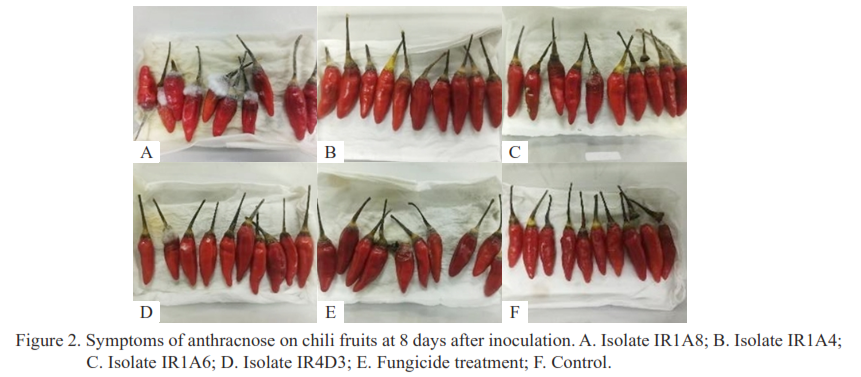
Symbiotic bacteria associated with termites are a largely unexplored resource with potential for use as biological control agents. This study investigates their effectiveness in managing anthracnose disease caused by Colletotrichum sp. in bird’s eye chili, a disease known to impact crop productivity and yield. Despite its prevalence, farmers often rely on chemical pesticides, which pose environmental risks. The research was carried out over four months at the Plant Protection Laboratory, Bioscience Laboratory, and Innovation Garden of Politeknik Negeri Jember. The experimental procedures included bacterial isolation, preliminary antagonistic screening, hypersensitivity testing, in vitro assays against Colletotrichum sp., in vivo efficacy testing for disease suppression, and molecular identification. Four bacterial isolates—IR1A4, IR1A6, IR1A8, and IR4D3—demonstrated inhibitory effects against the pathogen. In vitro inhibition rates ranged from 22.52% to 80.47%, while in vivo suppression ranged from 7.89% to 18.42%. The IR1A6 isolate, closely related to Bacillus amyloliquefaciens, was the most effective in reducing pathogen growth. These findings highlight the potential of termite-derived bacteria as novel sources of biocontrol agents capable of suppressing fungal pathogens across diverse ecosystems.
How to Cite
References
Aditiya DR. 2021. Herbisida: Risiko terhadap lingkungan dan efek menguntungkan [Herbicides: Environmental risks and beneficial effects]. Sainteknol. 19(1): 6–10.
Adra C, Tran TD, Foster K, Tomlin R, & Kurtböke Dİ. 2023. Untargeted MS-based metabolomic analysis of termite gut-associated Streptomycetes with antifungal activity against Pyrrhoderma noxium. Antibiotics. 12(9): 1373. https://doi.org/10.3390/antibiotics12091373
Andriyani F, Nurchayati Y, & Haryanti S. 2020. Pengaruh ekstrak daun suren (Toona sureni Merr.) terhadap produksi buah cabai rawit yang diserang penyakit antraknosa [The effect of suren leaf extract (Toona sureni Merr.) on the production of cayenne pepper fruit attacked by antracnose disease. NICHE J. Trop. Biol. 3(2): 89–98.
Anitasari R. 2016. Pengujian Beberapa Formulasi Biofungisida Trichoderma harzianum untuk Mengendalikan Penyakit Antraknosa (Colletotrichum sp.) pada Cabai Besar di Lapang [Evaluation of Several Trichoderma harzianum Biofungicide Formulations to Control Anthracnose Disease (Colletotrichum sp.) on Chili Pepper in the Field]. Thesis. Universitas Jember. Jember.
Ashraf A, Qadeer S, Ullah S, Asad M, Fatima H, Nasir MF, Shaheen N, & Qureshi NA. 2024. Characterization and in-vitro plant-based control of hindgut bacteria isolated from Odontotermes obesus Rambur (Termitidae) and Heterotermes indicola Wasmann (Rhinotermitidae). Sci. Prog. 107(1): 00368504241236026. https://doi.org/10.1177/00368504241236026
Blanton AG, Perkins S, & Peterson BF. 2023. In vitro assays reveal inherently insecticide-tolerant termite symbionts. Front. Physiol. 14: 1134936. https://doi.org/10.3389/fphys.2023.1134936
Camacho C, Coulouris G, Avagyan V, Ma N, Papadopoulos J, Bealer K, & Madden TL. 2009. BLAST+: architecture and applications. BMC Bioinformatics. 10: 421.
Cawoy H, Debois D, Franzil L, De Pauw E, Thonart P, & Ongena M. 2015. Lipopeptides as main ingredients for inhibition of fungal phytopathogens by Bacillus subtilis/amyloliquefaciens. Microb. Biotechnol. 8(2): 281–295. https://doi.org/10.1111/1751-7915.12238
Chen XH, Koumoutsi A, Scholz R, Eisenreich A, Schneider K, Heinemeyer I, Morgenstern B, Voss B, Hess WR, Reva O, Junge H, Voigt B, Jungblut PR, Vater J, Süssmuth R, Liesegang H, Strittmatter A, Gottschalk G, & Borriss R. 2007. Comparative analysis of the complete genome sequence of the plant growth-promoting bacterium Bacillus amyloliquefaciens FZB42. Nat. Biotechnol. 25(9): 1007–1014. https://doi.org/10.1038/nbt1325
Compant S, Duffy B, Nowak J, Clément C, & Barka EA. 2005. Use of plant growth-promoting bacteria for biocontrol of plant diseases: Principles, mechanisms of action, and future prospects. Appl Environ Microbiol. 71(9): 4951–4959. https://doi.org/10.1128/AEM.71.9.4951-4959.2005
de Silva DD, Groenewald JZ, Crous PW, Ades PK, Nasruddin A, Mongkolporn O, & Taylor PWJ. 2019. Identification, prevalence and pathogenicity of Colletotrichum species causing anthracnose of Capsicum annuum in Asia. IMA Fungus. 10(1): 8. https://doi.org/10.1186/s43008-019-0001-y
Dimopoulou A, Theologidis I, Benaki D, Koukounia M, Zervakou A, Tzima A, Diallinas G, Hatzinikolaou D G, & Skandalis N. 2021. Direct antibiotic activity of bacillibactin broadens the biocontrol range of Bacillus amyloliquefaciens MBI600. Msphere. 6(4): 10–128. https://doi.org/10.1128/mSphere.00376-21
Dinata GF, Aini LQ, & Abadi AL. 2023. In vitro evaluation of the effect of combined indigenous antagonistic bacteria against Fusarium oxysporum. Int. J. Agric. Syst. 11(1): 55–64. https://doi.org/10.20956/ijas.v11i1.4330
Dinata GF, Ariani N, Purnomo A, & Aini LQ. 2021. Pemanfaatan biodiversitas bakteri serasah kopi sebagai solusi pengendali penyakit moler pada bawang merah [Utilization of bacterial biodiversity from coffee leaf litter as a biocontrol solution for Fusarium basal rot disease in shallot]. Jurnal HPT. 9(1): 28–34. https://doi.org/10.21776/ub.jurnalhpt.2021.009.1.5
Dinata GF, Utami CD, Nur FM, Anindita DC, & Fibriani S. 2026. Preliminary screening of rhizosphere bacteria in shallot plants grown in organic field as antagonists against Fusarium oxysporum f. sp. cepae. In: Yonemura S, Bin Sharaai AH, Samitsu S, Hidayat Y, Utami MMD, Rudianto B, Subagja H, Nugroho WT, Susmiati Y, Kurniawati E, Ermawati N, Irawan A, Yunus M, & Agustianto K (eds.). BIO Web of Conferences. 210: 02018. https://doi.org/10.1051/bioconf/202621002018
Do QT, Do DQ, Pham VN, Nguyen TN, Ngo TTL, Van Pham TH, Nguyen TT, & Van Dinh M. 2024. Application of endophytic bacteria from tomato stems to control bacterial wilt disease in tomato and enhance plant growth. Acta fytotech. zootech. 27(2): 179–186. https://doi.org/10.15414/afz.2024.27.02.179-186
Dwiastuti ME, Fajri MN, & Yunimar. 2016. Potensi Trichoderma spp. sebagai agens pengendali Fusarium spp. penyebab penyakit layu pada tanaman stroberi (Fragaria x ananassa Dutch.) [Potential of Trichoderma spp. as a control agents of Fusarium spp. pathogens on strawberry (Fragaria x ananassa Dutch.)]. Jurnal Hortikultura. 25(4): 331–339. https://doi.org/10.21082/jhort.v25n4.2015.p331-339
Egamberdieva D, Wirth SJ, Alqarawi AA, Abd_Allah EF, & Hashem A. 2017. Phytohormones and beneficial microbes: Essential components for plants to balance stress and fitness. Front. Microbiol. 8: 2104. https://doi.org/10.3389/fmicb.2017.02104
Elfina Y, Sukendi S, Efriyeldi E, & Sutikno A. 2024. Uji kemampuan Bacillus spp. dalam menghambat Ganoderma boninense Pat. penyebab penyakit busuk pangkal batang kelapa sawit secara in vitro [Ability test of Bacillus spp. in inhibiting Ganoderma boninense Pat. the causal agent of oil palm basal stem rot disease in vitro]. Agro Bali: Agricultural Journal. 7(2): 575–590. https://doi.org/10.37637/ab.v7i2.1816
Fanani AK, Abadi AL, & Aini LQ. 2015. Eksplorasi bakteri patogen pada beberapa spesies tanaman kantong semar (Nepenthes sp.) [Exploration of pathogenic bacteria in several species of pitcher plants (Nepenthes sp.)]. Jurnal HPT. 3(3): 104–110. https://jurnalhpt.ub.ac.id/index.php/jhpt/article/view/210
Fitriana Y, Tampubolon DAT, Suharjo R, Lestari P, & Swibawa IG. 2022. Lysinabacillus fusiformis and Paenibacillus alvei obtained from the internal of nasutitermes termites revealed their ability as antagonist of plant pathogenic fungi. Plant Pathol J. 38(5): 449–460. https://doi.org/10.5423/PPJ.OA.03.2022.0031
Gamez R, Cardinale M, Montes M, Ramirez S, Schnell S, & Rodriguez F. 2019. Screening, plant growth promotion and root colonization pattern of two rhizobacteria (Pseudomonas fluorescens Ps006 and Bacillus amyloliquefaciens Bs006) on banana cv. Williams (Musa acuminata Colla). Microbiol. Res. 220: 12–20. https://doi.org/10.1016/j.micres.2018.11.006
Ginting C. 2013. Ilmu Penyakit Tumbuhan: Konsep dan Aplikasi [Plant Pathology: Concepts and Applications]. Lembaga Penelitian Universitas Lampung. http://repository.lppm.unila.ac.id/id/eprint/869
Gu S, Yang T, Shao Z, Wang T, Cao K, Jousset A, Friman VP, Mallon C, Mei X, & Wei Z. 2020. Siderophore-mediated interactions determine the disease suppressiveness of microbial consortia. Msystems. 5(3): e00811–19. https://doi.org/10.1128/msystems.00811-19
Hamidson H, Suwandi S, & Effendy TA. 2019. Anthracnose disease (Colletotrichum spp.) of chilli (Capsicum annum L) in Ogan Ilir District. In: Herlinda S, Lakitan B, Handoko WD, Febriani E, Adriani D, Wijayanti M, Anggriani M, Wulandari W, Yosnita D, Nurhasanah H, & Tanbiyaskur (eds.). Seminar Nasional Lahan Suboptimal. pp. 129–137. Unsri Press. Palembang. https://conference.unsri.ac.id/index. php/lahansuboptimal/article/view/1237
Herliyana EN, Jamilah R, Taniwiryono D, & Firmansyah MA. 2013. Uji in-vitro pengendalian hayati oleh Trichoderma spp. terhadap Ganoderma yang menyerang sengon [In-vitro test of biological control by Trichoderma spp. toward Ganoderma that attacked sengon]. J. Silvikultur Tropika. 4(3): 190–195.
Kazerooni EA, Maharachchikumbura SSN, Al-Sadi AM, Kang SM, Yun BW, & Lee IJ. 2021. Biocontrol potential of Bacillus amyloliquefaciens against Botrytis pelargonii and Alternaria alternata on Capsicum annuum. J Fungi. 7(6): 472. https://doi.org/10.3390/jof7060472
Kim TY, Hwang SH, Noh JS, Cho JY, & Maung CEH. 2022. Antifungal potential of Bacillus velezensis CE 100 for the control of different Colletotrichum species through isolation of active dipeptide, cyclo-(d-phenylalanyl-d-prolyl). Int. J. Mol. Sci. 23(14): 7786. https://doi.org/10.3390/ijms23147786
Köhl J, Kolnaar R, & Ravensberg WJ. 2019. Mode of action of microbial biological control agents against plant diseases: Relevance beyond efficacy. Front. Plant Sci. 10: 845. https://doi.org/10.3389/fpls.2019.00845
Kumar S, Stecher G, Li M, Knyaz C, & Tamura K. 2018. MEGA X: Molecular evolutionary genetics analysis across computing platforms. Mol Biol and Evol. 35(6): 1547–1549.
Luo L, Zhao C, Wang E, Raza A, & Yin C. 2022. Bacillus amyloliquefaciens as an excellent agent for biofertilizer and biocontrol in agriculture: An overview for its mechanisms. Microbiol. Res. 259: 127016. https://doi.org/10.1016/j.micres.2022.127016
Marsaoli F, Matinahoru JM, & Leiwakabessy C. 2019. Isolasi, seleksi, dan uji antagonis bakteri endofit diisolasi dari Salawaku (Falcataria mollucana) dalam menekan pertumbuhan cendawan patogen Cercospora spp. [Isolation, selection, and antagonis test of endophytic bacteria isolated from Falcataria mollucana to inhibit growth of Cercospora spp.]. Agrologia. 8(2): 44–54. https://doi.org/10.30598/a.v8i2.1009
Moreira EA, Persinoti GF, Menezes LR, Paixão DAA, Alvarez TM, Cairo JPLF, Squina FM, Costa-Leonardo AM, Rodrigues A, Sillam-Dusses D, Arab A. 2021. Complementary contribution of fungi and bacteria to lignocellulose digestion in the food stored by a neotropical higher termite. Front. Ecol. Evol. 9: 632590. https://doi.org/10.3389/fevo.2021.632590
Muhibuddin A, Salsabila S, & Sektiono AW. 2021. Kemampuan antagonis Tricoderma harzianum terhadap beberapa jamur patogen penyakit tanaman [Evaluation of the antagonistic activity of Trichoderma harzianum against various plant pathogenic fungi]. Agrosaintifika. 4(1): 225–233. https://doi.org/10.32764/agrosaintifika.v4i1.2371
Mugiastuti E, Hidayat F, Sastyawan MWR, Leana NWA, & Soesanto L. 2025. Application of biocontrol products Bio P60 and Bio T10 as single or in combination in suppressing chili fruit anthracnose in the field. J. Trop. Plant Pests Dis. 25(2): 230–240. https://doi.org/10.23960/jhptt.225230-240
Nurbailis, Martinus, & Naipinta R. 2017. Kesintasan beberapa jamur antagonis pada buah cabai dan potensinya dalam menekan penyakit antraknosa yang disebabkan oleh Colletotrichum gloeosporioide [Persistence of several antagonistic fungus on chilli and its potential to suppress anthracnose disease caused by Colletotrichum gloeosporioides]. J. Trop. Plant Pests Dis. 17(2): 162–169. https://doi.org/10.23960/j.hptt.217162-169
Nurjasmi R & Suryani S. 2020. Uji antagonis actinomycetes terhadap patogen Colletotrichum capsici penyebab penyakit antraknosa pada buah cabai rawit [Antagonistic activity of actinomycetes against Colletotrichum capsici causing anthracnose in chili peppers]. Jurnal Ilmiah Respati. 11(1): 1–12. https://doi.org/10.52643/jir.v11i1.843
Ongena M & Jacques P. 2008. Bacillus lipopeptides: Versatile weapons for plant disease biocontrol. Trends Microbiol. 16(3): 115–125. https://doi.org/10.1016/j.tim.2007.12.009
Pal KK & Gardener BM. 2006. Biological control of plant pathogens. The Plant Health Instructor. 2(5): 1117–1142. https://doi.org/10.1094/PHI-A-2006-1117-02
Perdani AY, Paradisa YB, Wahyuni, Indrayani S, Sulistyowati Y, & Cahyani Y. 2021. Response of six chili varieties to anthracnose disease caused by Colletotrichum acutatum and C. gloeosporioides. J. Trop. Plant Pests Dis. 21(2): 144–150. https://doi.org/10.23960/jhptt.221144-150
Puspitasari AE, Abadi AL, & Sulistyowati L. 2014. Potensi khamir sebagai agens pengendali hayati patogen Colletotrichum sp. pada buah cabai, buncis, dan stroberi [Potential of yeast as a biological control agent against Colletotrichum spp. on chili, green bean, and strawberry fruits]. Jurnal HPT. 2(3): 92–101. https://jurnalhpt.ub.ac.id/index.php/jhpt/article/view/115
Putri N, Purnawati A, & Suharto. 2024. Eksplorasi dan identifikasi bakteri Paenibacillus polymyxa pada tanaman padi Oryza sativa L. dari Kelurahan Jeruk Kecamatan Lakarkasantri Kota Surabaya [Exploration and Identification of Paenibacillus polymyxa Bacteria on Rice Plants (Oryza sativa L.) from Jeruk Subdistrict, Lakarsantri District, Surabaya City]. Seminar Nasional Kedaulatan Pertanian 2024. 1(1): 457–468. https://prosiding.umy.ac.id/semnas-datan/index.php/dt/article/view/43
Qiao JQ, Wu HJ, Huo R, Gao XW, & Borriss R. 2014. Stimulation of plant growth and biocontrol by Bacillus amyloliquefaciens subsp. plantarum FZB42 engineered for improved action. Chem. Biol. Technol. Agric. 1(1): 12. https://doi.org/10.1186/s40538-014-0012-2
Rahayu DA & Nugroho ED. 2015. Biologi Molekuler dalam Perspektif Konservasi [Molecular Biology in a Conservation Perspective]. Plantaxia. Yogyakarta. Ramdan EP, Risnawati, Kanny PI, Miska MEE, & Lestari SA. 2021. Penekanan pertumbuhan Colletotrichum sp. penyebab penyakit antraknosa oleh beberapa agens hayati pada skala in vitro [Inhibition of Colletotrichum sp. Growth, the Causal Agent of Anthracnose, by Several Biological Control Agents under In Vitro Conditions]. Agrium. 24(2): 68–72. https://doi.org/10.30596/agrium.v24i2.8061
Sakti VHP, Widura AD, Maulana AD, Wiya ZA, Rofiqoh RA, Alif T, & Dinata GF. 2024. Potensi bakteri simbion rayap sebagai agens pengendali hayati penyakit rebah semai (Sclerotium rolfsii) pada tanaman kedelai secara in vitro [Potential of termite symbiont bacteria as biological control agents of damping-off disease (Sclerotium rolfsii) in soybean in vitro]. Gontor Agrotech Sci J. 10(2): 157–164.
Samaras A, Efthimiou K, Roumeliotis E, & Karaoglanidis GS. 2018. Biocontrol potential and plant-growth-promoting effects of Bacillus amyloliquefaciens MBI 600 against Fusarium oxysporum f. sp. radicis-lycopersici on tomato. Acta Hortic. 1207: 139–146. https://doi.org/10.17660/ActaHortic.2018.1207.18
Sarma BK, Yadav SK, Singh S, & Singh HB. 2015. Microbial consortium-mediated plant defense against phytopathogens: Readdressing for enhancing efficacy. Soil Biol. Biochem. 87: 25–33. https://doi.org/10.1016/j.soilbio.2015.04.001
Schaad NW, Jones JB, & Chun W. 2001. Laboratory Guide for Identification of Plant Pathogenic Bacteria. APS Press. Shahid I, Han J, Hanooq S, Malik KA, Borchers CH, & Mehnaz S. 2021. Profiling of metabolites of Bacillus spp. and their application in sustainable plant growth promotion and biocontrol. Front. Sustain. Food Syst. 5: 605195. https://doi.org/10.3389/fsufs.2021.605195
Sibarani FM. 2008. Uji Efektivitas Beberapa Pestisida Nabati untuk Mengendalikan Penyakit Antraknosa (Colletotrichum Capsici) pada Tanaman Cabai (Capsicum Annuum L) di Lapangan [Evaluation of the Effectiveness of Selected Botanical Pesticides in Controlling Anthracnose (Colletotrichum capsici) on Chili Pepper (Capsicum annuum L.) in the Field]. Thesis. Universitas Sumatera Utara. Medan.
Soesanto L. 2024. Kompendium Penyakit-Penyakit Cabai [Compendium of Chili Diseases]. Lily Publisher. Yogyakarta.
Siswadi E, Sulistyono NBE, Firgiyanto R, Dinata GF, & Suharjono. 2023. Exploration of bacterial diversity from the soil of citrus plantations applied with organic fertilizer and salicylic acid. IOP Conf. Ser.: Earth Environ. Sci. 1168: 012019. https://doi.org/10.1088/1755-1315/1168/1/012019
Soesanto L, Mugiastuti E, & Rahayuniati R. 2013a. Aplikasi formula cair Pseudomonas fluorescens P60 untuk menekan penyakit virus cabai merah [Liquid formula application of Pseudomonas fluorescens P60 for suppressing viral disease of chili pepper]. J. Fitopatol. Indones. 9(6): 179–185. https://doi.org/10.14692/jfi.9.6.179
Soesanto L, Mugiastuti E, Rahayuniati RF, & Dewi RS. 2013b. Uji kesesuaian empat isolat Trichoderma spp. dan daya hambat in vitro terhadap beberapa patogen tanaman [Compatibility test of four Trichoderma spp. isolates and their in vitro inhibitory activity against several plant pathogens]. J. Trop. Plant Pests Dis. 13(2): 117–123. https://doi.org/10.23960/j.hptt.213117-123
Soumare A, Diedhiou AG, Thuita M, Hafidi M, Ouhdouch Y, Gopalakrishnan S, & Kouisni L. 2020. Exploiting biological nitrogen fixation: A route towards a sustainable agriculture. Plants. 9(8): 1011. https://doi.org/10.3390/plants9081011
Souza LCS, Assis LAG, de Moraes Catarino A, & Hanada RE. 2019. Screening of chilli pepper genotypes against anthracnose (Colletotrichum brevisporum). Emir. J. Food Agric. 31(12): 919–929. https://doi.org/10.9755/ejfa.2019.v31.i12.2039
Suryanti IAP, Ramona Y, & Proborini MW. 2015. Isolasi dan identifikasi jamur penyebab penyakit layu dan antagonisnya pada tanaman kentang yang dibudidayakan di Bedugul, bali [Isolation and identification of the causative agents of wilting and their antagonistics in potato plants cultivated In Bedugul, Bali. Jurnal Biologi. 17(2): 37–41. https://ojs.unud.ac.id/index.php/bio/article/view/12065
Tampubolon DAT. 2021. Eksplorasi dan Identifikasi Bakteri Simbion Rayap yang Berperan sebagai Agensia Hayati Pengendali Jamur Patogen Tanaman [Exploration and Identification of Termite Symbiont Bacteria Acting as Biological Control Agents Against Plant Pathogenic Fungi]. Thesis. Universitas Lampung. Bandar Lampung.
Widodo & Hidayat SH. 2018. Identification of Colletotrichum species associated with chili anthracnose in Indonesia by morphological characteristics and species-specific primers. Asian J. Plant Pathol. 12(1): 7–15. https://doi.org/10.3923/ajppaj.2018.7.15
Widura AD, Maulana AD, Sakti VHP, Wiya ZA, Rofiqoh RAR, & Dinata GF. 2024. Eksplorasi bakteri simbion rayap dari sarang berbeda menggunakan media nutrient agar dan yeast peptone agar [Exploration of termite symbiont bacteria from different nests using nutrient agar and yeast peptone agar media]. Agriland. 12(1): 52–58.
License
Copyright (c) 2026 Jurnal Hama dan Penyakit Tumbuhan Tropika

This work is licensed under a Creative Commons Attribution-NonCommercial 4.0 International License.
Authors retain copyright of their published articles and grant the journal the right of first publication.
All articles published in Jurnal Hama dan Penyakit Tumbuhan Tropika: Journal of Tropical Plant Pests and Diseases are licensed under the Creative Commons Attribution-NonCommercial 4.0 International (CC BY-NC 4.0) license.
This license permits others to share, copy, distribute, and adapt the published work for non-commercial purposes, provided that appropriate credit is given to the original author(s) and the journal.