
Efficacy of organic and inorganic treatments against Alternaria leaf spot disease of Conocarpus erectus L. in Iraq
Abstract
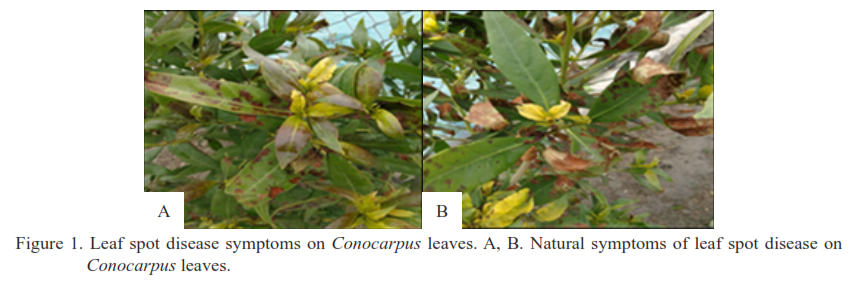
Severe leaf spot disease has recently been observed on Conocarpus erectus (buttonwood) trees in Iraq, with artificial inoculation resulting in a disease severity of 91.6%. Morphological, microscopic, and molecular analyses using ITS1/ITS4 primers identified Alternaria alternata as the causal agent. Two isolates (Alt.1IQ and Alt.2IQ; GenBank accession numbers OM994386 and OM994387) exhibited 98.05–100% sequence similarity with previously reported Iraqi isolates. In vitro antifungal assays demonstrated that magnesium sulphate, sodium bicarbonate, and neem oil at a concentration of 0.4% inhibited fungal growth by 57.63%, 55.62%, and 50.80%, respectively. Laboratory leaf assays revealed that all tested treatments at 0.2–0.4% completely suppressed fungal development, resulting in 0% affected leaf area compared with 31.96% in the untreated control. Nursery trials showed that neem oil and sodium bicarbonate were the most effective treatments, reducing disease severity to 8.3–16.6% and 8.3–25.0%, respectively, while magnesium sulphate achieved a moderate reduction (24.33–25.0%. The chemical fungicide Coastine 38WG completely prevented disease development (0% severity), whereas untreated seedlings exhibited 91.6% disease severity. Overall, neem oil and sodium bicarbonate at 0.4% emerged as promising eco-friendly alternatives for managing A. alternata –induced leaf spot disease in Conocarpus seedlings. These findings support their potential incorporation into sustainable and integrated disease management strategies aimed at reducing reliance on synthetic fungicides.
How to Cite
References
Ahmed R, Raheel M, Ali L, Ashraf W, Aslam MN, Faisal M, Anwer M, Ikram MT, Afzal T, Iqbal R, Ditta A, Rehman AU, Rizwana R, & Abid, I. 2025. First Report of Leaf Spot of Conocarpus lancifolius Caused by Alternaria burnsii. Pol J Environ Stud. 34(5): 6017–6026. https://doi.org10.15244/pjoes/192105
Alkhail AAA. 2005. Antifungal activity of some extracts against some plant pathogenic fungi. Pak. J. Biol. Sci. 8(3): 413–417. https://doi.org/10.3923/pjbs.2005.413.417
Al-Waily DS, Al-Saad LA, & Al-Dery SS. 2018. Formulation of Pseudomonas fluorescens as a biopesticide against soil-borne root pathogens. Iraqi J. Agric. Sci. 49(2): 235–242. https://doi.org/10.36103/ijas.v49i2.227
Bashir M, Uzair M, & Chaudhry BA. 2015. A review of phytochemical and biological studies on Conocarpus erectus (Combretaceae). Pak. J. Pharm. Res. 1(1): e18143. https://doi.org/10.22200/PJPR.201511-8
Duong DH, Ngo XQ, Do DG, Le TAH, Nguyen VT, & Nic S. 2014. Effective control of neem (Azadirachta indica A. Juss) cake to plant parasitic nematodes and fungi in black pepper diseases in vitro. J. Viet. Environ. 6(3): 233–238. https://doi.org/10.13141/jve.vol6.no3.pp233-238
Ellis MB. 1971. Dematiaceous hyphomycetes. Commonwealth Mycological Institute. https://doi.org/10.1079/9780851986180.0000
García C, González-Maldonado J, Gómez-Vargas JC, Torres-Hernández G, Cuicas-Huerta R, López-Pérez E, Estrada-Paqui E, & Jáuregui-Plata I. 2023. Reproductive characterization of hair ewe in the American tropics: A review part 1. Agro Prod. 16(4): 61–71. https://doi.org/10.32854/agrop.v16i3.2454
Indra N, Kauvyashree AS, Swetha D, & Asmina M. 2019. Fungitoxic effect of inorganic salts for the management of seed-borne Macrophomina phaseolina and Fusarium sp. causing charcoal rot and wilt disease in black gram. Indian J. Agric. Res. 53(2): 208–212
Jawaid M, Kian LK, Fouad H, Saba N, Alothman OY, & Hashem M. 2021. Morphological, structural, and thermal analysis of three parts of Conocarpus cellulosic fibers. J. Mater. Res. Technol. 10: 24–33. https://doi.org/10.1016/j.jmrt.2020.11.108
Kareem TA, Hassan AK, Naemah RA, & Alsamir M. 2020a. Morphological and molecular characteristics of fungal isolates causing onion neck rot disease. Biochem. Cell. Arch. 20(1): 403–408.
Kareem TA, Jamel DS, Ali AJ, & Saeed RI. 2020b. Morphological and molecular characteristics of Alternaria citrus stem end rot. Int. J. Psychosoc. Rehabil. 24(9): 5071–5077. https://doi.org/10.37200/V24I10/35879
Kimura M. 1980. A simple method for estimating evolutionary rates of base substitutions through comparative studies of nucleotide sequences. J. Mol. Evol. 16(2): 111–120. https://doi.org/10.1007/BF01731581
Kolaei EA, Tweddell RJ, & Avis TJ. 2012. Antifungal activity of sulfur-containing salts against the development of carrot cavity spot and potato dry rot. Postharvest Biol. Technol. 63(1): 55–59. https://doi.org/10.1016/j.postharvbio.2011.09.006
Kumar S, Stecher G, & Tamura K. 2016. MEGA7: Molecular evolutionary genetics analysis version 7.0 for bigger datasets. Mol. Biol. Evol. 33(7): 1870–1874. https://doi.org/10.1093/molbev/msw054
Lonard RI, Judd FW, DeYoe HR, & Stalter R. 2021. Biology of the Mangal Halophyte Conocarpus erectus L.: A Review. In: Grigore, MN. (eds) Handbook of Halophytes. Springer, Cham. https://doi.org/10.1007/978-3-030-17854-3_72-2
Masoud SA, Emara AR, & Mansy AS. 2022. Studying the efficiency of some nanoparticles on some plant pathogenic fungi and their effects on hyphal morphology. Iraqi. J. Agric. Sci. 53(6): 1476–1485. https://doi.org/10.36103/ijas.v53i6.1664
Mossini SAG, Arrotéia CC, & Kemmelmeier C. 2009. Effect of neem leaf extract and neem oil on Penicillium growth, sporulation, morphology, and ochratoxin A production. Toxins. 1(1): 3–13. https://doi.org/10.3390/toxins1010003
Othman BA & Kakey ES. 2021. Pesticides bioaccumulation and their soil pollutant effect. Iraqi. J. Agric. Sci. 52(1): 36–47. https://doi.org/10.36103/ijas.v52i1.1234
Piermann L, Fujinawa MF, Pontes NDC, Galvão JAH, & Bettiol W. 2022. Inhibition of mycelial growth, conidial germination, and Botrytis cinerea Pers.: Fr colonization in begonia with biocompatible products. Sci. Agric. 80: e20210062. http://doi.org/10.1590/1678-992X-2021-0062
Quayyum HA, Dobinson KF, & Traquair JA. 2005. Conidial morphology, virulence, molecular characterization, and host-parasite interactions of selected Alternaria panax isolates on American ginseng. Botany. 83(9): 1133–1143. https://doi.org/10.1139/b05-086
Rabea A, Naeem E, Balabel NM, & Daigham GE. 2023. Management of potato brown rot disease using chemically synthesized CuO-NPs and MgO-NPs. Bot. Stud. 64(1): 20. https://doi.org/10.1186/s40529-023-00393-w
Rawat K, Sahoo UK, Hegde N, & Kumar A. 2018. Effectiveness of neem (Azadirachta indica A. Juss) oil against decay fungi. Sci. Technol. J. 5(1): 48–51. https://doi.org/10.22232/STJ.2017.05.01.06
Rehman S, Azam F, Rehman S, Rehman TU, Mehmood A, Gohar A, & Samad A. 2019. A review on botanical, phytochemical, and pharmacological reports of Conocarpus erectus. Pak. J. Pharm. Res. 32(1): 212–217. http://dx.doi.org/10.17582/journal.pjar/2019/32.1.212.217
Rodrigues MP, Astoreca AL, Oliveira ÁAD, Salvato LA, Biscoto GL, Keller LAM, Rosa CADR, Cavaglieri LR, Azevedo MID, & Keller KM. 2019. In vitro activity of neem (Azadirachta indica) oil on growth and ochratoxin A production by Aspergillus carbonarius isolates. Toxins. 11(10): 579. https://doi.org/10.3390/toxins11100579
Saeed RI & Juber KS. 2016. Detect the fungi that is associated with zinnia seeds and its effect on plant growth stage. Iraqi. J. Agric. Sci. 47(4): 1101–1110. https://doi.org/10.36103/ijas.v47i4.549
Thomma BPHJ. 2003. Alternaria spp.: From general saprophyte to specific parasite. Mol. Plant Pathol. 4(4): 225–236. https://doi.org/10.1046/j.1364-3703.2003.00173.x
Türkkan M. 2013. Antifungal effect of various salts against Fusarium oxysporum f. sp. cepae, the causal agent of Fusarium basal rot of onion. J. Agric. Sci. 19(3): 178–187. https://doi.org/10.1501/Tarimbil_0000001243
Türkkan M & Erper I. 2014. Evaluation of antifungal activity of sodium salts against onion basal rot caused by Fusarium oxysporum f. sp. cepae. Plant Prot. Sci. 50(1): 19–25. http://dx.doi.org/10.17221/9/2013-PPS
Türkkan M, Erper I, Eser Ü, & Baltaci A. 2018. Evaluation of inhibitory effects of some bicarbonate salts and fungicides against hazelnut powdery mildew. Gesunde Pflanzen. 70: 39–44. https://doi.org/10.1007/s10343-017-0411-y
Wati C, Nawangsih AA, Wahyudi AT, Wiyono S, & Munif A. 2024. The effectiveness of Liliaceae phyllospheric Actinomycetes as biocontrol agent of purple blotch disease (Alternaria porri Ell. Cif) on shallot. J. Trop. Plant Pests Dis. 24(2): 190–198. https://doi.org/10.23960/jhptt.224190-198
License
Copyright (c) 2026 Jurnal Hama dan Penyakit Tumbuhan Tropika

This work is licensed under a Creative Commons Attribution-NonCommercial 4.0 International License.
The copyright of each published article are with the Jurnal Hama dan Penyakit Tumbuhan Tropika : Journal of Tropical Plant Pests and Diseases. By submitting and publishing manuscript in Jurnal Hama dan Penyakit Tumbuhan Tropika: Journal of Tropical Plant Pests and Diseases, the author(s) grant the journal the right of first publication and the right to publish, reproduce, and disseminate the article in various formats, including print, online, and electronic media, with full acknowledgment of the author(s) as the copyright holder(s).
All articles published in Jurnal Hama dan Penyakit Tumbuhan Tropika: Journal of Tropical Plant Pests and Diseases are licensed under the Creative Commons Attribution–NonCommercial (CC BY-NC) license. Under this license, others are permitted to copy, distribute, display, and adapt the work for non-commercial purposes, provided that appropriate credit is given to the original author(s) and source. Any commercial use of the published material is prohibited without prior written consent from the author(s).
The journal reserves the right to archive, preserve, distribute, and provide access to published articles for academic, educational, and other non-commercial purposes in accordance with the terms and conditions of the CC BY-NC license.