
Oviposition preference of Zeugodacus cucurbitae (Diptera: Tephritidae) on melon manis terengganu, Cucumis melo var. inodorus
Abstract
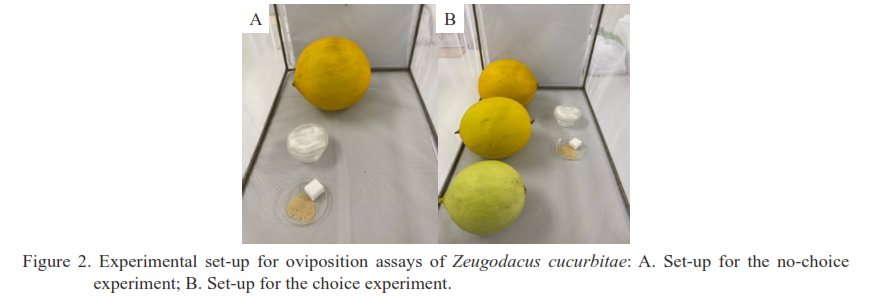
Understanding the ovipositional preferences of insect pests is essential for developing effective management strategies in agricultural systems. Zeugodacus cucurbitae (Coquillett) is a highly destructive tephritid fruit fly that infests fruits at various maturity stages, causing significant damage to economically important crops such as Melon Manis Terengganu (MMT). This study investigated the ovipositional preference of Z. cucurbitae across three fruit maturity stages—unripe, ripe, and fully ripe—under no-choice and choice experimental conditions. In the no-choice experiment, pupal formation (7.44 ± 2.10 pupae) and adult emergence (6.20 ± 2.03 flies) were significantly lower (P < 0.05) in unripe MMT, whereas the percentage of adult emergence and sex ratio did not differ significantly (P > 0.05) among fruit maturity stages. Under choice conditions, pupal formation was also significantly lower (P < 0.05) in unripe MMT (11.40 ± 4.68 pupae), while fully ripe fruits supported significantly higher (P < 0.05) male (51.70 ± 21.07%) and female (55.00 ± 26.59%) emergence. Correlation analysis revealed significant relationships (P < 0.05) between pupal formation, adult emergence, and fruit characteristics in the choice experiment. These findings demonstrate a strong preference of Z. cucurbitae for fully ripe MMT as oviposition sites, indicating that fruit maturity plays a critical role in host selection. This study provides valuable insights for the development of targeted pest management strategies, including early-stage fruit protection, to reduce infestation in MMT cultivation.
How to Cite
References
Aguilar P, Dag B, Carazo P, & Sultanova Z. 2023. Sex-specific paternal age effects on offspring quality in Drosophila melanogaster. J. Evol. Biol. 36(4): 720–729. https://doi.org/10.1111/jeb.14167
Arena ME, Povilonis IS, Borroni V, Pérez E, Pellegrino N, Cacciatore C, & Radice S. 2023. Changes in carbohydrates, organic acids, and minerals at different development stages of Hexachlamys edulis fruit, a wild south American species with horticultural potential. Horticulturae. 9(3): 314. https://doi.org/10.3390/horticulturae9030314
Ayaz M, Khan MH, Azam A, Noor S, Aiman, Salman M, Shah SKA, & Hajra B. 2024. Host preference of fruit fly, Bactrocera zonata towards different host fruits at various stages of ripeness. J. Liaoning Tech. Univ. (Nat. Sci. Ed.). 18(8): 352–374.
Azeli NA, Mohamed S, & Md. Yusof NA. 2022. Assessment of fruit fly infestation on melon manis Terengganu (Cucumis melo var. inodorus) at different fruit ripening stages. J. Agrobiotech. 13(1S): 1–8. https://doi.org/10.37231/jab.2022.13.1s.307
Benelli G & Canale A. 2012. Learning of visual cues in the fruit fly parasitoid Psyttalia concolor (Szépligeti) (Hymenoptera: Braconidae). BioControl. 57(6): 767–777. https://doi.org/10.1007/s10526-012-9456-0
Busatto N & Herrera R. 2025. Fruit development and ripening–A molecular and physiological view modulating and enhancing fruit quality. J. Plant Growth Regul. 44(3): 1069–1071. https://doi.org/10.1007/s00344-025-11643-5
Cai P, Song Y, Huo D, Lin J, Zhang H, Zhang Z, Xiao C, Huang F, & Ji Q. 2020. Chemical cues induced from fly-oviposition mediate the host-seeking behaviour of Fopius arisanus (Hymenoptera: Braconidae), an effective egg parasitoid of Bactrocera dorsalis (Diptera: Tephritidae), within a tritrophic context. Insects. 11(4): 231. https://doi.org/10.3390/insects11040231
Calvo MV, Delgado S, Duarte F, Garcia FRM, Scatoni I, & González A. 2022. Fruit flies (Diptera: Tephritidae) and hosts association in different ecosystems in Uruguay. Int. J. Pest Manag. 68(4): 369–380. https://doi.org/10.1080/09670874.2022.2126023
Carpentier J, Martin C, Luttenschlager H, Deville N, Ferrara D, Purcaro G, Blecker C, Francis F, & Megido RC. 2024. Common soluble carbohydrates affect the growth, survival, and fatty acid profile of black soldier fly larvae Hermetia illucens (Stratiomyidae). Sci. Rep. 14(1): 28157. https://doi.org/10.1038/s41598-024-75730-5
Cassiano CV, da Silva PP, Pinheiro DT, dos Santos Dias DCF, de Morais AA, & Nascimento WM. 2023. Study of physiological maturity of melon seeds by enzymatic changes. Rev. Ciênc. Agron. 54: e20207665. https://doi.org/10.5935/1806-6690.20230026
Cavey M, Charroux B, Travaillard S, Manière G, Berthelot-Grosjean M, Quitard S, Minervino C, Detailleur B, Grosjean Y, & Prud’homme B. 2023. Increased sugar valuation contributes to the evolutionary shift in egg-laying behavior of the fruit pest Drosophila suzukii. PLoS Biol. 21(12): e3002432. https://doi.org/10.1371/journal.pbio.3002432
Chung HH, Chong J, Lim CJ, & Lim LWK. 2024. A survey of fruit quality properties, growth, and yield of several melon varieties (Cucumis melo L.) using fertigation approach. Pertanika J. Trop. Agri. Sci. 47(3): 855–865. https://doi.org/10.47836/pjtas.47.3.16
Dinh H, Lundbäck I, Kumar S, Than AT, Morimoto J, & Ponton F. 2022. Sugar-rich larval diet promotes lower adult pathogen load and higher survival after infection in a polyphagous fly. J. Exp. Biol. 225(16): jeb243910. https://doi.org/10.1242/jeb.243910
Doorenweerd C, Chung AYC, Mustapeng AMA, & Rubinoff D. 2025. The Dacini fruit flies of Borneo: An annotated checklist with 89 species including three new to science (Tephritidae, Dacinae). ZooKeys. 1240: 305–325. https://doi.org/10.3897/zookeys.1240.116278
Durán-Soria S, Pott DM, Osorio S, & Vallarino JG. 2020. Sugar signaling during fruit ripening. Front. Plant Sci. 11: 564917. https://doi.org/10.3389/fpls.2020.564917
Farcuh M, Copes B, Le-Navenec G, Marroquin J, Jaunet T, Chi-Ham C, Cantu D, Bradford KJ, & Van Deynze A. 2020. Texture diversity in melon (Cucumis melo L.): Sensory and physical assessments. Postharvest Biol. Technol. 159: 111024. https://doi.org/10.1016/j.postharvbio.2019.111024
Ferdousi J, Hossain MI, Saha SR, Rob M, Afroz T, Pramanik S, Islam MR, & Nath DD. 2024. Postharvest physiology of fruits and vegetables and their management technology: A review. J. Anim. Plant Sci. 34(2): 291–303. https://doi.org/10.36899/JAPS.2024.2.0717
Follett PA, Haynes FEM, & Dominiak BC. 2021. Host suitability index for polyphagous Tephritid fruit flies. J. Econ. Entomol. 114(3): 1021–1034. https://doi.org/10.1093/jee/toab035
Fu FKT, Gumbek M, & Hanapi S. 2013. Status and geographical distribution of indigenous and quarantine fruit fly species (Diptera: Tephritidae) in Sarawak. BJRST. 2(2): 28–41. https://doi.org/10.33736/bjrst.276.2013
Giudice A, Castillo G, Díaz V, Moyano A, Palladini A, Pérez-Staples D, Olea CdL, & Abraham S. 2025. Male seminal fluid allocation according to socio-sexual context in the South American fruit fly. J. Comp. Physiol A. 211(2): 235–245. https://doi.org/10.1007/s00359-024-01728-z
Gómez M, Paranhos BAJ, Silva JG, De Lima MAC, Silva MA, Macedo AT, Virginio JF, & Walder JMM 2019. Oviposition preference of Ceratitis capitata (Diptera: Tephritidae) at different times after pruning “Italia” table grapes grown in Brazil. J. Insect Sci. 19(1): 16. https://doi.org/10.1093/jisesa/iey136
González-Fernández A, Rallo P, Peres AM, Pereira JA, & Morales-Sillero A. 2023. Developing predictive models under controlled conditions for the selection of new genotypes that are less susceptible to Bactrocera oleae (Rossi) in table olive (Olea europaea L.) breeding programs. Agronomy. 13(12): 3050. https://doi.org/10.3390/agronomy13123050
Grechi I, Preterre AL, Lardenois M, & Ratnadass A. 2022. Bactrocera dorsalis invasion increased fruit fly incidence on mango production in Reunion Island. Crop. Prot. 161: 106056. https://doi.org/10.1016/j.cropro.2022.106056
Guillén L, Monribot-Villanueva JL, Guerrero-Analco JA, Ortega R, Altúzar-Molina A, Mena V, Ruiz-May E, & Aluja M. 2022. Influence of sunlight incidence and fruit chemical features on oviposition site selection in mango by Anastrepha obliqua: Implications for management. Insects. 13(2): 141. https://doi.org/10.3390/insects13020141
IPPC. 2023. Report on Zeugodacus sp. detection. International Plant Protection Convention. https://assets.ippc.int/static/media/files/pestreport/2023/08/15/report__zeugodacus_DNSAB_03_augst_2023. Accessed 29 August 2025.
Jacob V, Ramiaranjatovo G, Persyn E, Machara A, Kyjaková P, Atiama-Nurbel T, Pompeiano A, Benelli G, De Meyer M, & Vaníčková L. 2024. Female melon fruit flies, Zeugodacus cucurbitae, are attracted to a synthetic chemical blend based on male epicuticular components. J. Pest Sci. 97(3): 1395–1415. https://doi.org/10.1007/s10340-023-01707-4
Jaleel W, He Y, & Lü L. 2019. The response of two Bactrocera species (Diptera: Tephritidae) to fruit volatiles. J. Asia-Pac. Entomol. 22(3): 758–765. https://doi.org/10.1016/j.aspen.2019.05.011
Jia K, Wang W, Zhang Q, & Jia W. 2023. Cell wall integrity signaling in fruit ripening. Int. J. Mol. Sci. 24(4): 4054. https://doi.org/10.3390/ijms24044054
Jusoh MF, Bakar TATHS, Abdullah FA, Maidin MKH, & Muttalib MFA. 2022. A scoping review of melon manis Terengganu research perspective in Malaysia. J. Agrobiotech. 13(2): 10–27. https://doi.org/10.37231/jab.2022.13.2.294
Kay BJ, Harris C, & Clarke AR. 2024. Larval competition between three endemic fruit flies (Diptera: Tephritidae) of differing phylogenetic relatedness. Austral. Entomol. 63(2): 270–282. https://doi.org/10.1111/aen.12686
Kaya HK & Vega FE. 2012. Scope and basic principles of insect pathology. In: Vega FE & Kaya HK (Eds.). Insect pathology. Second Edition. pp. 1–12. Academic Press. Amsterdam. https://doi.org/10.1016/B978-0-12-384984-7.00001-4
Komarov N, Fritsch C, Maier GL, Bues J, Biočanin M, Avalos CB, Dodero A, Kwon JY, Deplancke B, & Sprecher SG. 2025. Food hardness preference reveals multisensory contributions of fly larval gustatory organs in behaviour and physiology. PLoS Biol. 23(1): e3002730. https://doi.org/10.1371/journal.pbio.3002730
Korneyev VA. 2021. Gall-inducing Tephritid flies (Diptera: Tephritidae): Evolution and host–plant relations. Front. Ecol. Evol. 9: 578323. https://doi.org/10.3389/fevo.2021.578323
Louzeiro LRF, de Souza-Filho MF, Raga A, & Schmidt FL. 2020. Relationship between fruit fly (Diptera: Tephritidae) infestation and the physicochemical changes in fresh fruits. Afr. J. Agric. Res. 15(1): 122–133. https://doi.org/10.5897/AJAR2019.14533
Li C, Cao S, Yang Z, Watkins CB, & Wang K. 2023. Editorial: The physiology, molecular biology and biochemistry in ripening and stored fruit. Front. Plant Sci. 14: 1296816. https://doi.org/10.3389/fpls.2023.1296816
Li X, Li C, Sun J, & Jackson A. 2020. Dynamic changes of enzymes involved in sugar and organic acid level modification during blueberry fruit maturation. Food Chem. 309: 125617. https://doi.org/10.1016/j.foodchem.2019.125617
Mawtham MM, Justin CGL, Roseleen SSJ, & Yasodha P. 2020. Biophysical basis of resistance in bitter gourd against melon fruit fly, Zeugodacus cucurbitae Coquillett (Diptera: Tephritidae). J. Entomol. Zool. Stud. 8(3): 991–994.
Mishra J, Singh S, Tripathi A, & Chaube MN. 2012. Population dynamics of oriental fruit fly, Bactrocera dorsalis (Hendel) in relation to abiotic factors. HRS. 1(2): 187–189.
Mohamed S, Adam NA, Muhamad R, Hong LW, & Ahmad H. 2017. Ovipositional preference of oriental fruit fly Bactrocera dorsalis Hendel (Diptera: Tephritidae) on mango (Mangifera indica L. cv. Chokanan). Aust. J. Basic & Appl. Sci. 11(13): 14–19.
Mollá-Albaladejo R & Sánchez-Alcañiz JA. 2021. Behavior individuality: A focus on Drosophila melanogaster. Front. Physiol. 12: 719038. https://doi.org/10.3389/fphys.2021.719038
Morimoto J, Nguyen B, Lundbäck I, Than AT, Tabrizi ST, Ponton F, & Taylor PW. 2020. Effects of carbohydrate types on larval development and adult traits in a polyphagous fruit fly. J. Insect Physiol. 120: 103969. https://doi.org/10.1016/j.jinsphys.2019.103969
Muhamad N & Redzuan NAM. 2019. Effects of drying methods on the quality parameters of dried manis Terengganu melon (Cucumis melo). J. Agrobiotech. 10(1S): 46–58. https://journal.unisza.edu.my/agrobiotechnology/index.php/agrobiotechnology/article/view/197
Nagashima Y, He K, Singh J, Metrani R, Crosby KM, Jifon J, Jayaprakasha GK, Patil B, Qian X, & Koiwa H. 2021. Transition of aromatic volatile and transcriptome profiles during melon fruit ripening. Plant Sci. 304: 110809. https://doi.org/10.1016/j.plantsci.2020.110809
Nor SM, Mohamed S, Sajili MH, & Ngah N. 2018. Ovipositional behaviour preference of oriental fruit fly, Bactrocera dorsalis Hendel (Diptera: Tephritidae) on different host fruits. J. Agrobiotech. 9(1S): 173–181. https://journal.unisza.edu.my/agrobiotechnology/index.php/agrobiotechnology/article/view/151
Ong YQ & Khandaker MM. 2021. Growth and development of melon manis Terengganu in response to seasonal variation. Asian J. Plant Sci. 20(4): 659–664. https://doi.org/10.3923/ajps.2021.659.664
Otárola-Jiménez J, Nataraj N, Bisch-Knaden S, Hansson BS, & Knaden M. 2024. Oviposition experience affects oviposition preference in Drosophila melanogaster. iScience. 27(8): 110472. https://doi.org/10.1016/j.isci.2024.110472
Rattanapun W, Amornsak W, & Clarke AR. 2009. Bactrocera dorsalis preference for and performance on two mango varieties at three stages of ripeness. Entomol. Exp. Appl. 131(3): 243–253. https://doi.org/10.1111/j.1570-7458.2009.00850.x
Rattanapun W, Tarasin M, Thitithanakul S, & Sontikun Y. 2021. Host preference of Bactrocera latifrons (Hendel) (Diptera: Tephritidae) among fruits of solanaceous plants. Insects. 12(6): 482. https://doi.org/10.3390/insects12060482
Saeed M, Ahmad T, Alam M, Al-Shuraym LA, Ahmed N, Alshehri M, Ullah H, & Sayed SM. 2022. Preference and performance of peach fruit fly (Bactrocera zonata) and Melon fruit fly (Bactrocera cucurbitae) under laboratory conditions. Saudi J. Biol. Sci. 29(4): 2402–2408. https://doi.org/10.1016/j.sjbs.2021.12.001
Saputra HM & Afriyansyah B. 2021. Distribution and identification of fruit flies (Diptera: Tephritidae) attracted on methyl euganol and cue lure in Central Bangka Regency, Bangka Belitung. J. Trop. Plant Pests Dis. 21(1): 72–81. https://doi.org/10.23960/jhptt.12172-81
Seo MH, Tilahun S, Park DS, Melaku A, & Jeong CS. 2018. Effect of ripening conditions on the quality and storability of muskmelon (Cucumis melo L.) fruits. Hortic. Sci. Technol. 36(5): 741–755. https://doi.org/10.12972/KJHST.20180073
Silva-Soares NF, Nogueira-Alves A, Beldade P, & Mirth CK. 2017. Adaptation to new nutritional environments: Larval performance, foraging decisions, and adult oviposition choices in Drosophila suzukii. BMC Ecol. 17: 21. https://doi.org/10.1186/s12898-017-0131-2
Sumanth M, Veeranna R, Pandit, Hegde MG, Yadahalli KB, & Shreya N. 2024. Survey of melon fruit fly, Zeugodacus cucurbitae (Coquillett) infestation on cucurbits in Dharwad and Haveri Districts of Karnataka, India. Int. J. Environ. Clim. Chang. 14(1): 847–854. https://doi.org/10.9734/ijecc/2024/v14i13903
Supratiwi R, Apriyadi R, & Asriani E. 2020. Fruit flies (Diptera: Tephritidae) diversity in horticultural farm of Merawang Sub-District, Bangka District, Bangka Belitung Islands. J. Trop. Plant Pests Dis. 20(1): 61–70. https://doi.org/10.23960/j.hptt.12061-70
Stringer LD, Soopaya R, Butler RC, Vargas RI, Souder SK, Jessup AJ, Woods B, Cook PJ, & Suckling DM. 2019. Effect of lure combination on fruit fly surveillance sensitivity. Sci Rep. 9(1): 2653. https://doi.org/10.1038/s41598-018-37487-6
Terengganu Agrotech Development Corp (TADC). 2025. Projek Melon Manis Terengganu (MMT). https://www.tadc.my/index.php/produk/projek-melon-manis-terengganu-mmt. Accessed 29 August 2025.
Tahir NA, Hashim NA, Tahir AM, & Azmi WA. 2020. Pest and diseases incidence at different growth stages of melon manis Terengganu (Cucumis melo var. Inodorus cv. Melon Manis Terengganu). Serangga. 25(1): 1–14.
Uchizono S, Tabuki Y, Kawaguchi N, Tanimura T, & Itoh TQ. 2017. Mated Drosophila melanogaster females consume more amino acids during the dark phase. PLoS ONE. 12(2): e0172886. https://doi.org/10.1371/journal.pone.0172886
Wijekoon CD, Ganehiarachchi M, Wegiriya H, & Vidanage S. 2024. The variation of oviposition preference and host susceptibility of the oriental fruit fly (Bactrocera dorsalis Hendel) (Diptera: Tephritidae) on commercial mango varieties. Adv. Agric. 2024(1): 7490120. https://doi.org/10.1155/2024/7490120
Wu Z, Yang L, He Q, & Zhou S. 2021. Regulatory mechanisms of vitellogenesis in insects. Front. Cell Dev. Biol. 8: 593613. https://doi.org/10.3389/fcell.2020.593613
Zhu Y, Qi F, Tan X, Zhang T, Teng Z, Fan Y, Wan F, & Zhou H. 2022. Use of age-stage, two-sex life table to compare the fitness of Bactrocera dorsalis (Diptera: Tephritidae) on northern and southern host fruits in China. Insects. 13(3): 258. https://doi.org/10.3390/insects13030258
License
Copyright (c) 2026 Jurnal Hama dan Penyakit Tumbuhan Tropika

This work is licensed under a Creative Commons Attribution-NonCommercial 4.0 International License.
The copyright of each published article are with the Jurnal Hama dan Penyakit Tumbuhan Tropika : Journal of Tropical Plant Pests and Diseases. By submitting and publishing manuscript in Jurnal Hama dan Penyakit Tumbuhan Tropika: Journal of Tropical Plant Pests and Diseases, the author(s) grant the journal the right of first publication and the right to publish, reproduce, and disseminate the article in various formats, including print, online, and electronic media, with full acknowledgment of the author(s) as the copyright holder(s).
All articles published in Jurnal Hama dan Penyakit Tumbuhan Tropika: Journal of Tropical Plant Pests and Diseases are licensed under the Creative Commons Attribution–NonCommercial (CC BY-NC) license. Under this license, others are permitted to copy, distribute, display, and adapt the work for non-commercial purposes, provided that appropriate credit is given to the original author(s) and source. Any commercial use of the published material is prohibited without prior written consent from the author(s).
The journal reserves the right to archive, preserve, distribute, and provide access to published articles for academic, educational, and other non-commercial purposes in accordance with the terms and conditions of the CC BY-NC license.