
Characterization and bioactivity of nanoemulsions from Leucaena leucocephala and Annona muricata extracts against Spodoptera frugiperda
Abstract
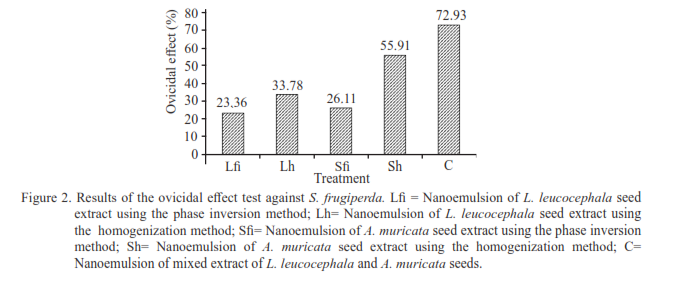
Spodoptera frugiperda is a major pest that attacks food and horticultural crops. The development of botanical pesticides in nanoemulsion form is one strategy to manage this pest. This research aimed to analyse the properties and effectiveness of nanoemulsions formulated using phase inversion and homogenization methods from Leucaena leucocephala and Annona muricata seed extracts against S. frugiperda. The research methods included mass rearing of S. frugiperda, extraction of L. leucocephala and A. muricata seeds, nanoemulsion formulation, and characterization of nanoemulsion properties. The results showed that the phase inversion method produced larger particle sizes compared to the homogenization method. Similarly, the phase inversion method resulted in a wider particle size distribution, while homogenization produced more uniform droplets. The nanoemulsion of the mixed extract of L. leucocephala and A. muricata seeds formulated using the homogenization method provided an antifeedant effect of 56.15% (medium inhibition criteria). The lowest antifeedant activity was observed in nanoemulsion from L. leucocephala using the phase inversion method (36.87%, low inhibition criteria). The highest ovicidal effect (72.93%) was also obtained from the mixed-seed nanoemulsion prepared by homogenization.
How to Cite
References
Adak T, Barik N, Patil NB, Govindharaj GPP, Gadratagi BG, Annamalai M, Mukherjee AK, & Rath PC. 2020. Nanoemulsion of eucalyptus oil: An alternative to synthetic pesticides against two major storage insects (Sitophilus oryzae (L.) and Tribolium castaneum (Herbst)) of rice. Ind. Crop. Prod. 143: 111849. https://doi.org/10.1016/j.indcrop.2019.111849
Adelia YW & Iskandar D. 2020. Uji efektivitas ekstrak biji lamtoro (Leucaena leucocephala) sebagai insektisida terhadap kecoa Amerika (Periplaneta americana) [Effectiveness test of lamtoro (Leucaena leucocephala) seed extract as an insecticide against American cockroaches (Periplaneta americana)]. Jurnal Riset Kimia. 11(2): 72–79. https://doi.org/10.25077/jrk.v11i2.354
Ardiansyah S, Nuryanti NSP, & Wahyudi A. 2024. Toksisitas campuran minyak atsiri biji jarak pagar dan serai wangi terhadap Callosobruchus chinensis [Toxicity of mixture essential oils of Jatropha curcas seeds and Cymbopogon nardus on Callosobruchus chinensis]. Jurnal Agrotek Tropika. 12(3): 599–607. https://doi.org/10.23960/jat.v12i3.6840
Blandino MG, Suárez JP, Calero SM, Carcache ER, Urbina JR, Romero ML, Ortega FB, & Chamorro HP. 2020. Analysis of the proximal composition and insecticidal potential of the soursop seed (Annona muricata L.) for the control of the corn cogollero worm (Spodoptera frugiperda J. E. Smith). Revista Torreón Universitario. 9(24): 120–137. https://doi.org/10.5377/torreon.v9i24.9722
Chen WH, Itza B, Kafle L, & Chang TY. 2023. Life table study of fall armyworm (Spodoptera frugiperda) (Lepidoptera: Noctuidae) on three host plants under laboratory conditions. Insects. 14(4): 329. https://doi.org/10.3390/insects14040329
Demisli S, Mitsou E, Pletsa V, Xenakis A, & Papadimitriou V. 2020. Development and study of nanoemulsions and nanoemulsion‐based hydrogels for the encapsulation of lipophilic compounds. Nanomaterials. 10(12): 2464. https://doi.org/10.3390/nano10122464
Djatmiko R, Murniyati A, Noorhamsyah, & Bulkis S. 2023. Penggunaan pestisida nabati ekstrak campuran daun sirsak (Annona muricata Linn) dengan daun tembakau (Nicotiana tabacum L.) terhadap pencegahan dan pemberantasan hama belalang pada semai jati (Tectona grandis L. f.) [Use of organic pesticides mixed extract of soursop (Annona muricata Linn) leaves with with tobacco (Nicotiana tabacum L.) leaves against the prevention and eradication of locust pests on teak (Tectona grandis L.f.)]. Buletin Loupe. 19(1): 92–97. https://doi.org/10.51967/buletinloupe.v19i01.2443
Djunaedy A, Khoiri S, Azari DFH, Syamsiyah Z, Pawana G, Megasari D, & Giyanto G. 2024. Development of Bacillus Thuringiensis-Based Liquid and Paste Formulations for Controlling Invasive Pest Species Spodoptera Frugiperda J. E. Smith. J Trop Plant Pests Dis. 24 (2): 154-161. https://doi.org/10.23960/jhptt.224154-161
Giuliano G, Campolo O, Forte G, Urbaneja A, Pérez-Hedo M, Latella I, Palmeri V, & Giunti G. 2024. Insecticidal activity of Allium sativum essential oil-based nanoemulsion against Spodoptera littoralis. Insects. 15(7): 476. https://doi.org/10.3390/insects15070476
Hadji TKAI, Senanayake NS, & Dharmasena A. 2023. Formulation of botanical extracts as nanoemulsion: Towards sustainable pest management in agriculture – A review. Trop. Agric. 171(1): 1–22. https://doi.org/10.4038/ta.v171i1.35
Harikarnpakdee S & Chuchote C. 2018. Oviposition deterrent efficacy and characteristics of a botanical natural product, Ocimum gratissimum (L.) oil-alginate beads, against Aedes aegypti (L.). Sci. World J. 2018(1): 3127214. https://doi.org/10.1155/2018/3127214
Haritha D, Ahmed MF, Bala S, & Choudhury D. 2021. Eco-friendly plant based on botanical pesticides. Plant Arch. 21(1): 2197–2204. https://doi.org/10.51470/plantarchives.2021.v21.s1.362
Herlinda S, Suharjo R, Sinaga ME, Fawwazi F, & Suwandi S. 2022. First report of occurrence of corn and rice strains of fall armyworm, Spodoptera frugiperda in South Sumatra, Indonesia and its damage in maize. J. Saudi Soc. Agric. Sci. 21(6): 412–419. https://doi.org/https://doi.org/10.1016/j.jssas.2021.11.003
Irmawati, Masriany, & Iqbal A. 2023. Pengaruh pemberian pestisida nabati terhadap larva Tenebrio molitor (ulat hongkong) pada tanaman sawi (Brassica juncea) di BBPP Batangkaluku Provinsi Sulawesi Selatan [The effect of administering botanical pesticides on Tenebrio molitor larvae (Hong Kong caterpillars) on mustard greens (Brassica juncea) at the Batangkaluku BBPP, South Sulawesi Province]. Filogeni: Jurnal Mahasiswa Biologi. 3(1): 33–37. https://doi.org/10.24252/filogeni.v3i1.30314
Jayadi F & Latief R. 2023. Application of value chain analysis to corn (Zea mays) commodities in Indonesia: Integrative review. IOP Conf. Ser.: Earth Environ. Sci. 1230: 012003. https://doi.org/10.1088/1755-1315/1230/1/012003
Kato-Noguchi H & Kurniadie D. 2022. Allelopathy and allelochemicals of Leucaena leucocephala as an invasive plant species. Plants. 11(13): 1672. https://doi.org/10.3390/plants11131672
Kotta S, Khan AW, Ansari SH, Sharma RK, & Ali J. 2015. Formulation of nanoemulsion: A comparison between phase inversion composition method and high-pressure homogenization method. Drug Deliv. 22(4): 455–466. https://doi.org/10.3109/10717544.2013.866992
Kumar M, Bishnoi RS, Shukla AK, & Jain CP. 2019. Techniques for formulation of nanoemulsion drug delivery system: A review. Prev Nutr Food Sci. 24(3): 225–234. https://doi.org/10.3746/pnf.2019.24.3.225
Latumahina FS, Mardiatmoko G, Tjoa M, & Wattimena C. 2020. Penggunaan Biopestisida Nabati: Untuk Pengendalian Hama Tanaman Kehutanan (Peluang Pengembangan Kelompok Tani) [Use of Botanical Biopesticides: For Controlling Forestry Plant Pests (Opportunity for Developing Farmer Groups)]. Penerbit Adab. Indramayu.
de la Cruz ASL, Barrera-Cortés J, Lina-García LP, Ramos-Valdivia AC, & Santillán R. 2022. Nanoemulsified formulation of Cedrela odorata essential oil and its larvicidal effect against Spodoptera frugiperda (J.E. Smith). Molecules. 27(9): 2975. https://doi.org/10.3390/molecules27092975
Lina EC, Holeng HSF, Nelly N, Reflin, & Ernis G. 2023. Nanoemulsion of the mixture of Citronella grass distillation waste and Piper aduncum essential oil to control Spodoptera frugiperda (Lepidoptera: Noctuidae). Philipp. J. Sci. 152(3): 1131–1137. https://doi.org/10.56899/152.03.30
Lina EC, Reflin, Erlina LH, & Tama DP. 2021. Nanoemulation of mixed Tephrosia vogelii and Piper aduncum as an alternative control of cabbage pest Crocidolomia pavonana. IOP Conf. Ser.: Earth Environ. Sci. 819: 012085. https://doi.org/10.1088/1755-1315/819/1/012085
Luqman BA & Yuliani. 2023. Efektifitas ekstrak campuran daun mengkudu (Morinda citrifolia L.) dan bintaro (Cerbera odollam) terhadap mortalitas Spodoptera litura F. [The effectiveness extract of noni leaf (Morinda citrifolia L.) and bintaro leaf (Cerbera odollam) against mortality of Spodoptera litura]. Lentera Bio. 12(2): 179–185. https://doi.org/10.26740/lenterabio.v12n2.p179-185
Malode GP, Chavhan SA, Bartare SA, Malode LL, Manwar JV, & Bakal RL. 2022. A critical review on nanoemulsion: Advantages, techniques and characterization. J. Appl. Pharm. Sci. Res. 4(3): 6–12. https://doi.org/10.31069/japsr.v4i3.2
McClements DJ. 2012. Nanoemulsions versus microemulsions: Terminology, differences, and similarities. Soft Matter. 8: 1719–1729. https://doi.org/10.1039/C2SM06903B
Modarres-Gheisari SMM, Gavagsaz-Ghoachani R, Malaki M, Safarpour P, & Zandi M. 2019. Ultrasonic nano-emulsification – A review. Ultrason. Sonochem. 52: 88–105. https://doi.org/10.1016/j.ultsonch.2018.11.005
Mokodompit TA, Koneri R, Siahaan P, & Tangapo AM. 2013. Uji ekstrak daun Tithonia diversifolia sebagai penghambat daya makan Nilaparvata lugens Stal. pada Oryza sativa L. [Evaluation of Tithonia diversifolia leaf extract as feeding capacity inhibitor of Nilaparvata lugens in Oryza sativa L.]. Jurnal Bios Logos. 3(2): 50–56. https://doi.org/10.35799/jbl.3.2.2013.4430
Mustafa IF & Hussein MZ. 2020. Synthesis and technology of nanoemulsion-based pesticide formulation. Nanomaterials. 10(8): 1608. https://doi.org/10.3390/nano10081608
Naik AV & Sellappan K. 2020. Chromatographic fingerprint of essential oils in plant organs of Annona muricata L. (Annonaceae) using HPTLC. Analytical Chemistry Letters. 10(2): 214–226. https://doi.org/10.1080/22297928.2020.1763197
Ngegba PM, Cui G, Khalid MZ, & Zhong G. 2022. Use of botanical pesticides in agriculture as an alternative to synthetic pesticides. Agriculture. 12(5): 600. https://doi.org/10.3390/agriculture12050600
Nuryanti NSP, Budiarti L, Dulbari, Sutrisno H, Sudrajat D, Yuriansyah, Priyadi, Rahmadi R, Rochman F, Sari EY, & Maharani JS. 2023. Activity of nanoemulsion botanical insecticides from Myristica fragrans and Jatropha curcas essential oil against Sitophilus zeamais. Biodiversitas. 24(10): 5610–5617. https://doi.org/10.13057/biodiv/d241042
Pascual-Villalobos MJ, Guirao P, Díaz-Baños FG, Cantó-Tejero M, & Villora G. 2019. Oil in water nanoemulsion formulations of botanical active substances. In: Koul O (Ed.). Nano-Biopesticides Today and Future Perspectives. pp. 223–247. Academic Press. London. https://doi.org/10.1016/B978-0-12-815829-6.00009-7
Pavoni L, Perinelli DR, Bonacucina G, Cespi M, & Palmieri GF. 2020. An overview of micro-and nanoemulsions as vehicles for essential oils: Formulation, preparation and stability. Nanomaterials. 10(1): 135. https://doi.org/10.3390/nano10010135
Pires PC, Fernandes M, Nina F, Gama F, Gomes MF, Rodrigues LE, Meirinho S, Silvestre S, Alves G, & Santos AO. 2023. Innovative aqueous nanoemulsion prepared by phase inversion emulsification with exceptional homogeneity. Pharmaceutics. 15(7): 1878. https://doi.org/10.3390/pharmaceutics15071878
Pradhan S & Mailapalli DR. 2020. Nanopesticides for pest control. In: Lichtfouse E. (Ed.). Sustainable Agriculture Reviews, Volume 40. pp. 43–74. Springer, Cham. https://doi.org/10.1007/978-3-030-33281-5_2
Pratiwi N, Wirawati CU, & Nirmagustina DE. 2022. Red ginger oleoresin nanoemulsion characteristics by ultrasonication. J. Nat. Sci.Math. Res. 8(2): 59–65. https://doi.org/10.21580/jnsmr.2022.8.2.12494
Prihantini M, Zulfa E, Prastiwi LD, & Yulianti ID. 2019. Pengaruh waktu ultrasonikasi terhadap karakteristik fisika nanopartikel kitosan ekstrak etanol daun suji (Pleomele angustifolia) dan uji stabilitas fisika menggunakan metode cycling test [The effect of ultrasonication time on the physical characteristics of chitosan nanoparticles from ethanol extract of suji leaves (Pleomele angustifolia) and physical stability test using the cycling test method]. Jurnal Ilmu Farmasi dan Farmasi Klinik (JIFFK). 16(2): 125–133. https://doi.org/10.31942/jiffk.v16i02.3237
Safaya M & Rotliwala YC. 2020. Nanoemulsions: A review on low energy formulation methods, characterization, applications and optimization technique. Materials Today: Proceedings. 27(1): 454–459. https://doi.org/10.1016/j.matpr.2019.11.267
Sahumena MH, Suryani, & Pratiwi W. 2023. Preparasi dan karakterisasi sistem pembawa liposom dari ekstrak etanol daun miana (Coleus atropurpureus L. Benth) [Preparation and characterization of liposome carrier system from ethanol extract of miana leaves (Coleus atropurpureus L. Benth)]. Indones. J. Pharm. Educ. 3(2): 297–308. https://doi.org/10.37311/ijpe.v3i2.20414
Saputri AE, Hariyanti DB, Ramadhani IA, & Harijani WS. 2020. Potensi daun lamtoro (Leucaena leucocephala) sebagai biopestisida ulat grayak (Spodoptera litura F.) [Potential of lamtoro leaf (Leucaena leucochepala) as biopesticide of armyworm (Spodoptera litura F.)]. Agritop. 18(2): 209–216. https://doi.org/10.32528/agritrop.v18i2.3740
Setianingsih S, Saputro RA, Fauziah VR, Wibowo WS, & Shabrina A. 2023. Physical characterization and sunscreen activity of nutmeg oil nanoemulsion with isopropyl myristate variations. JFSP. 9(2): 168–177. https://doi.org/10.31603/pharmacy.v9i2.8481
Shaker N, Mesbah HA, Ismail S, Wahba T, El-Sabrout A, & Ghabyous S. 2022. Toxicological and histological evaluation of insecticides and essential oils in nano emulsion and formulated form against Spodoptera littoralis. JAAR. 27(3): 544–557. https://doi.org/10.21608/jalexu.2022.159519.1079
Sharma S, Loach N, Gupta S, & Mohan L. 2020. Phyto-nanoemulsion: An emerging nano-insecticidal formulation. Environ. Nanotechnol. Monit. Manage. 14: 1–41. https://doi.org/https://doi.org/10.1016/j.enmm.2020.100331
Solans C & Solé I. 2012. Nano-emulsions: Formation by low-energy methods. Curr. Opin. Colloid Interface Sci. 17(5): 246–254. https://doi.org/10.1016/j.cocis.2012.07.003
Tadros T, Izquierdo P, Esquena J, & Solans C. 2004. Formation and stability of nano-emulsions. Adv. Colloid Interface Sci. 108–109: 303–318. https://doi.org/10.1016/j.cis.2003.10.023
Vijayakumar MD, Surendhar GJ, Natrayan L, Patil PP, Ram PMB, & Paramasivam P. 2022. Evolution and recent scenario of nanotechnology in agriculture and food industries. J. Nanomater. 2022(1): 1280411. https://doi.org/10.1155/2022/1280411
Wahyuni DP & Yuliani. 2023. Efektivitas ekstrak daun lamtoro (Leucaena leucocephala), daun pepaya (Carica papaya) dan kombinasinya terhadap aktivitas antimakan dan mortalitas Spodoptera litura F [Effectiveness of lamtoro (Leucaena leucocephala), papaya (Carica papaya) leaf extract and their combination against antifeedant activity and mortality of Spodoptera litura F]. Lentera Bio. 12(3): 290–298. https://doi.org/10.26740/lenterabio.v12n3.p290-298
Wirawati CU, Pratiwi N, & Nirmagustina DE. 2023. Effect of ultrasonication on some chemical properties of red ginger (Zingiber officinale var. rubrum) oleoresin nanoemulsion bioactive compounds. Trends Sci. 20(11): 6805. https://doi.org/10.48048/tis.2023.6805
Yang F, Wang Z, & Kerns DL. 2022. Resistance of Spodoptera frugiperda to Cry1, Cry2, and Vip3Aa proteins in Bt corn and cotton in the Americas: Implications for the rest of the world. J. Econ. Entomol. 115(6): 1752–1760. https://doi.org/10.1093/jee/toac099
License
Copyright (c) 2026 Jurnal Hama dan Penyakit Tumbuhan Tropika

This work is licensed under a Creative Commons Attribution-NonCommercial 4.0 International License.
The copyright of each published article are with the Jurnal Hama dan Penyakit Tumbuhan Tropika : Journal of Tropical Plant Pests and Diseases. By submitting and publishing manuscript in Jurnal Hama dan Penyakit Tumbuhan Tropika: Journal of Tropical Plant Pests and Diseases, the author(s) grant the journal the right of first publication and the right to publish, reproduce, and disseminate the article in various formats, including print, online, and electronic media, with full acknowledgment of the author(s) as the copyright holder(s).
All articles published in Jurnal Hama dan Penyakit Tumbuhan Tropika: Journal of Tropical Plant Pests and Diseases are licensed under the Creative Commons Attribution–NonCommercial (CC BY-NC) license. Under this license, others are permitted to copy, distribute, display, and adapt the work for non-commercial purposes, provided that appropriate credit is given to the original author(s) and source. Any commercial use of the published material is prohibited without prior written consent from the author(s).
The journal reserves the right to archive, preserve, distribute, and provide access to published articles for academic, educational, and other non-commercial purposes in accordance with the terms and conditions of the CC BY-NC license.