
Augmentorium devices: A sanitation tools for control fruit flies and augmentation parasitoids of fruit flies on chilli plants
Abstract
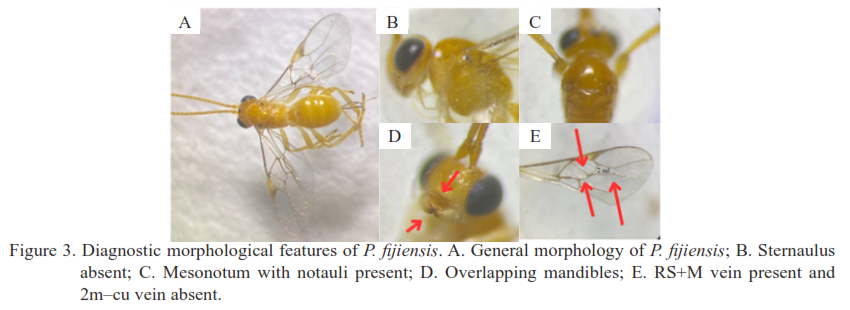
Fruit flies, Bactrocera spp. (Diptera: Tephritidae), cause severe yield losses in chili production and conventional insecticide-based control raises environmental and resistance concerns. To our knowledge, this study was the first field evaluation in Indonesia to measure the mesh size threshold for an augmentorium that simultaneously retains newly emerged adult Bactrocera insects and allows for the release of naturally occurring parasitoids. This research aimed to identify fruit fly parasitoid species found in chili (Capsicum frutescens L.) fields and recommend mesh sizes that would enable parasitoids to pass through augmentation devices. This study was conducted in Balung District and the Agrofarmaka Laboratory of Jember University, Jember Regency, East Java, Indonesia. Infested chili fruits were placed in augmentorium devices fitted with four mesh diameters 0.5 mm/32 Mesh; 0.75 mm/24 Mesh; 1 mm/16 Mesh; and.5 mm/12 Mesh. Observations were made by identifying parasitoid species and counting the number of emerging parasitoids. The results showed the presence of two parasitoids, Psyttalia fijiensis and Trichopria sp., which successfully emerged from samples and passed through the meshes. P. fijiensis was able to traverse only the largest mesh (1.5 mm), whereas Trichopria sp. passed even the smallest mesh (0.5 mm). Based on these results, the 1.5 mm (12-mesh) augmentorium optimizes its dual function as a sanitation tool for fruit infested with fruit flies and as a parasitoid augmentation in chili cultivation. This evidence supports the practical application of augmentorium as a landscape-scale celement in integrated pest management for Bactrocera spp. is supported by this evidence.
How to Cite
References
Abdullah T, Aminah SN, Nasruddin A, Fatahuddin. 2021. The ability of fruit fly Bactrocera spp.(Diptera: Tephritidae) attack different age and variety of chili pepper. Proceedings of the International Seminar on Promoting Local Resources for Sustainable Agriculture and Development (ISPLRSAD 2020). pp. 56–58. Atlantis Press. https://doi.org/10.2991/absr.k.210609.010
Allan SA, Geden CJ, & Sobel JL. 2022. Laboratory evaluation of pupal parasitoids for control of the cornsilk fly species, Chaetopsis massyla and Euxesta eluta. Insects. 13(11): 990. https://doi.org/10.3390/insects13110990
Beers EH, Mills NJ, Shearer PW, Horton DR, Milickzy ER, Amarasekare KG, & Gontijo LM. 2016. Nontarget effects of orchard pesticides on natural enemies: Lessons from the field and laboratory. Biol. Control. 102: 44–52. https://doi.org/10.1016/j.biocontrol.2016.04.010
Bogka G, Anastasaki E, Milonas PG, Psoma A, Kabourakis EM, Zwaan BJ, Pannebakker BA, & Fatouros NE. 2023. Chemical cues involved in the host foraging behavior of Psyttalia concolor wasps to locate the olive fruit fly Bactrocera oleae. Front. Ecol. Evol. 11: 1100983. https://doi.org/10.3389/fevo.2023.1100983
Buonocore-Biancheri MJ, Suárez LdC, Núñez-Campero SR, Ponssa MD, Garcia FRM, Kirschbaum DS, & Ovruski SM. 2024. Trichopria anastrephae: A promising neotropical-native parasitoid for Drosophila suzukii control. Agronomy. 14(3): 520. https://doi.org/10.3390/agronomy14030520
Chen J, Zhou S, Wang Y, Shi M, Chen X, & Huang J. 2018. Biocontrol characteristics of the fruit fly pupal parasitoid Trichopria drosophilae (Hymenoptera: Diapriidae) emerging from different hosts. Sci rep. 8(1): 13323. https://doi.org/10.1038/s41598-018-31718-6
Colombari F, Tonina L, Battisti A, & Mori N. 2020. Performance of Trichopria drosophilae (Hymenoptera: Diapriidae), a generalist parasitoid of Drosophila suzukii (Diptera: Drosophilidae), at low temperature. J. Insect Sci. 20(3): 9. https://doi.org/10.1093/jisesa/ieaa039
Cuny MAC & Poelman EH. 2022. Evolution of koinobiont parasitoid host regulation and consequences for indirect plant defence. Evol. Ecol. 36(3): 299–319. https://doi.org/10.1007/s10682-022-10180-x
da Costa Oliveira D, Stupp P, Martins LN, Wollmann J, Geisler FCS, Cardoso TDN, Bernardi D, & Garcia FRM. 2021. Interspecific competition in Trichopria anastrephae parasitism (Hymenoptera: Diapriidae) and Pachycrepoideus vindemmiae (Hymenoptera: Pteromalidae) parasitism on pupae of Drosophila suzukii (Diptera: Drosophilidae). Phytoparasitica. 49(2): 207–215. https://doi.org/10.1007/s12600-020-00843-2
Deguine JP, Atiama-Nurbel T, Aubertot JN, Augusseau X, Atiama M, Jacquot M, & Reynaud B. 2015. Agroecological management of cucurbit-infesting fruit fly: A review. Agron. Sustain. Dev. 35(3): 937–965. https://dx.doi.org/10.1007/s13593-015-0290-5
Deguine JP, Atiama-Nurbel T, & Quilici S. 2011. Net choice is key to the augmentorium technique of fruit fly sequestration and parasitoid release. Crop Prot. 30(2): 198–202. https://doi.org/10.1016/j.cropro.2010.10.007
Desurmont GA, Tannières M, Roche M, Blanchet A, & Manoukis NC. 2022. Identifying an optimal screen mesh to enable augmentorium-based enhanced biological control of the olive fruit fly Bactrocera oleae (Diptera: Tephritidae) and the mediterranean fruit fly Ceratitis capitata (diptera: tephritidae). J. Insect Sci. 22(3): 11. https://doi.org/10.1093/jisesa/ieac027
Dieng EO, Ndiaye S, Balayara A, Faye PD, Coly EV, & Mbackésembene P. 2020. Parasitoids of fruit flies (Diptera: Tephritidae) and their distribution along mango production zones in Senegal. Pest Manag. Horti. Ecosyst. 26(1): 1–10. https://doi.org/10.5958/0974-4541.2020.00001.6
Funes CF, Rendon D, Saez JV, Allori Stazzonelli E, Pastor LC, Gibilisco SM, Bouvet JP, Maza N, & Kirschbaum DS. 2024. Evaluation of Trichopria anastrephae performance as parasitoid of Drosophila suzukii and Zaprionus indianus, under controlled laboratory conditions. Entomol. Exp. Appl. 172(6): 472–478. https://doi.org/10.1111/eea.13436
Githiomi C, Muriithi B, Irungu P, Mwungu CM, Diiro G, Affognon H, Mburu J, & Ekesi S. 2019. Economic analysis of spillover effects of an integrated pest management (IPM) strategy for suppression of mango fruit fly in Kenya. Food Policy. 84: 121–132. https://doi.org/10.1016/j.foodpol.2019.03.006
Gomina M, Vayssières JF, Kasseney BD, Glitho IA, & Amevoin K. 2020. Diversity of parasitoids associated with fruit flies on cultivated and wild plants in southern Togo. Int. J. Trop. Insect Sci. 40: 887–898. https://doi.org/10.1007/s42690-020-00147-2
Guedes RNC. 2017. Insecticide resistance, control failure likelihood and the First Law of Geography. Pest Manag. Sci. 73(3): 479–484. https://doi.org/10.1002/ps.4452
Herlinda S, Mayasari R, Adam T, & Pujiastuti Y. 2007. Populasi dan serangan lalat buah Bactrocera dorsalis (Hendel) (Diptera: Tephritidae) serta potensi parasitoidnya pada pertanaman cabai (Capsicum annuum L.) [Population and fruitfly Bactrocera dorsalis (Hendel) (Diptera: Tephritidae) infestation and its parasitoids potency on chili (Capsicum annuum L.)]. Seminar Nasional dan Kongres Ilmu Pengetahuan Wilayah Barat. pp. 3–5. Palembang.
Hikmah ZN & Purnomo H. 2020. Uji alat augmentasi dan konservasi parasitoid telur kepik hijau (Nezara viridula L.) pada tanaman kedelai (Glycine max L.) [The test of augmentation and conservation tools for the egg parasitoid of green stinkbug (Nezara viridula L.) at soybean plant (Glycine max L.)]. Jurnal Pengendalian Hayati. 3(1): 1–5. https//doi.org/10.19184/jph.v3i1.17145
Hodiyah I & Hartini E. 2019. Efikasi ekstrak daun jarak pagar (Jatropha curcas L.) sebagai pestisida nabati untuk mengendalikan lalat buah (Bactrocera dorsalis H.) pada cabai (Capsicum annuum L.) [The efficacy of jatropha leaf extract (Jatropha curcas L.) as biopesticide to control fruit flies (Bactrocera dorsalis H.) on chili (Capsicum annuum L.)]. Media Pertanian. 4(1): 21–29. https://doi.org/10.37058/mp.v4i1.1355
Ingwell LL, Avila-Ruiz DA, Foster R, & Kaplan I. 2018. Tailoring insect biocontrol for high tunnels. Biol. Control. 123: 76–86. https://doi.org/10.1016/j.biocontrol.2018.04.012
Istas O & Szűcs M. 2023. Biological control potential of a laboratory selected generalist parasitoid versus a co‐evolved specialist parasitoid against the invasive Drosophila suzukii. Evol. Appl. 16(11): 1819–1829. https://doi.org/10.1111/eva.13605
Jang EB, Klungness LM, & McQuate GT. 2007. Extension of the use of augmentoria for sanitation in a cropping system susceptible to the alien terphritid fruit flies (Diptera: terphritidae) in Hawaii. J. Appl. Sci. Environ. Manag. 11(2): 239–248. https://doi.org/10.4314/jasem.v11i2.55053
Jin T, Zeng L, Lin Y, Lu Y, & Liang G. 2011. Insecticide resistance of the oriental fruit fly, Bactrocera Dorsalis (Hendel) (Diptera: Tephritidae), in mainland China. Pest Manag. Sci. 67 (3): 370–76. https://doi.org/10.1002/ps.2076
Kehrli P, Lehmann M, & Bacher S. 2005. Mass-emergence devices: A biocontrol technique for conservation and augmentation of parasitoids. Biol. Control. 32(2): 191–199. https://doi.org/10.1016/j.biocontrol.2004.09.012
Klungness LM, Jang EB, Mau RFL, Vargas RI, Sugano JS, & Fujitani E. 2005. New sanitation techniques for controlling tephritid fruit flies (Diptera: Tephritidae) in Hawaii. J. Appl. Sci. Environ. Manag. 9(2): 5–14. http://hdl.handle.net/1807/6447
Lin J, Yang D, Hao X, Cai P, Guo Y, Shi S, Liu C, & Ji Q. 2021. Effect of cold storage on the quality of Psyttalia incisi (Hymenoptera: Braconidae), a larval parasitoid of Bactrocera dorsalis (Diptera: Tephritidae). Insects. 12(6): 558. https://doi.org/10.3390/insects12060558
Lucatero A & Philpott SM. 2024. Biodiversity and pest control services. In: Scheiner SM (Ed.). Encyclopedia of Biodiversity. Third Edition. pp. 400–416. Academic Press. Oxford, UK. https://doi.org/10.1016/B978‑0‑12‑822562‑2.00020‑7
Lukman A. 2009. Peran hormon dalam metamorfosis serangga [Hormone role in insect methamorphosis]. Biospecies. 2(1): 42–45. https://doi.org/10.22437/biospecies.v2i1.692 Octavia E, Tarno H, Himawan T, & Setiawan Y. 2021. Abundance and diversity of fruit flies species (Diptera: Tephritidae) in Bogor and Depok District. Res. J. Life Sci. 8(3): 173–180. https://doi.org/10.21776/ub.rjls.2021.008.03.7
Ode PJ, Vyas DK, & Harvey JA. 2022. Extrinsic inter-and intraspecific competition in parasitoid wasps. Annu. Rev. Entomol. 67(1): 305–328. https://doi.org/10.1146/annurev-ento-071421-073524
Pinheiro LA, Pereira JA, Medina P, & Santos SAP. 2022. Longevity and parasitism capacity of Psyttalia concolor (Hymenoptera: Braconidae) fed on sugar solutions and insect honeydew. Agronomy. 12(10): 2401. https://doi.org/10.3390/agronomy12102401
Pujiastuti Y. 2009. Perkembangan pradewasa dan lama hidup imago Psyttalia sp.(Hymenoptera: Braconidae), parasitoid larva lalat buah Bactrocera dorsalis HEND (Diptera: Tephritidae) [Pre-adult development and adult longevity of Psyttalia sp. (Hymenoptera: Braconidae), a larval parasitoid of the fruit fly Bactrocera dorsalis HEND (Diptera: Tephritidae)]. Jurnal Rekayasa Lingkungan. 5(3): 199–208. https://repository.unsri.ac.id/25956/
Rauf A. 2000. Parasitisasi telur penggerek batang padi putih, Scirpophaga innotata (Walker)(Lepidoptera: Pyralidae), saat terjadi ledakan di Karawang pada awal 1990-an [Egg parasitization of the white rice stem borer, Scirpophaga innotata (Walker) (Lepidoptera: Pyralidae), during an outbreak in Karawang in early 1990’s]. Buletin Hama dan Penyakit Tumbuhan. 12(1): 1–10. https://repository.ipb.ac.id/handle/123456789/29217
Reddy KV, Devi YK, & Komala G. 2020. Management strategies for fruit flies in fruitcrops—A Review. JETIR. 7(12): 1472–1480.
Rossi-Stacconi MV, Brewer L, Miller B, Dalton D, Lee J, Park K, Pfab F, Walton V, & Da Silva CB. 2019. Biocontrol of spotted-wing drosophila. Oregon State University Extension Service. EM 9269. https://extension.oregonstate.edu/sites/extd8/files/documents/em9269.pdf
Rousse P, Gourdon F, & Quilici S. 2006. Host specificity of the egg pupal parasitoid Fopius arisanus (Hymenoptera: Braconidae) in La Reunion. Biol. Control. 37(3): 284–290. https://doi.org/10.1016/j.biocontrol.2005.12.008
Sanjaya Y & Dibiyantoro ALH. 2012. Keragaman serangga pada tanaman cabai (Capsicum annuum) yang diberi pestisida sintetis versus biopestisida racun laba-laba (Nephila sp.) [Insect diversity in chili plants (Capsicum annuum) treated with synthetic pesticide and biopesticide venom of spider (Nephila sp.)]. J Trop. Plant Pests Dis. 12(2): 192–199. https://doi.org/10.23960/j.hptt.212192-199
Shimbori EM, Costa VA, & Zucchi RA. 2020. Annotated checklist and illustrated key to parasitoids (Hymenoptera: Diapriidae, Eulophidae and Pteromalidae) of fruit flies (Diptera, Tephritidae) in Brazil. Zootaxa. 4858(1): 53–70. https://doi.org/10.11646/zootaxa.4858.1.3
Sivaperumal P, Anand P, & Riddhi L. 2015. Rapid determination of pesticide residues in fruits and vegetables, using ultra-high-performance liquid chromatography/time-of-flight mass spectrometry. Food Chem. 168: 356–365. https://doi.org/10.1016/j.foodchem.2014.07.072
Susanto A, Yuliastari PED, Ferliansyah KM, Hersanti, Widiantini, F, Maelani S, & Permana AD. 2022. The abundance of fruit flies (Bactrocera spp.) on some varieties of mango from three selling sources. Int. J. Fruit Sci. 22(1): 110–120. https://doi.org/10.1080/15538362.2021.2023934
Tarno H, Octavia E, Himawan T, & Setiawan Y. 2022. Detection of fruit flies (Diptera: Tephritidae) using cue-lure and methyl eugenol in Depok City and Bogor District, West Java, Indonesia. Biodiversitas. 23(8): 4202–4208. https://doi.org/10.13057/biodiv/d230843
Vargas RI, Mau RF, Jang EB, Faust RM, & Wong L. 2008. The Hawaii fruit fly areawide pest management programme. Areawide Pest Management: Theory and Implementation. pp. 300–325. CABI. Wallingford, UK. https://doi.org/10.1079/9781845933722.0300
Vieira JGA, Krüger AP, Scheuneumann T, Garcez AM, Morais MC, Garcia FRM, Nava DE, & Bernardi D. 2020. Effect of temperature on the development time and life‐time fecundity of Trichopria anastrephae parasitizing Drosophila suzukii. J. Appl. Entomol. 144(10): 857–865. https://doi.org/10.1111/jen.12799
Vieira JGA, Krüger AP, Scheuneumann T, Morais MC, Speriogin HJ, Garcia FRM, Nava DE, & Bernardi D. 2020. Some aspects of the biology of Trichopria anastrephae (Hymenoptera: Diapriidae), a resident parasitoid attacking Drosophila suzukii (Diptera: Drosophilidae) in Brazil. J. Econ. Entomol. 113(1): 81–87. https://doi.org/10.1093/jee/toz270
Wang XG, Kaçar G, Biondi A, & Daane KM. 2016. Life-history and host preference of Trichopria drosophilae, a pupal parasitoid of spotted wing Drosophila. Bio Control. 61(4): 387–397. https://doi.org/10.1007/s10526-016-9720-9
Wang X, Walton VM, Hoelmer KA, Pickett CH, Blanchet A, Straser RK, Kirk AA, & Daane KM. 2021. Exploration for olive fruit fly parasitoids across Africa reveals regional distributions and dominance of closely associated parasitoids. Sci Rep. 11: 6182. https://doi.org/10.1038/s41598-021-85253-=y
Wharton R & Gilstrap FE. 1983. Key to and status of Opiine braconid (Hymenoptera) parasitoids used in biological control of Ceratitis and Dacus s.l. (Diptera: Tephritidae). Ann. Entomol. Soc. Am. 76(4): 721–742. https://doi.org/10.1093/aesa/76.4.721
Woltering SB, Romeis J, & Collatz J. 2019. Influence of the rearing host on biological parameters of Trichopria drosophilae, a potential biological control agent of Drosophila suzukii. Insects. 10(6): 183. https://doi.org/10.3390/insects10060183
License
Copyright (c) 2026 Jurnal Hama dan Penyakit Tumbuhan Tropika

This work is licensed under a Creative Commons Attribution-NonCommercial 4.0 International License.
Authors retain copyright of their published articles and grant the journal the right of first publication.
All articles published in Jurnal Hama dan Penyakit Tumbuhan Tropika: Journal of Tropical Plant Pests and Diseases are licensed under the Creative Commons Attribution-NonCommercial 4.0 International (CC BY-NC 4.0) license.
This license permits others to share, copy, distribute, and adapt the published work for non-commercial purposes, provided that appropriate credit is given to the original author(s) and the journal.