
Pattern distribution and epidemic factors of stem canker disease caused by Neoscytalidium dimidiatum on pitahaya in Banyuwangi Regency, East Java, Indonesia
Abstract
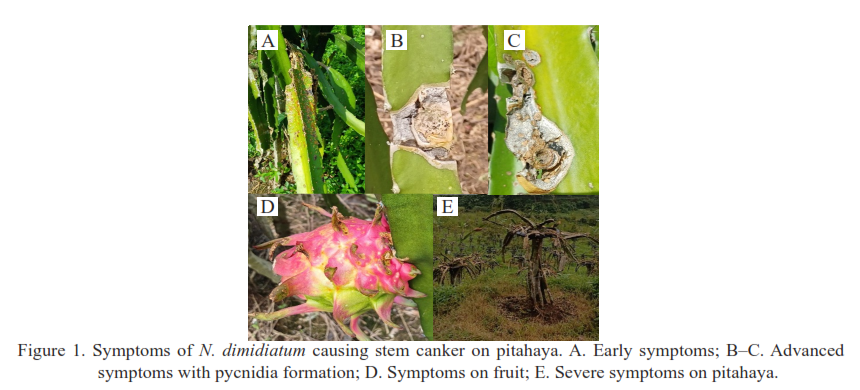
Neoscytalidium dimidiatum is an airborne pathogen that causes stem canker disease, characterized by small brown spots surrounded by a yellow halo on the plant stem. These spots expand and darken from brown to dark brown and eventually black. In addition to attacking the plant stem, this disease can also infect the fruit. This research aims to understand the distribution pattern model of stem canker disease and to identify the factors contributing to the epidemic caused by N. dimidiatum. The study was conducted through the collection of secondary data, field observations of disease severity, assessment of farmers’ cultivation practices via questionnaires, isolation of phyllosphere and rhizosphere microbes, and soil chemical analysis. The results showed that this pathogen initially exhibits a random distribution pattern but later develops into infection patches with two possible dissemination modes based on the observed distribution pattern: airborne transmission and vegetative planting materials. Environmental factors influencing the stem canker epidemic include rainfall exceeding 98 mm/month, a temperature of 27 ºC, and humidity of 78.3%. Biotically, the diversity and abundance of phylloplane and rhizosphere microbes in low-severity areas are higher than in high-severity areas. From the abiotic aspect of soil chemistry, the elements P, Mg, Fe, and total N are associated with reduced stem canker intensity. Four aspects of cultivation techniques are closely related to the human role in the formation of the stem canker epidemic: the use of phytohormones, the control methods employed, the choice of pitahaya varieties, and yield losses.
How to Cite
References
BPS-Statistics Indonesia. 2025. Data Tahunan. https://www.bps.go.id/en/statistics-table/3/U0dKc1owczVSalJ5VFdOMWVETnlVRVJ6YlRJMFp6MDkjMw==/produksi-buah-buahan-menurut-jenis-tanaman-menurut-provinsi--2023.html?year=2024
Batool F, Rehman Y, & Hasnain S. 2016. Phylloplane associated plant bacteria of commercially superior wheat varieties exhibit superior plant growth promoting abilities. Front. Life Sci. 9(4): 313–322. https://doi.org/10.1080/21553769.2016.1256842
Bowen KL. 2004. Plant Disease Epidemiology. In: Trigiano RN, Windham MT, Windham AS (Eds.). Plant Pathology: Concepts and Laboratory Exercises. pp. 476–499. CRC Press LLC. Florida.
Brown J. 1997. Plant Disease Epidemiology. In: Trigiano RN, Windham MT, Windham AS (Eds.). Plant Pathology: Concepts and Laboratory Exercises. pp. 476–499. CRC Press LLC. Florida.
Chuang MF, Ni HF, Yang HR, Shu SL, Lai SY, & Jiang YL. 2012. First report of stem canker disease of pitaya (Hylocereus undatus and H. polyrhizus) caused by Neoscytalidium dimidiatum in Taiwan. Plant Dis. 96(6): 906–907. https://doi.org/10.1094/pdis-08-11-0689-pdn
Dees MW, Lysoe E, Nordskog B, & Brurberg MB. 2015. Bacterial communities associated with surfaces of leafy greens: shift in composition and decrease in richness over time. Appl. Environ. Microbiol. 81(4): 1530–1539. https://doi.org/10.1128/AEM.03470-14
Farhat N, Elkhouni A, Zorrig W, Smaoui A, Abdelly C, & Rabhi M. 2016. Effects of magnesium deficiency on photosynthesis and carbohydrate partitioning. Acta Physiol. Plant. 38(6): 145. https://doi.org/10.1007/s11738-016-2165-z
Fitriyani IH, Hazra F, & Rosita D. 2023. Analisis korelasi sifat biologi dan kimia tanah pada berbagai tipe penggunaan lahan di Kabupaten Bogor [Correlation analysis of soil biological and chemical properties in several types of land use in Bogor Regency. Jurnal Tanah dan Sumberdaya Lahan. 10(1): 119–123. https://doi.org/10.21776/ub.jtsl.2023.010.1.13
Freiberg E. 1998. Microclimatic parameters influenscing nitrogen fixation in the phyllosphere in a Costa Rican premontane rain forest. Oecologia. 117: 9–18. https://doi.org/10.1007/s004420050625
Hadiwiyono & Widono S. 2008. Hubungan faktor lingkungan tanah terhadap intensitas busuk pangkal batang putih di Tawangmangu [Relationship of soil environmental factors on intensity of basal rot of garlic in Tawangmangu]. Agrin. 12 (1): 15–21.
Harris KD, Vanajah T, & Puvanitha S. 2018. Effect of foliar application of Boron and Magnesium on growth and yield of green chili (Capsicum annum L.). Agrieast. 12(1): 26–33. http://dx.doi.org/10.4038/agrieast.v12i1.49
Hong CF, Gazis R. Crane JH, & Zhang S. 2020. Prevalence and epidemics of Neoscytalidium stem and fruit canker on pitahaya (Hylocereus spp.) in South Florida. Plant Dis. 104(5): 1433–1438. https://doi.org/10.1094/PDIS-10-19-2158-RE
Imang N, Juita F, & Honestman A. 2019. Analisis usahatani and pemasaran buah naga (Hylocereus costaricensis) di Desa Sanggulan Kecamatan Sebulu Kabupaten Kutai Kartanegara. [Analysis of farming and marketing of dragon fruit (Hylocereus costaricensis) in Sanggulan Village, Sebulu Subregency, Kutai Kartanegara Regency]. JAKP: J. Agribisnis Komun. Pertan. 2(2): 79–86. https://doi.org/10.35941/jakp.2.2.2019.2646.79-86
Jumjunidang, Yanda RP, Riska, & Emilda D. 2019. Identifikasi dan karakterisasi penyakit kanker batang dan buah pada tanaman buah naga (Hylocereus spp.) di Indonesia [Identification and characterization of stem and fruit canker diseases on dragon fruit (Hylocereus spp.) in Indonesia]. J. Hort. 29(1): 103–110.
Jumjunidang, Riska, Emilda D, Sudjijo, Muas I, & Subhana. 2014. Distribusi, karakterisasi and identifikasi hama and penyakit utama tanaman buah naga di beberapa sentra pengembangan di indonesia. [Distribution, characterization and identification of the main pests and diseases of dragon fruit plants in several development centers in Indonesia]. Laporan Hasil Penelitian Balitbu Tropika TA 2013. pp.14.
Yáñez-López R, Torres-Pacheco I, Guevara-González RG, Hernández-Zu MI, Quijano-Carranz JA, & Rico-García E. 2012. The effect of climate change on plant diseases. Afr. J. Biotechnol. 11(10): 2417–1428. https://doi.org/10.5897/AJB10.2442
Lupatini M, Korthals GW, de Hollander M, Janssens TKS, & Kuramae EE. 2017. Soil microbiome is more heterogeneous in organic than in conventional farming systems. Front. Microbiol. 7: 2064. https://doi.org/10.3389/fmicb.2016.02064
Morris CE. 2001. Phyllosphere. In: Encyclopedia of Life Science. Nature Publishing Group. London, England.
Muas I, Nurawan A, & Liferdi. 2016. Petunjuk Teknis Budidaya Buah Naga [Technical Instructions for Dragon Fruit Cultivation]. Balai Pengkajian Teknologi Pertanian (BPTP). Bandung.
Oksal E & Ozer G. 2021. First report of shoot blight and branch canker of Pyrus communis by Neoscytalidium novaehollandiae in Turkey. J Plant Pathol. 103: 673–674. https://doi.org/10.1007/s42161-021-00762-z
Rao NSS. 1994. Mikroorganisme Tanah dan Pertumbuhan Tanaman. UI-Press. Jakarta.
Reisberg EE, Hildebrandt U, Riederer M, & Hentschel U. 2013. Distinct phyllosphere bacterial communities on Arabidopsis wax mutant leaves. PLoS ONE. 8(11): e78613. https://doi.org/10.1371/journal.pone.0078613
Setyorini D, Widowati LR, & Kasno A. 2006. Petunjuk Penggunaan Perangkat Uji Tanah Sawah (PUTS). Balai Penelitian Tanah. Bogor.
Shikha S, Bhutia DD, & Gupta PK. 2020. Isolation and characterization of phylloplane yeasts. JPP. 9(2): 1434–1438. https://doi.org/10.13140/RG.2.2.23493.68326
Sukmana AS, Tondok ET, & Wiyono S. 2025. Kajian Epidemi Penyakit Kanker Batang Neoscytalidium dimidiatum pada Tanaman Buah Naga [Epidemiological Study of Stem Cancer Caused by Neoscytalidium dimidiatum in Dragon Fruit Plants]. Master’s thesis. Departemen Proteksi Tanaman. Institut Pertanian Bogor.
Sulaeman, Suparto, & Eviati. 2005. Petunjuk Teknis: Analisis Kimia Tanah, Tanaman, Air, dan Pupuk. Ed ke–1. Balai Penelitian Tanah. Bogor.
Syafnidarti Y, Nasir N, & Jumjunidang. 2013. Deskripsi gejala dan tingkat serangan penyakit bercak pada batang tanaman buah naga merah (Hylocereus polyrhizus, L.) di Padang Pariaman, Sumatra Barat [Description of Symptoms and Level of Attack of Spot Disease on Stems of Red Dragon Fruit Plants (Hylocereus polyrhizus L) in Padang Pariaman, West Sumatra]. Jurnal Biologi UNAND. 2(4): 277–283. https://doi.org/10.25077/jbioua.2.4.%25p.2013
Tanaka A, Loe R, & Navero SA. 1966. Some mechanism involved in the development of iron toxicity symptoms in the rice plant. Soil Sci Plant Nutr. 12(4): 158–164. https://doi.org/10.1080/00380768.1966.10431951
Yi RH, Lin QL, Mo JJ, Wu FF, & Chen J. 2015. Fruit internal brown rot caused by Neoscytalidium dimidiatum on pitahaya in Guangdong Province, China. Australasian. Plant Dis. Notes. 10: 13. https://doi.org/10.1007/s13314-015-0166-1
License
Copyright (c) 2026 Jurnal Hama dan Penyakit Tumbuhan Tropika

This work is licensed under a Creative Commons Attribution-NonCommercial 4.0 International License.
The copyright of each published article are with the Jurnal Hama dan Penyakit Tumbuhan Tropika : Journal of Tropical Plant Pests and Diseases. By submitting and publishing manuscript in Jurnal Hama dan Penyakit Tumbuhan Tropika: Journal of Tropical Plant Pests and Diseases, the author(s) grant the journal the right of first publication and the right to publish, reproduce, and disseminate the article in various formats, including print, online, and electronic media, with full acknowledgment of the author(s) as the copyright holder(s).
All articles published in Jurnal Hama dan Penyakit Tumbuhan Tropika: Journal of Tropical Plant Pests and Diseases are licensed under the Creative Commons Attribution–NonCommercial (CC BY-NC) license. Under this license, others are permitted to copy, distribute, display, and adapt the work for non-commercial purposes, provided that appropriate credit is given to the original author(s) and source. Any commercial use of the published material is prohibited without prior written consent from the author(s).
The journal reserves the right to archive, preserve, distribute, and provide access to published articles for academic, educational, and other non-commercial purposes in accordance with the terms and conditions of the CC BY-NC license.