
Pheromone-based monitoring and population dynamics of Spodoptera frugiperda: implications for maize IPM in Lampung Province, Indonesia
Abstract
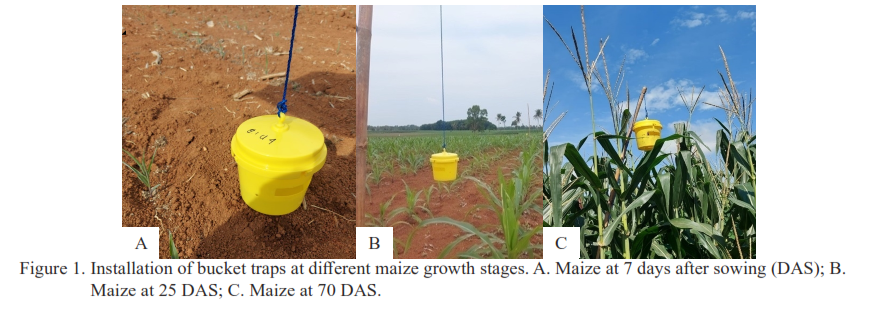
Spodoptera frugiperda is a major pest of maize, capable of causing damage throughout all crop growth stages. This study evaluated the use of sex pheromone traps to monitor adult male populations of S. frugiperda, characterize population dynamics during maize growth, and determine optimal trap density under field conditions. A trap density experiment was conducted using four pheromone trap densities (10, 20, 30, and 40 trap/ha⁻¹), each replicated five times. Adult moth captures were recorded at 7-day intervals from trap installation until harvest. In a separate assessment, the intensity of leaf and ear damage was compared between maize plots equipped with pheromone traps and conventional plots without pheromone deployment. Adult capture data revealed clear population fluctuations, with peak abundance occurring during the early vegetative stage of maize, followed by a gradual decline toward harvest. Increasing trap density significantly increased the number of male moths captured, indicating a density-dependent response to pheromone deployment. Maize plots with pheromone traps consistently exhibited lower leaf and ear damage than conventional plots, demonstrating a strong association between reduced adult populations and decreased crop injury. These results indicate that pheromone traps are effective tools for monitoring S. frugiperda populations and for identifying critical intervention periods within an integrated pest management (IPM) framework. While primarily serving as monitoring devices, higher trap densities also showed potential to reduce mating success when deployed over sufficiently large areas. The species-specific nature of pheromone traps further supports environmentally sustainable pest management by minimizing non-target effects.
How to Cite
References
Ahissou BR, Sawadogo WM, Sankara F, Brostaux Y, Bokonon-Ganta AH, Somda I, & Verheggen FJ. 2022. Annual dynamics of fall armyworm populations in West Africa and biology in different host plants. Sci. Afr.16: e01227. https://doi.org/10.1016/j.sciaf.2022.e01227
Akter S, Hossain MDS, Ali R, Regmi R, Park SJ, & Mainali B. 2025. Variations in sex pheromone of the Australian population of fall armyworm: Influence of age and mating status. J. Chem. Ecol. 51(3): 55. https://doi.org/10.1007/s10886-025-01607-0
Colacci M, Trematerra P, & Sciarretta A. 2022. Evaluation of trap devices for mass trapping of Ceratitis capitata (Diptera: Tephritidae) populations. Insects. 13(10): 941. https://doi.org/10.3390/insects13100941
Davis F, Ng SS, & Williams W. 1992. Visual rating scales for screening whorl-stage corn for resistance to fall armyworm. Mississippi Agricultural and Forestry Experiment Station. Technical Bulletin. 186: 1–9.
Day R, Abrahams P, Bateman M, Beale T, Clottey V, Cock M, Colmenarez Y, Corniani N, Early R, Godwin J, Gomez J, Moreno PG, Murphy ST, Oppong-Mensah B, Phiri N, Pratt C, Silvestri S, & Witt A. 2017. Fall armyworm: Impacts and implications for Africa. Pestic. Outlook. 28(5): 196–201. https://doi.org/10.1564/v28_oct_02
Deguine JP, Aubertot JN, Flor RJ, Lescourret F, Wyckhuys KAG, & Ratnadass A. 2021. Integrated pest management: Good intentions, hard realities. A review. Agron. Sustain. Dev. 41(3): 38. https://doi.org/10.1007/s13593-021-00689-w
Dessie B, Ferede B, Taye W, & Shimelash D. 2024. Field infestation of the invasive fall armyworm, Spodoptera frugiperda (Lepidoptera: Noctuidae) on maize in Southern Ethiopia. Crop Prot. 178: 106587. https://doi.org/10.1016/j.cropro.2024.106587
Hruska AJ. 2019. Fall armyworm (Spodoptera frugiperda) management by smallholders. CAB Reviews. 14(043): 1–11. https://doi.org/10.1079/PAVSNNR201914043
Kong WN, Hu RS, Zhao ZG, Li J, Zhang ZW, Li SC, & Ma RY. 2014. Effects of trap height, location, and spacing on pheromone-baited trap catch efficacy for oriental fruit moths (Lepidoptera: Tortricidae) in a peach orchard. Can. Entomol. 146(6): 684–692. https://doi.org/10.4039/tce.2014.20
Lestari P, Budiarti A, Fitriana Y, Susilo FX, Swibawa IG, Sudarsono H, Suharjo R, Hariri AM, Purnomo, Nuryasin, Solikhin, Wibowo L, Jumari, & Hartaman M. 2020. Identification and genetic diversity of Spodoptera frugiperda in Lampung Province, Indonesia. Biodiversitas. 21(4): 1670–1677. https://doi.org/10.13057/biodiv/d210448
Lestari P, Swibawa IG, Fitriana Y, Suharjo R, Utomo SD, & Hartaman M. 2024a. The population dynamics of Spodoptera frugiperda after its invasion in Lampung Province, Indonesia. J. Trop. Plant Pests Dis. 24(1): 98–108. https://doi.org/10.23960/jhptt.12498-108
Lestari P, Fitriana Y, Suharjo R, Swibawa IG, Utomo SD, & Andrianto E. 2024b. New parasitoids of Spodoptera frugiperda in Lampung Province, Indonesia. J. Asia-Pac. Biodivers. 17(4): 631–643. https://doi.org/10.1016/j.japb.2024.02.005
Liu J, Fang J, He XZ, Guo M, Xu Y, Gu X, Yu S, Liu X, & Deng J. 2025. Optimisation of an effective trapping system for monitoring fall armyworm Spodoptera frugiperda: Lure composition, dosage, trap design, and nonanal synergist. J. Econ. Entomol. toaf308. https://doi.org/10.1093/jee/toaf308
Londhe SS, Goswami DB, & Goswami MD. 2024. The potential use of pheromone traps in managing the invasive pest Spodoptera frugiperda. Asian Res. J. Agric.17(4): 157–167. https://doi.org/10.9734/arja/2024/v17i4511
Lubis AAN, Anwar R, Soekarno BPW, Istiaji B, Sartiami D, Irmansyah, & Herawati D. 2020. Serangan ulat grayak jagung (Spodoptera frugiperda) pada tanaman jagung di Desa Petir, Kecamatan Daramaga, Kabupatem Bogor dan potensi pengendaliannya menggunakan Metarizhium rileyi [Coray wood corn (Spodoptera frugiperda) caterpillars in corn crops in Petir Village, Daramaga Sub-District, Bogor Regency, and its control potential using Metarizhium rileyi]. Jurnal Pusat Inovasi Masyarakat. 2(6): 931–939.
Madhu TN, Shah VK, Prabhulinga T, Chakravarthy AK, & Ashok-Kumar CT. 2019. Optimization of pheromone trap densities and impact of insecticides on pheromone catches for mass trapping Helicoverpa armigera (Hubner) (Lepidoptera: Noctuidae) in chickpea. J. Entomol. Zool. Stud. 7(2): 78–84.
Maharani Y, Dewi VK, Puspasari LT, Rizkie L, Hidayat Y, & Dono D. 2019. Cases of fall army worm Spodoptera frugiperda J. E. Smith (Lepidoptera: Noctuidae) attack on maize in Bandung, Garut and Sumedang District, West Java. J. Cropsaver. 2(1): 38–46. https://doi.org/10.24198/cropsaver.v2i1.23013
Matova PM, Kamutando CN, Magorokosho C, Kutywayo D, Gutsa F, & Labuschagne M. 2020. Fall-armyworm invasion, control practices and resistance breeding in Sub-Saharan Africa. Crop Sci. 60(6): 2951–2970. https://doi.org/10.1002/csc2.20317
Meagher RL & Nagoshi RN. 2013. Attraction of fall armyworm males (Lepidoptera: Noctuidae) to host strain females. Environ. Entomol. 42(4): 751–757. https://doi.org/10.1603/EN13007
Montezano DG, Specht A, Sosa-Gómez DR, Roque-Specht VF, Sousa-Silva JC, Paula-Moraes S, Peterson JA, & Hunt TE. 2018. Host plants of Spodoptera frugiperda (Lepidoptera: Noctuidae) in the Americas. Afr. Entomol. 26(2): 286–300. https://doi.org/10.4001/003.026.0286
Navik O, Shylesha AN, Patil J, Venkatesan T, Lalitha Y, & Ashika TR. 2021. Damage, distribution and natural enemies of invasive fall armyworm Spodoptera frugiperda (J. E. smith) under rainfed maize in Karnataka, India. Crop Prot. 143: 105536. https://doi.org/10.1016/j.cropro.2021.105536
Nonci N, Kalqutny SH, Mirsam H, Muis A, Azrai M, & Aqli M. 2019. Pengenalan fall armyworm (Spodoptera frugiperda J.E Smith) hama baru pada tanaman jagung di Indonesia [Introduction of the fall armyworm (Spodoptera frugiperda J.E. Smith), a new pest on maize in Indonesia]. Balai Penelitian Serealia, Maros.
Sartiami D, Dadang, Harahap IS, Kusumah YM, & Anwar R. 2020. First record of fall armyworm (Spodoptera frugiperda) in Indonesia and its occurence in three provinces. IOP Conf. Ser.: Earth Environ. Sci. 468: 012021. https://doi.org/10.1088/1755-1315/468/1/012021
Sisay B, Simiyu J, Mendesil E, Likhayo P, Ayalew G, Mohamed S, Subramanian S, & Tefera T. 2019. Fall armyworm, Spodoptera frugiperda infestations in East Africa: Assessment of damage and parasitism. Insects. 10(7): 195. https://doi.org/10.3390/insects10070195
Sisay B, Subramanian S, Weldon CW, Krüger K, Khamis F, Tefera T, Torto B, & Tamiru A. 2024. Evaluation of pheromone lures, trap designs and placement heights for monitoring the fall armyworm, Spodoptera frugiperda (Lepidoptera: Noctuidae) in maize fields of Kenya. Crop Prot. 176: 106523. https://doi.org/10.1016/j.cropro.2023.106523
Song XP, Liang YJ, Zhang XQ, Qin ZQ, Wei JJ, Li YR, & Wu JM. 2020. Intrusion of fall armyworm (Spodoptera frugiperda) in sugarcane and its control by drone in China. Sugar Tech. 22: 734–737. https://doi.org/10.1007/s12355-020-00799-x
Srikanth J, Geetha N, Singaravelu B, Ramasubramanian T, Mahesh P, Saravanan L, Salin KP, Chitra N, & Muthukumar M. 2018. First report of occurrence of fall armyworm Spodoptera frugiperda in sugarcane from Tamil Nadu, India. J. Sugarcane Res. 8(2): 195–202
Tambo JA, Kansiime MK, Mugambi I, Rwomushana I, Kenis M, Day RK, & Lamontagne-Godwin J. 2020. Understanding smallholders’ responses to fall armyworm (Spodoptera frugiperda) invasion: Evidence from five African countries. Sci. Total Environ. 740: 140015. https://doi.org/10.1016/j.scitotenv.2020.140015
Trisyono YA, Suputa, Aryuwandari VEB, Hartaman M, & Jumari. 2019. Occurrence of heavy infestation by the fall armyworm Spodoptera frugiperda, a new alien invasive pest, in corn Lampung Indonesia. Jurnal Perlindungan Tanaman Indonesia. 23(1): 156–160. https://doi.org/10.22146/jpti.46455
License
Copyright (c) 2026 Jurnal Hama dan Penyakit Tumbuhan Tropika

This work is licensed under a Creative Commons Attribution-NonCommercial 4.0 International License.
The copyright of each published article are with the Jurnal Hama dan Penyakit Tumbuhan Tropika : Journal of Tropical Plant Pests and Diseases. By submitting and publishing manuscript in Jurnal Hama dan Penyakit Tumbuhan Tropika: Journal of Tropical Plant Pests and Diseases, the author(s) grant the journal the right of first publication and the right to publish, reproduce, and disseminate the article in various formats, including print, online, and electronic media, with full acknowledgment of the author(s) as the copyright holder(s).
All articles published in Jurnal Hama dan Penyakit Tumbuhan Tropika: Journal of Tropical Plant Pests and Diseases are licensed under the Creative Commons Attribution–NonCommercial (CC BY-NC) license. Under this license, others are permitted to copy, distribute, display, and adapt the work for non-commercial purposes, provided that appropriate credit is given to the original author(s) and source. Any commercial use of the published material is prohibited without prior written consent from the author(s).
The journal reserves the right to archive, preserve, distribute, and provide access to published articles for academic, educational, and other non-commercial purposes in accordance with the terms and conditions of the CC BY-NC license.